Emotional Intimacy Exercises for Couples
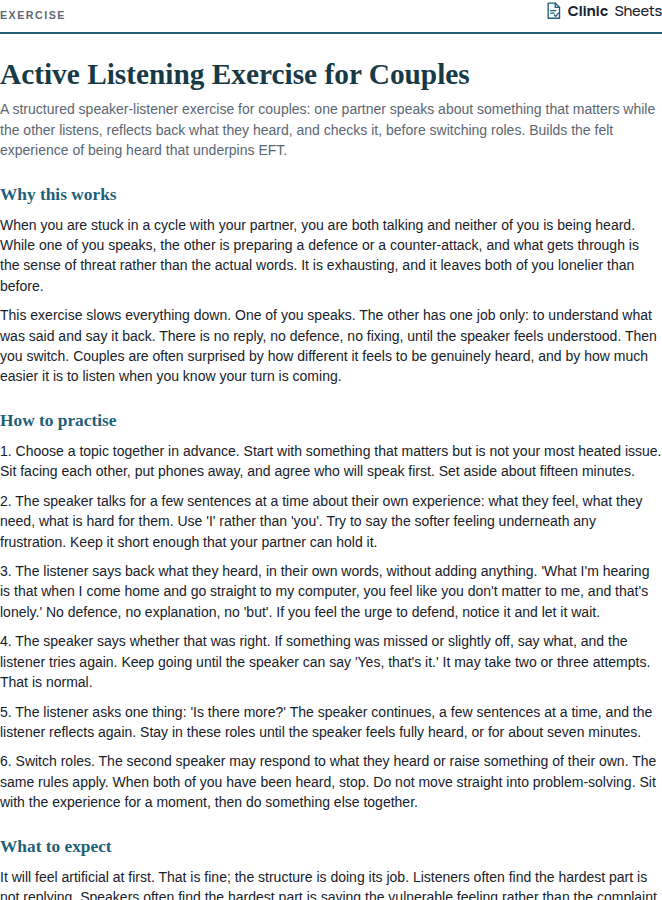
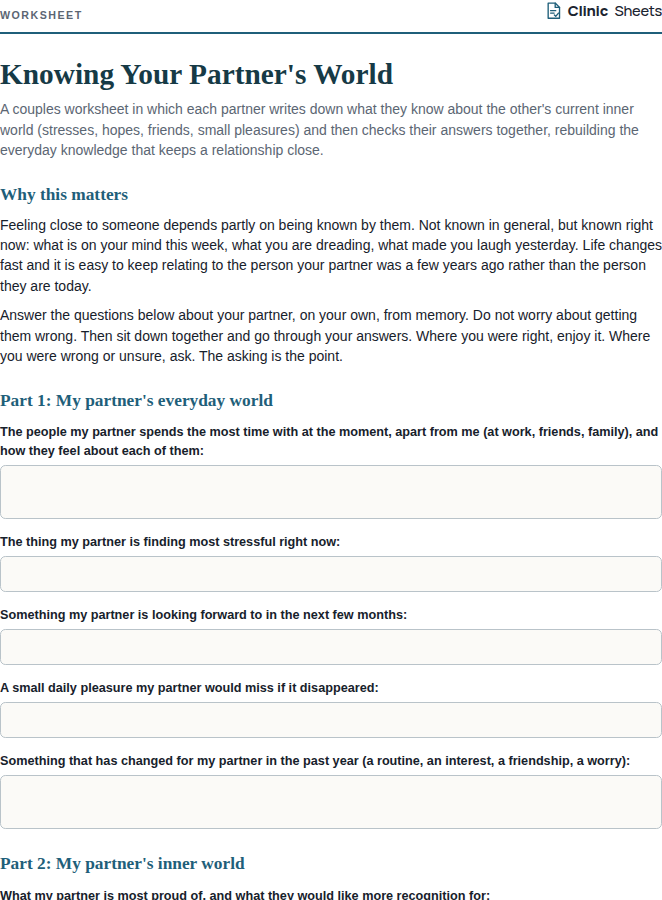
A set of three short, structured exercises couples can practise at home to rebuild emotional closeness: a daily check-in, a vulnerability exchange, and a reaching-and-responding practice drawn from emotionally focused therapy.
About this resource
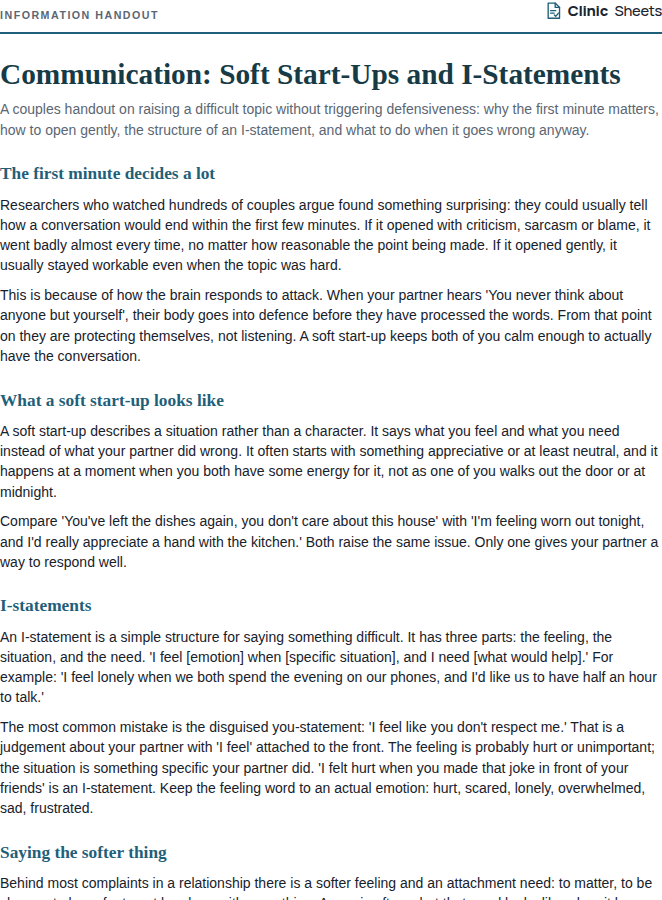
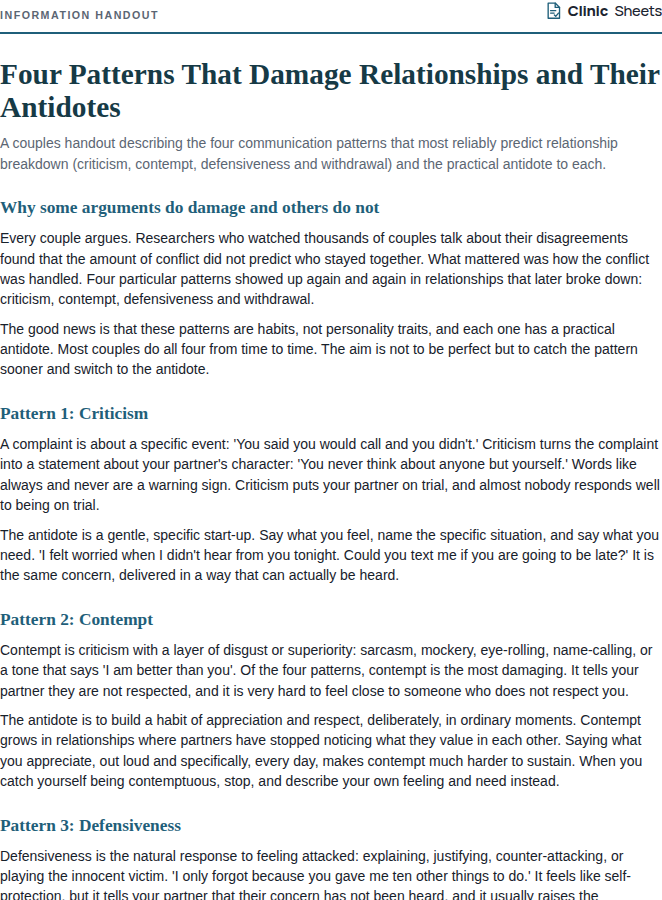
Emotional intimacy is the felt sense that your partner knows your inner world and is moved by it. In distressed relationships it is usually the first thing to go: partners stop sharing what is going on inside because the response has become unreliable, and the resulting distance confirms each person's fear that they are alone. Emotionally focused therapy understands this through an attachment lens. The negative cycle is driven by attachment insecurity, and change comes when partners risk expressing the softer feelings and needs underneath their protective moves and are met with responsiveness rather than defence or withdrawal.
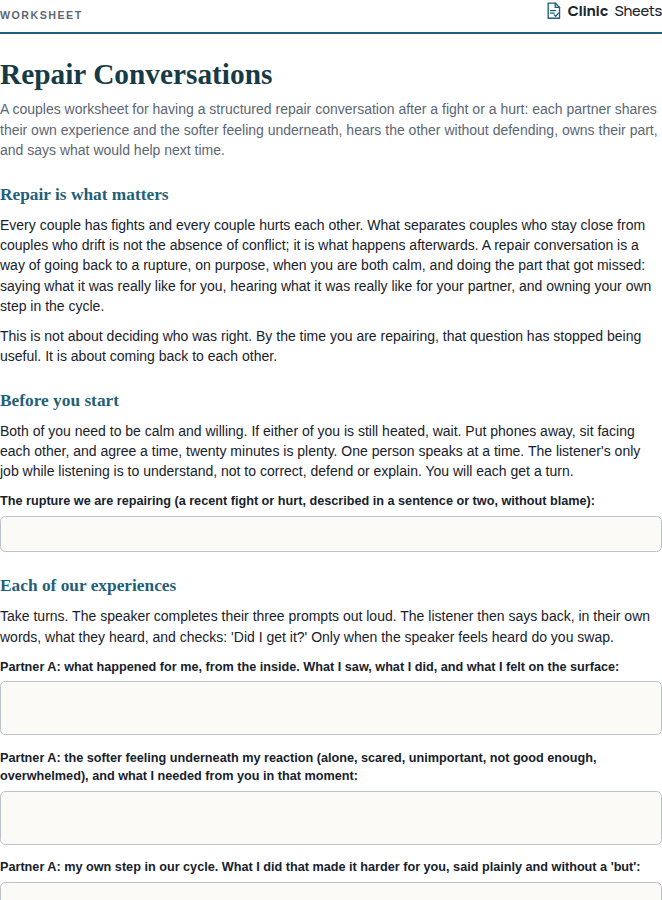
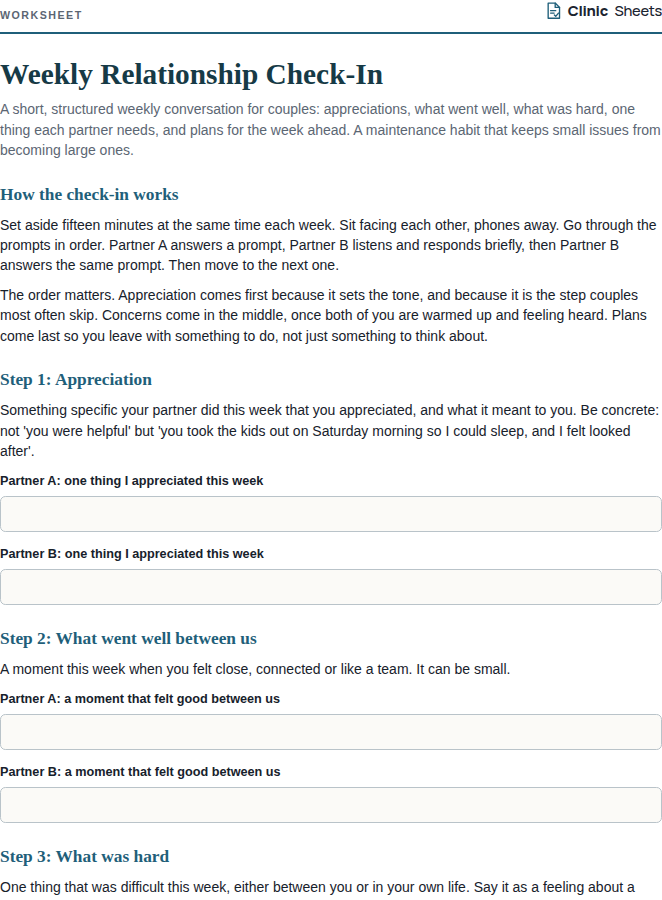
These three exercises give couples a repeatable way to practise that risk-and-response sequence between sessions. The daily check-in builds a habit of sharing inner experience in small, low-stakes doses. The vulnerability exchange uses graded self-disclosure, which experimental work by Aron and colleagues found reliably increases closeness, and directs it toward feelings and needs rather than facts. The reaching-and-responding practice is a home version of the enactments at the heart of EFT: one partner names a need directly, the other responds to it. Together they build the sense of accessibility and responsiveness that Johnson describes as the basis of a secure bond.
The professional version notes that these exercises suit couples in the middle stage of EFT who have de-escalated their cycle and can name underlying feelings with some help. Assigning them too early, to a couple still in high conflict, tends to produce a failed attempt that reinforces the cycle. It also describes common breakdowns (the responder rushing to fix, the sharer using the exercise to complain, one partner going through the motions) and how to work with them in session.
How to use it
- Assign these once the couple has de-escalated, can describe their cycle, and has had at least one experience in session of a softer feeling being expressed and received.
- Introduce one exercise at a time. Start with the daily check-in for a week or two before adding the others.
- Run the vulnerability exchange and the reaching-and-responding practice in session first, so each partner has felt what a good response is like before attempting it at home.
- Ask the couple to keep the log and bring it to session. The moments where the exercise went wrong are as useful as the moments where it went well; both show the cycle and the bond in action.
- If a partner reports feeling nothing or going through the motions, explore that in session with curiosity. It is often a protective stance rather than a lack of feeling.
References
- Johnson, S. M. (2020). The Practice of Emotionally Focused Couple Therapy: Creating Connection (3rd ed.). Routledge.
- Johnson, S. M. (2008). Hold Me Tight: Seven Conversations for a Lifetime of Love. Little, Brown.
- Aron, A., Melinat, E., Aron, E. N., Vallone, R. D., & Bator, R. J. (1997). The experimental generation of interpersonal closeness: A procedure and some preliminary findings. Personality and Social Psychology Bulletin, 23(4), 363-377.