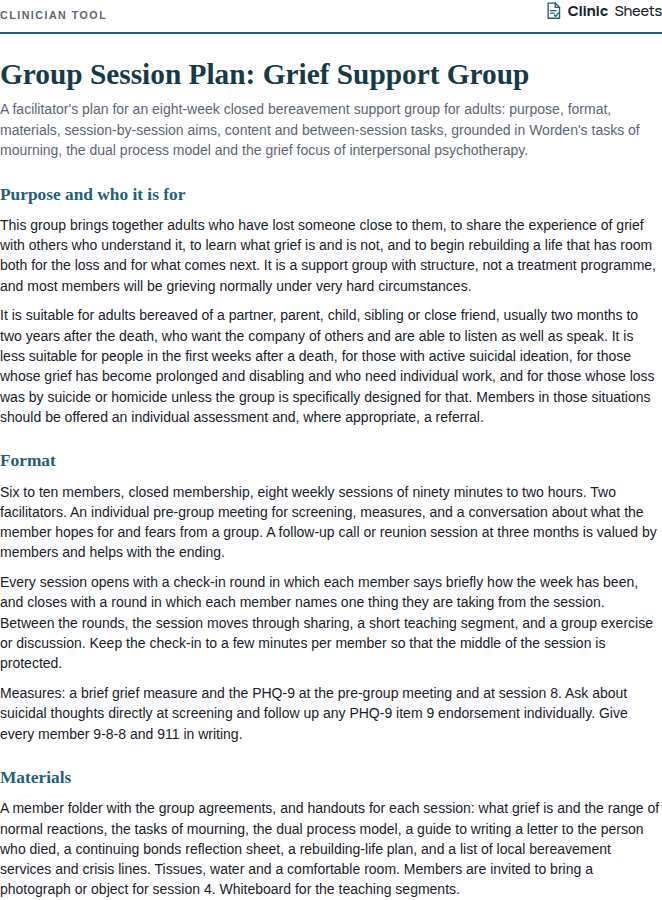
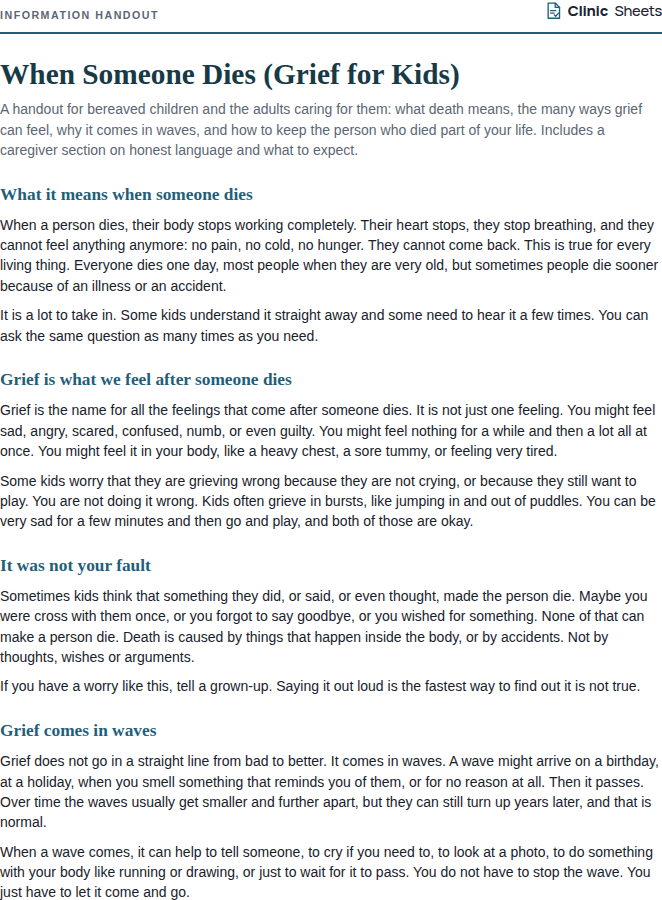
Grief After Suicide Loss
A handout for adults and families bereaved by suicide. It explains why this grief often carries questions, guilt, shame and shock alongside sadness, and offers steady, practical ground for the early months.
About this resource
Bereavement after suicide shares much with other grief, but several features tend to be more prominent: a persistent search for why, guilt and self-blame over what was or was not noticed, anger at the person or at services, shame linked to stigma, intrusive images or imaginings of the death, and a sense of rejection or abandonment. Jordan's review of the literature suggests that the differences are more of degree and theme than of kind, which is useful framing for clients who fear that their grief is abnormal.
This handout normalises these reactions, addresses the 'why' question directly, names shame and secrecy as barriers to support, and gives the reader permission to grieve at their own pace. It draws on cognitive behavioural and interpersonal approaches: it targets the self-blaming appraisals that maintain distress, and it encourages the person to make use of relationships rather than withdraw from them. It also includes the Canadian crisis line, because people bereaved by suicide are themselves at elevated risk and should know where help is.
The professional version adds notes on eliciting the client's private theory of why the death happened, on distinguishing ordinary grief from prolonged grief disorder as time passes, and on assessing the bereaved person's own safety without treating them as fragile.
How to use it
- Offer the handout after the client has told the story of the death in their own way and at their own pace. Do not lead with it.
- Ask gently what the client believes caused the death and what they believe they should have done. Write these beliefs down; they are the material for later cognitive work.
- Screen for the client's own suicidal thoughts in a matter-of-fact way at assessment and periodically thereafter. Give the 9-8-8 number and confirm they know how to reach you or a crisis service.
- Use the reflection fields to open a conversation about who the client has told and what has stopped them telling others.
- If, after six to twelve months, grief remains as intense and disabling as in the first weeks, consider a formal assessment for prolonged grief and a targeted treatment such as complicated grief therapy.
References
- Jordan, J. R. (2001). Is suicide bereavement different? A reassessment of the literature. Suicide and Life-Threatening Behavior, 31(1), 91-102.
- Jordan, J. R., & McIntosh, J. L. (Eds.). (2011). Grief after suicide: Understanding the consequences and caring for the survivors. Routledge.
- Shear, M. K. (2015). Complicated grief. New England Journal of Medicine, 372(2), 153-160.
- Worden, J. W. (2018). Grief counseling and grief therapy: A handbook for the mental health practitioner (5th ed.). Springer.