Living with Grief: A Guide
A complete client guide to grief after bereavement: what grief is and how it varies, the tasks of mourning, moving between loss and restoration, telling the story of the loss, dealing with guilt and unfinished business, rebuilding a life and a continuing bond, and recognising when grief has become stuck.
About this resource
Grief is not an illness, and most bereaved people adapt over time without professional help. Clinicians nevertheless see grief constantly: as a presenting problem, as a complicating factor in depression and anxiety, and occasionally as prolonged grief, in which acute yearning and preoccupation persist for well over a year with significant impairment. This guide is written for the ordinary bereaved client who wants to understand what they are going through and to grieve well, and it is also a foundation for work with those whose grief has become stuck.
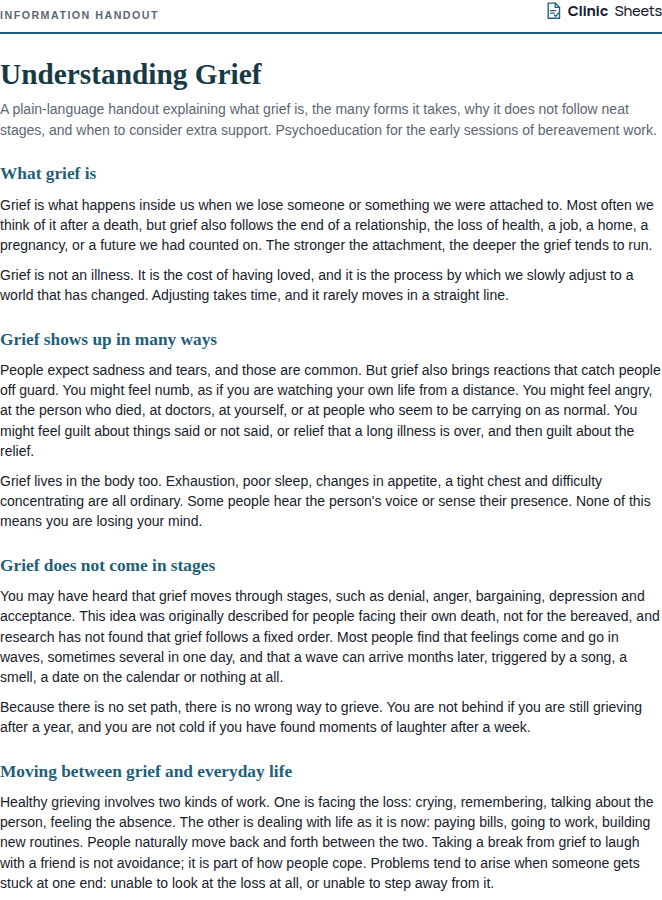
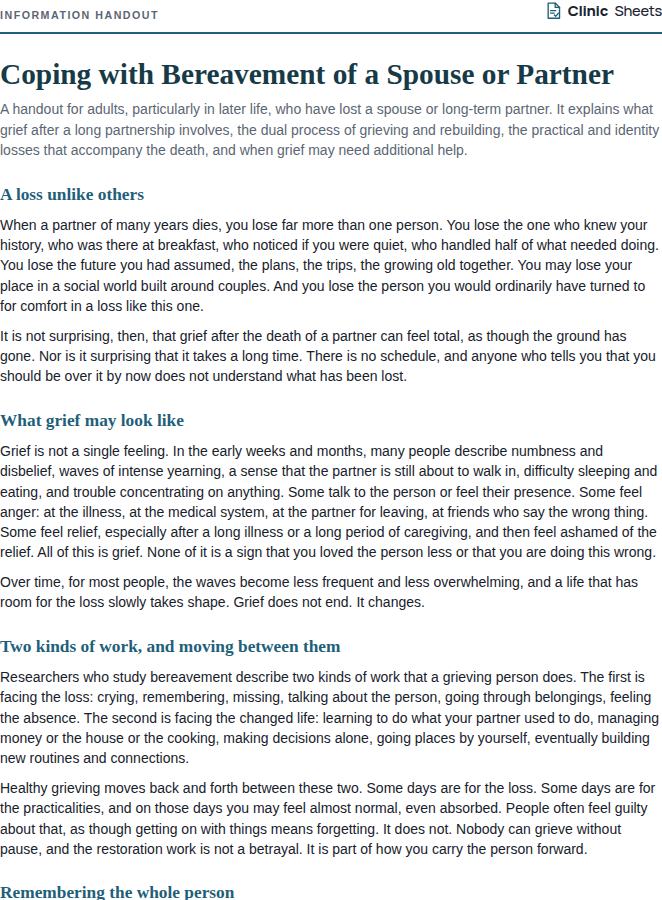
The guide draws on three frameworks. Worden's tasks of mourning describe grief as active work: accepting the reality of the loss, processing the pain, adjusting to a world without the person, and finding an enduring connection with them while moving forward in life. Stroebe and Schut's dual process model describes healthy grieving as oscillation between loss-oriented activity (confronting the loss and its pain) and restoration-oriented activity (attending to the practical and social life that must now be rebuilt), rather than as a linear progression through stages. Interpersonal psychotherapy's approach to grief, which focuses on reconstructing a realistic picture of the relationship, including its difficulties, and on facilitating the mourning process and re-engagement with others, informs the sections on telling the story and on guilt.
The professional version adds guidance on distinguishing normal grief from depression and from prolonged grief disorder, on the circumstances that raise the risk of complicated grief (sudden or violent death, death of a child, ambivalent or dependent relationships, isolation, previous losses), and on when to refer for specialist grief treatment.
How to use it
- Assess the nature of the loss, the relationship, the circumstances of the death, the time elapsed, and the client's supports before using the guide. Screen for depression and suicidal ideation, which are elevated after bereavement.
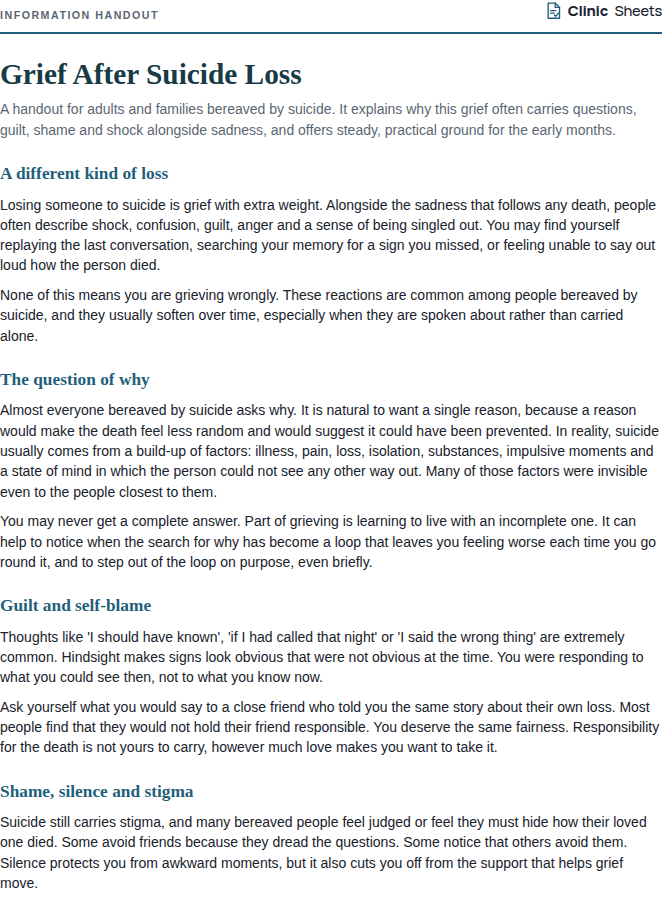
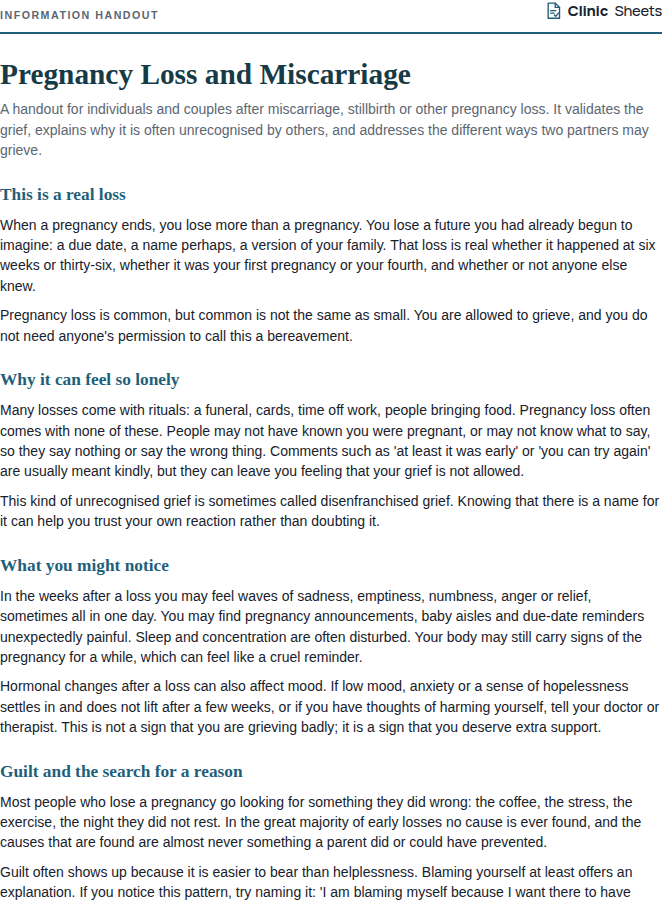
- Use the first three sections to normalise the client's experience. Many bereaved people fear they are grieving wrongly, and psychoeducation alone brings relief.
- Invite the client to tell the story of the loss in session, in detail and at their own pace, over one or more sessions. The writing prompts in the guide support this between sessions.
- Use the guilt and unfinished business section carefully, exploring the realistic picture of the relationship, including its imperfections, rather than reassuring prematurely.
- Support restoration-oriented activity alongside loss-oriented work, and watch for clients who are stuck at one pole, either unable to face the loss or unable to leave it.
- If grief remains acute and impairing well beyond a year, with persistent yearning and preoccupation, consider a specialist prolonged grief treatment or refer.
References
- Worden, J. W. (2018). Grief Counseling and Grief Therapy: A Handbook for the Mental Health Practitioner (5th ed.). Springer.
- Stroebe, M., & Schut, H. (1999). The dual process model of coping with bereavement: Rationale and description. Death Studies, 23(3), 197-224.
- Shear, M. K. (2015). Complicated grief. New England Journal of Medicine, 372(2), 153-160.
- Weissman, M. M., Markowitz, J. C., & Klerman, G. L. (2018). The Guide to Interpersonal Psychotherapy (Updated and expanded ed.). Oxford University Press.