Group Session Plan: Grief Support Group
A facilitator's plan for an eight-week closed bereavement support group for adults: purpose, format, materials, session-by-session aims, content and between-session tasks, grounded in Worden's tasks of mourning, the dual process model and the grief focus of interpersonal psychotherapy.
About this resource
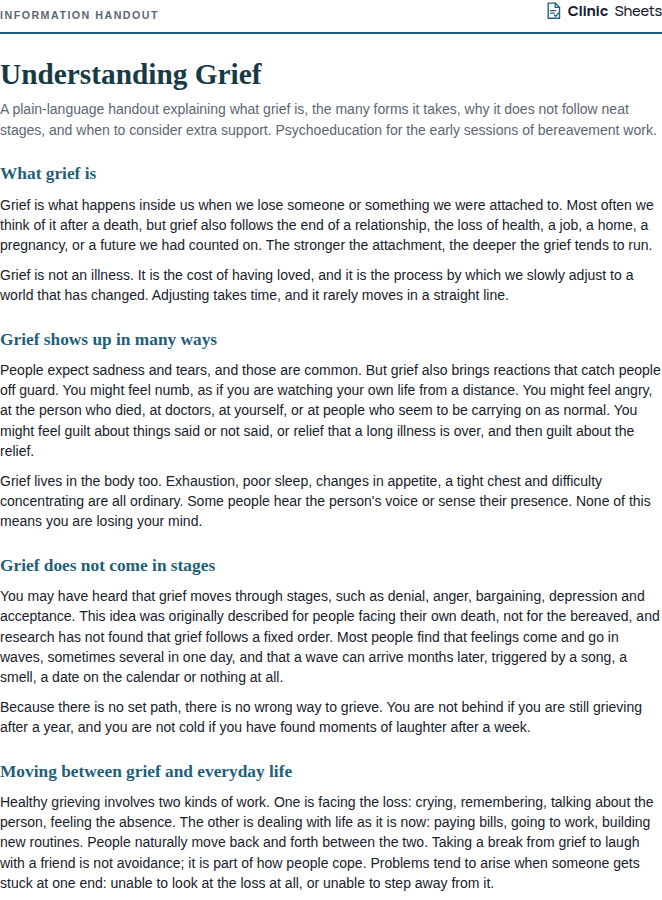
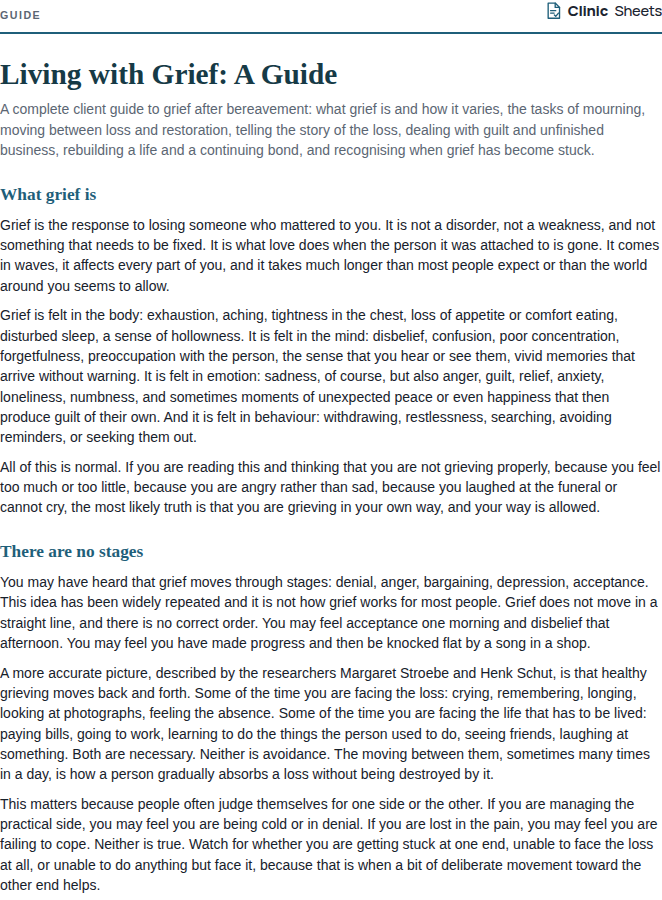
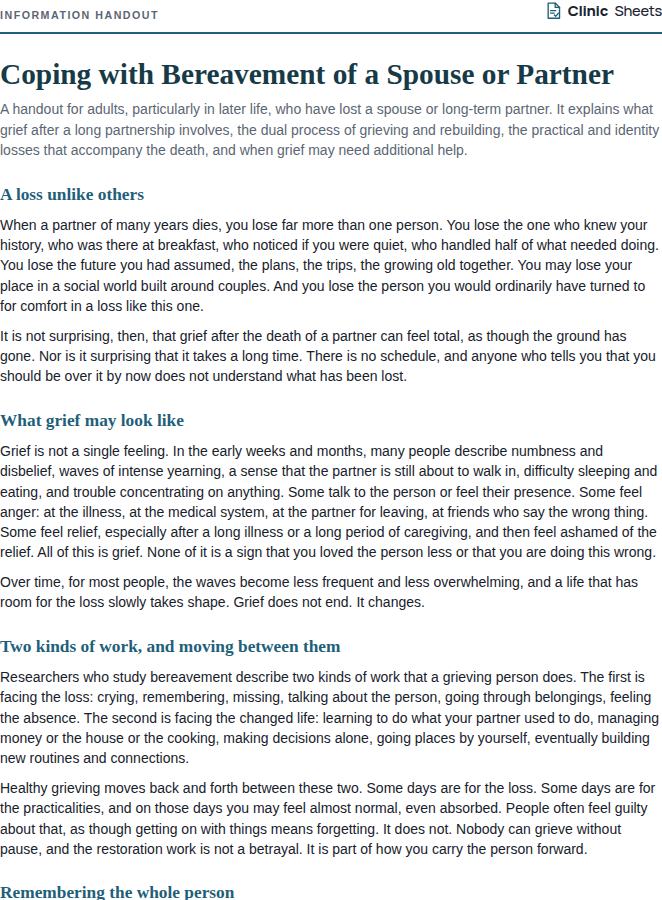
Most bereaved people do not need treatment; they need time, support and the company of others who understand. A structured grief group offers exactly that, together with enough psychoeducation and gentle skill-building to help members who are stuck. The framework here combines three well-established sources. Worden's tasks of mourning (accepting the reality of the loss, processing the pain, adjusting to a world without the person, and finding an enduring connection while moving forward) give the arc. Stroebe and Schut's dual process model, in which healthy grieving oscillates between confronting the loss and attending to the demands of restored daily life, gives the rationale for balancing memory work with practical rebuilding. And interpersonal psychotherapy's approach to grief, which facilitates mourning and then helps the person re-establish interests and relationships, gives the shape of the later sessions.
The group is a support and psychoeducation group rather than a treatment for prolonged grief disorder. Members with severe, persistent impairment a year or more after the loss, or with marked avoidance and preoccupation, are better served by an individual protocol such as Shear's complicated grief treatment, and the plan says how to identify them at screening.
The professional version gives the facilitator the full session outlines, guidance on screening and on the mix of losses to include in one group, and a section on the challenges that arise most often in grief groups, including a member whose loss was traumatic, unequal grief timelines, and the facilitator's own bereavement history.
How to use it
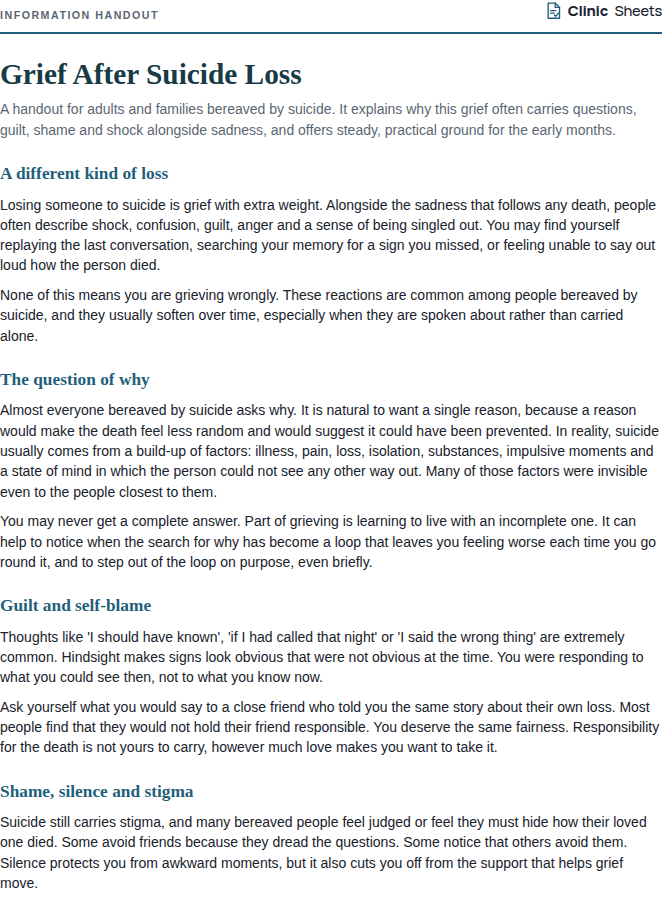
- Screen each prospective member individually. Ask about the loss, its circumstances and timing, current functioning, support, and risk. Members are usually best placed at least two to three months after the death, and most groups mix losses (partner, parent, child, sibling, friend) while keeping the circumstances broadly compatible. Consider a separate group for bereavement by suicide, which has its own needs.
- Screen for prolonged grief and depression. Use a brief grief measure and the PHQ-9 at intake and at the final session. Members with severe impairment long after the loss, or with active suicidal ideation, should be offered individual treatment rather than the group, or alongside it.
- Run the group with two facilitators. Grief groups produce strong emotion in the room and one facilitator needs to be free to sit with a member who is overwhelmed.
- Balance the sessions. Each week includes space for members' stories and feelings, a short piece of teaching, and a task that turns the group's attention outward. Groups that are all memory work leave members flooded; groups that are all skills leave them feeling unheard.
- Prepare members for the ending from the start. The group itself becomes an attachment, and its close is a small loss that should be worked with, not glossed over.
References
- Worden, J. W. (2018). Grief Counseling and Grief Therapy: A Handbook for the Mental Health Practitioner (5th ed.). Springer Publishing.
- Stroebe, M., & Schut, H. (1999). The dual process model of coping with bereavement: Rationale and description. Death Studies, 23(3), 197-224.
- Shear, K., Frank, E., Houck, P. R., & Reynolds, C. F. (2005). Treatment of complicated grief: A randomized controlled trial. JAMA, 293(21), 2601-2608.
- Weissman, M. M., Markowitz, J. C., & Klerman, G. L. (2018). The Guide to Interpersonal Psychotherapy (Updated and expanded ed.). Oxford University Press.