Guilt vs Shame
A handout that separates guilt (I did something bad) from shame (I am bad), explains why the difference matters for recovery, and helps clients notice which one they are actually feeling.
About this resource
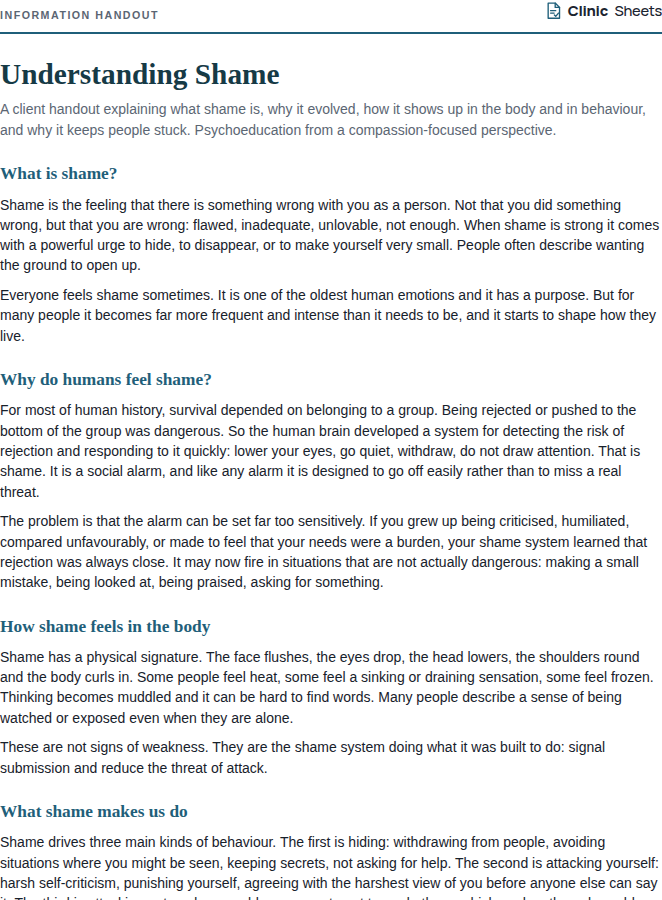
Guilt and shame are often used interchangeably, but research since Helen Block Lewis's original distinction has consistently shown that they function differently. Guilt focuses on a specific behaviour and its effect on others; it tends to motivate repair, apology and behaviour change. Shame focuses on the global self; it tends to motivate hiding, withdrawal, defensiveness and, in some people, anger. Tangney and Dearing's work shows that shame-proneness is associated with poorer psychological outcomes, while guilt-proneness, when it stays tied to specific actions, is generally adaptive.
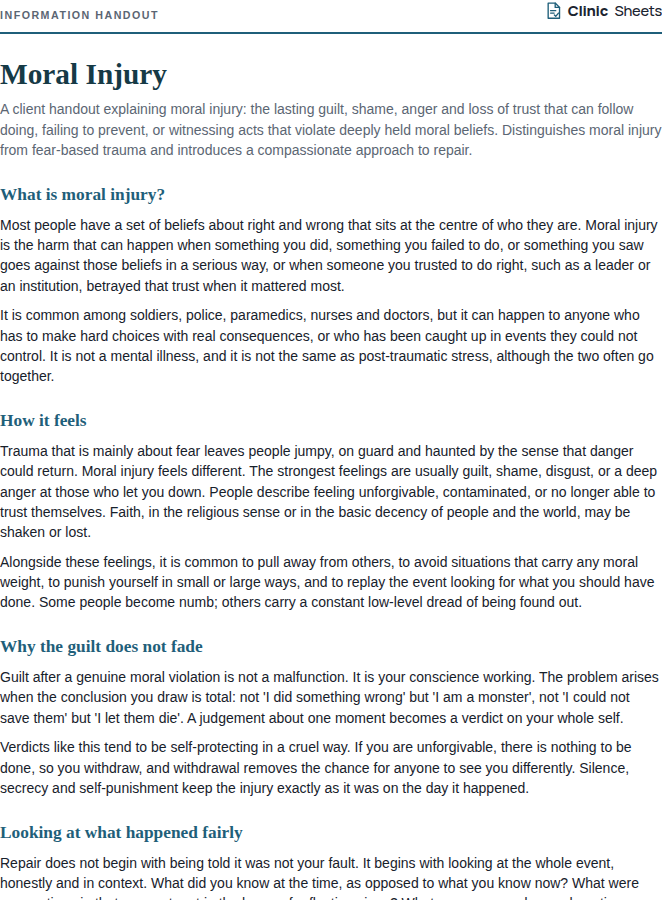
Clinically, many clients experience what starts as appropriate guilt over an action and rapidly converts it into shame about the self: 'I forgot her birthday' becomes 'I am a terrible person'. Once the emotion is about the whole self, the constructive route of repair is blocked, because there is no way to repair a defective self. This handout makes the distinction visible and gives clients a simple way to notice the shift as it happens.
The professional version adds guidance on working with clients whose guilt is disproportionate or misplaced (common in trauma and OCD), and on cases where shame is used to avoid the discomfort of appropriate guilt.
How to use it
- Use when a client describes a mistake or wrongdoing and the emotional response seems to be about who they are rather than what they did.
- Read the comparison section together and ask the client to bring a recent example. Walk through the questions: what exactly did you do, what effect did it have, what did you conclude about yourself?
- Help the client locate the moment the emotion shifted from action to self. That moment is where the intervention lies.
- If the guilt is proportionate, move to repair: what can be done, said or changed. If it is disproportionate, use responsibility pie charts or a thought record to test the appraisal.
- Follow with Understanding Shame or compassion-focused work when shame is the dominant response.
References
- Tangney, J. P., & Dearing, R. L. (2002). Shame and Guilt. Guilford Press.
- Lewis, H. B. (1971). Shame and Guilt in Neurosis. International Universities Press.
- Tangney, J. P., Stuewig, J., & Mashek, D. J. (2007). Moral emotions and moral behavior. Annual Review of Psychology, 58, 345-372.
- Gilbert, P. (2009). The Compassionate Mind. Constable.