Understanding Shame
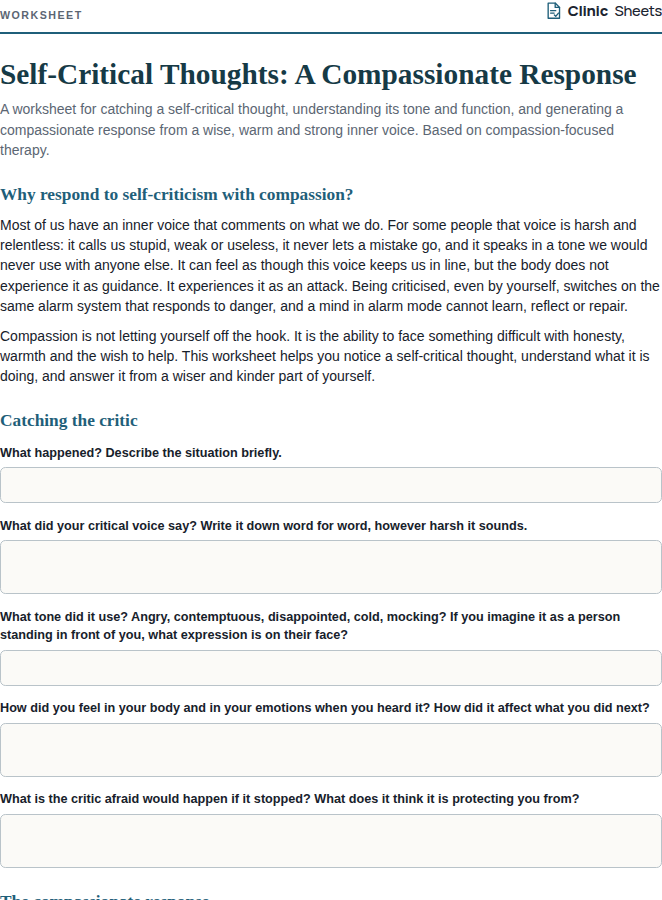
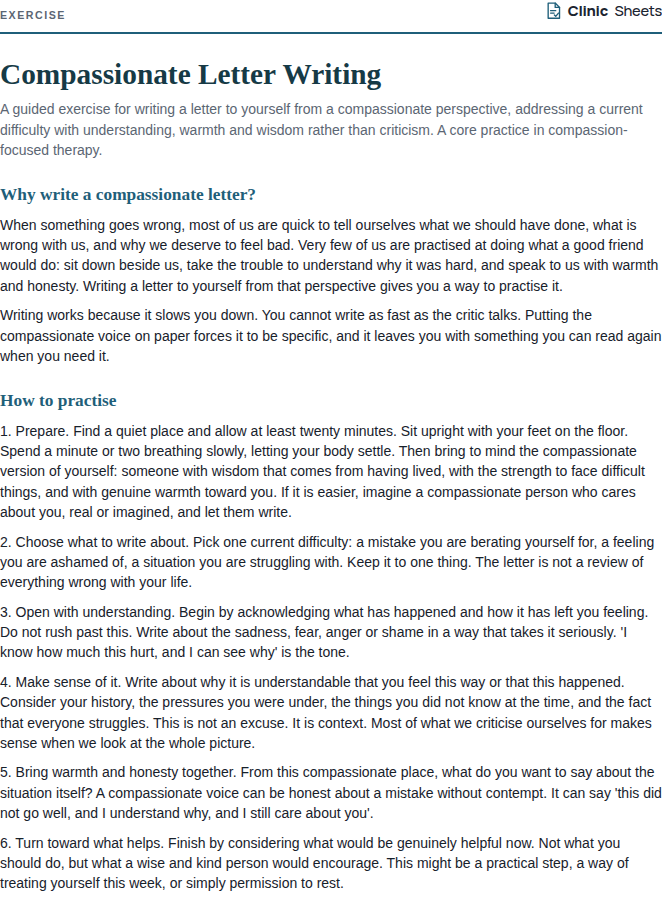
A client handout explaining what shame is, why it evolved, how it shows up in the body and in behaviour, and why it keeps people stuck. Psychoeducation from a compassion-focused perspective.
About this resource
Shame is a self-conscious emotion centred on the sense of being flawed, inadequate or unacceptable in the eyes of others. Unlike guilt, which concerns a specific action, shame concerns the whole self. Gilbert's evolutionary account frames shame as a social threat response: it evolved to detect the risk of rejection or loss of status within a group and to trigger submissive, concealing behaviours that reduce that risk. In modern life, and especially after early experiences of criticism, neglect or humiliation, the system can become chronically over-active, so that the person feels exposed and defective even in safe relationships.
This handout explains shame in plain terms: its function, its typical bodily signature, the behaviours it drives (hiding, withdrawing, attacking the self or others), and the reason it is so hard to talk about. It introduces the distinction between external shame (how I believe others see me) and internal shame (how I see myself), and prepares the client for the compassion-focused work that follows.
The professional version adds notes on assessing shame when the client cannot name it, on the shame-rage cycle, and on the therapist's own responses to a client's shame in the room.
How to use it
- Use early in treatment once the client has described experiences of feeling exposed, worthless or wanting to disappear, even if they have not used the word shame.
- Read the handout together rather than sending it home. Shame is easier to discuss when it has been normalised in the room first.
- Ask the client which of the bodily signs and behaviours they recognise. Use these to build a shared language for noticing shame when it appears in session.
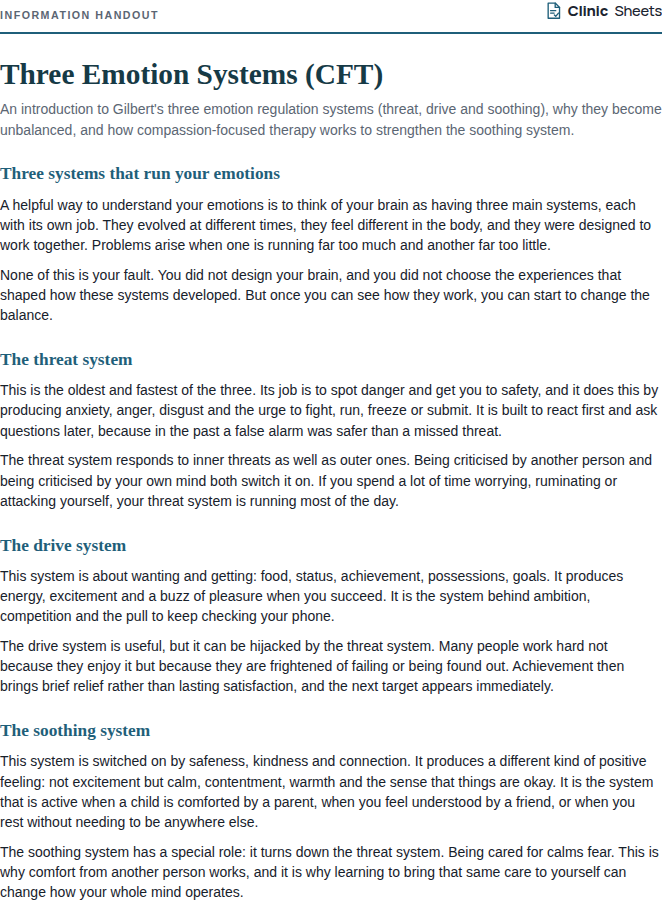
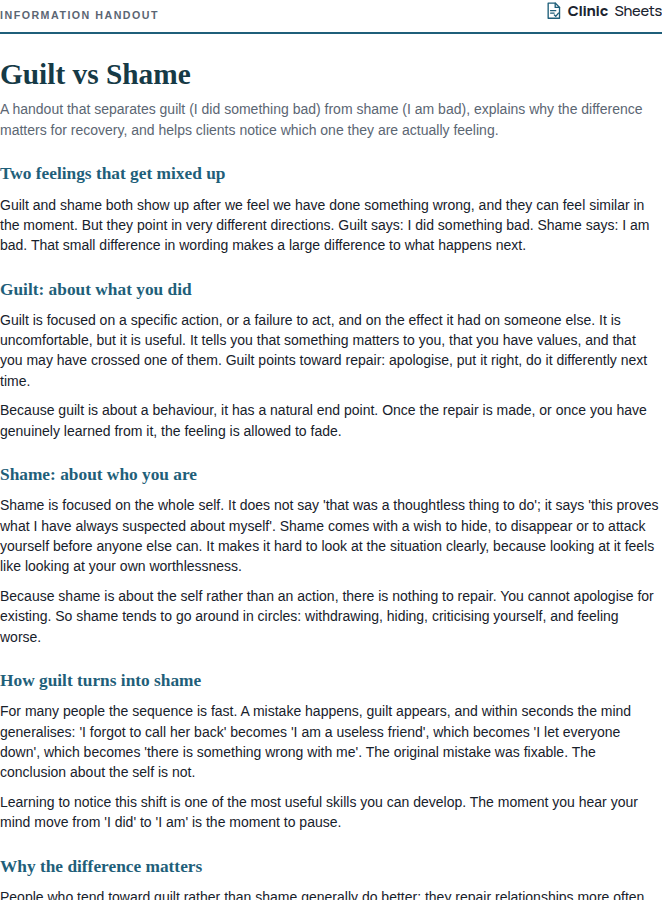
- Follow with Guilt vs Shame if the client tends to collapse the two, and with the Three Emotion Systems handout to set up compassion-focused work.
- Return to the handout when shame appears in session. Naming it in the moment ('I wonder if some shame just showed up') is often the most useful intervention.
References
- Gilbert, P. (1998). What is shame? Some core issues and controversies. In P. Gilbert & B. Andrews (Eds.), Shame: Interpersonal Behavior, Psychopathology, and Culture (pp. 3-38). Oxford University Press.
- Gilbert, P. (2009). The Compassionate Mind. Constable.
- Tangney, J. P., & Dearing, R. L. (2002). Shame and Guilt. Guilford Press.
- Lewis, H. B. (1971). Shame and Guilt in Neurosis. International Universities Press.