Health Anxiety Formulation
An individualised formulation of health anxiety following the Salkovskis and Warwick cognitive model: triggering sensations, feared interpretation, anxiety and its physical effects, attention to the body, checking, reassurance seeking, avoidance, and the beliefs about illness that underlie it all.
About this resource
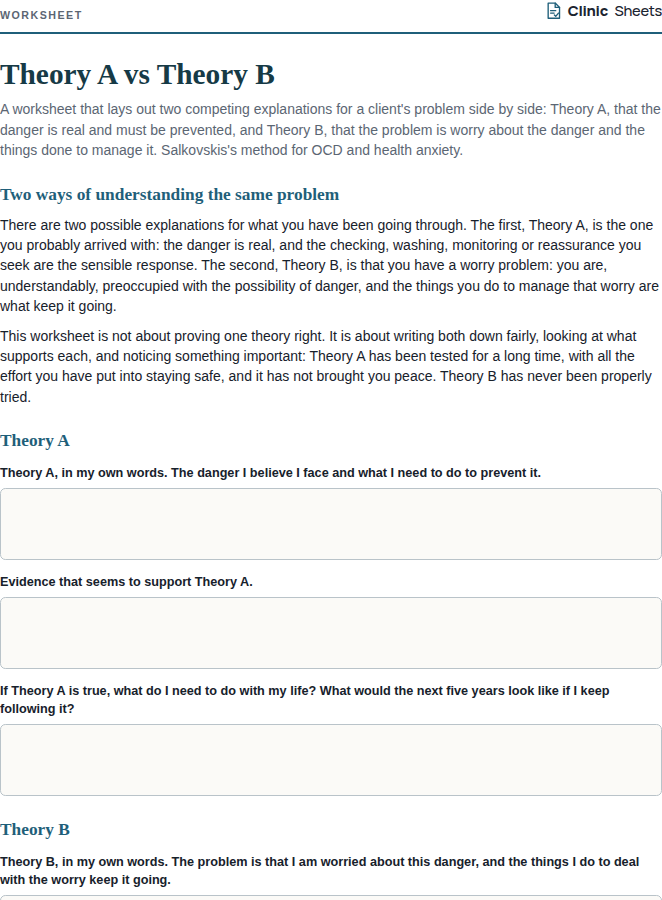
A shared formulation is the turning point in CBT for health anxiety. Clients typically arrive with a single-factor explanation (there is something physically wrong) and years of evidence gathering that has failed to settle it. Building a diagram together that shows how attention, interpretation, anxiety and behaviour combine to produce and maintain their symptoms offers an alternative explanation that fits the facts at least as well, and points to a treatment that does not depend on any further medical tests.
This formulation follows the cognitive behavioural model of health anxiety set out by Salkovskis and Warwick and elaborated in subsequent work. It begins with the trigger (a sensation, a piece of health news, an illness in someone else), moves to the interpretation and the beliefs about illness and vulnerability that make that interpretation likely, then traces the consequences: anxiety with its physiological effects, hypervigilance to the body, body checking, reassurance seeking, safety behaviours and avoidance. Each component has a field so that the client writes the model in their own words, and the final section draws the loop that maintains the problem.
Suitable for adults. The professional version adds a completed example, guidance on eliciting underlying assumptions about health (such as 'any symptom must have a cause that can be found' or 'if I do not catch it early it will be too late'), and notes on using the formulation to plan behavioural experiments and to explain why medical reassurance has not worked.
How to use it
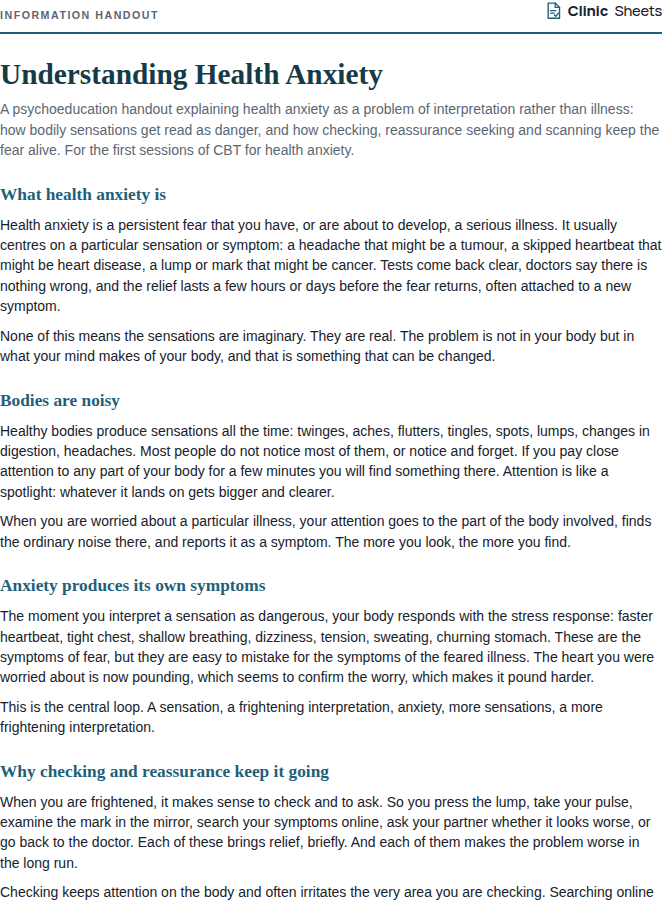
- Complete the formulation in session, after the Understanding Health Anxiety handout, using a recent specific episode of health worry rather than the problem in general.
- Start with the trigger and the interpretation, then draw out the anxiety and its physical effects. Ask whether any of the symptoms the client attributes to illness could also be produced by anxiety.
- Elicit the behaviours in detail: what checking, searching, asking, and avoiding look like day to day, and how much time they take. Ask what happens to the fear immediately after each behaviour, and then an hour later.
- Explore the underlying beliefs about illness, symptoms and the client's own vulnerability. These often connect to past experiences of illness in the family or being dismissed by a doctor.
- Draw the maintaining cycle together and ask the client whether this explanation could account for what they have been experiencing. Aim for a degree of belief in the alternative model, not certainty.
- Use the completed formulation to plan treatment: which behaviours to drop first, what experiments would test the model, and what the client predicts will happen.
References
- Salkovskis, P. M., & Warwick, H. M. C. (1986). Morbid preoccupations, health anxiety and reassurance: A cognitive-behavioural approach to hypochondriasis. Behaviour Research and Therapy, 24(5), 597-602.
- Warwick, H. M. C., & Salkovskis, P. M. (1990). Hypochondriasis. Behaviour Research and Therapy, 28(2), 105-117.
- Salkovskis, P. M., Warwick, H. M. C., & Deale, A. C. (2003). Cognitive-behavioral treatment for severe and persistent health anxiety (hypochondriasis). Brief Treatment and Crisis Intervention, 3(3), 353-367.
- Furer, P., Walker, J. R., & Stein, M. B. (2007). Treating Health Anxiety and Fear of Death: A Practitioner's Guide. Springer.