Session-by-Session Protocol: CBT for Health Anxiety
A session-by-session clinician protocol for cognitive behavioural therapy for health anxiety, following the Salkovskis and Warwick model: engagement and the two alternative explanations, the individual formulation, dropping checking and reassurance seeking, behavioural experiments on attention and body checking, work on beliefs about illness and uncertainty, and relapse prevention.
About this resource
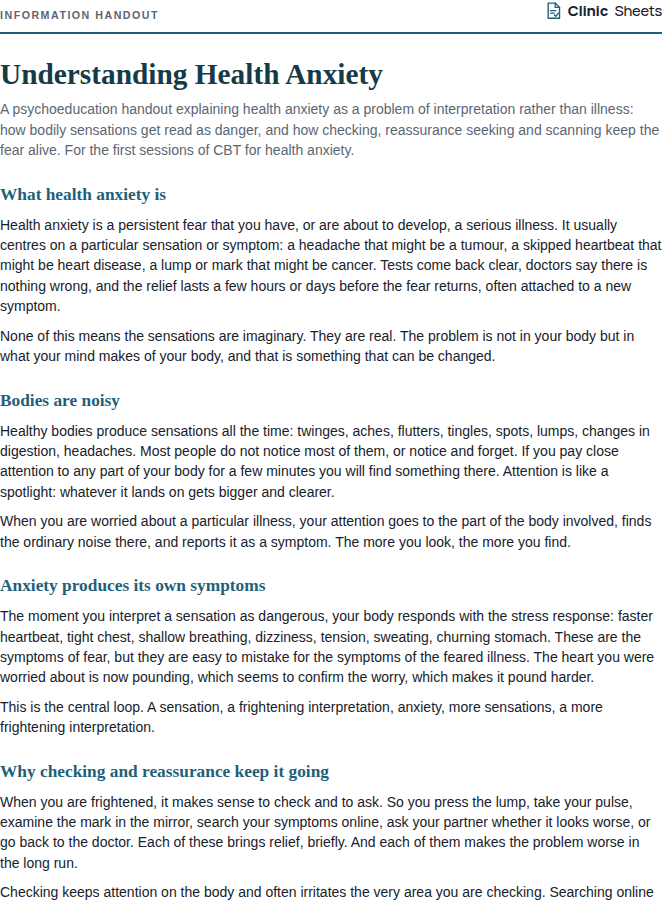
Salkovskis and Warwick's cognitive model of health anxiety proposes that the problem is not the presence of symptoms but the interpretation of bodily sensations, bodily changes and medical information as evidence of serious illness. That interpretation produces anxiety, and the anxiety produces further sensations, selective attention to the body, checking, reassurance seeking and avoidance, each of which maintains the preoccupation. Reassurance is central: it reduces anxiety briefly and so is repeated, but it prevents the person from learning to tolerate uncertainty and keeps health at the centre of attention. Cognitive behavioural treatment based on this model was superior to a waiting list and comparable to or better than behavioural stress management in the Clark et al. (1998) trial, and a brief version delivered by general clinicians was effective in the large CHAMP trial.
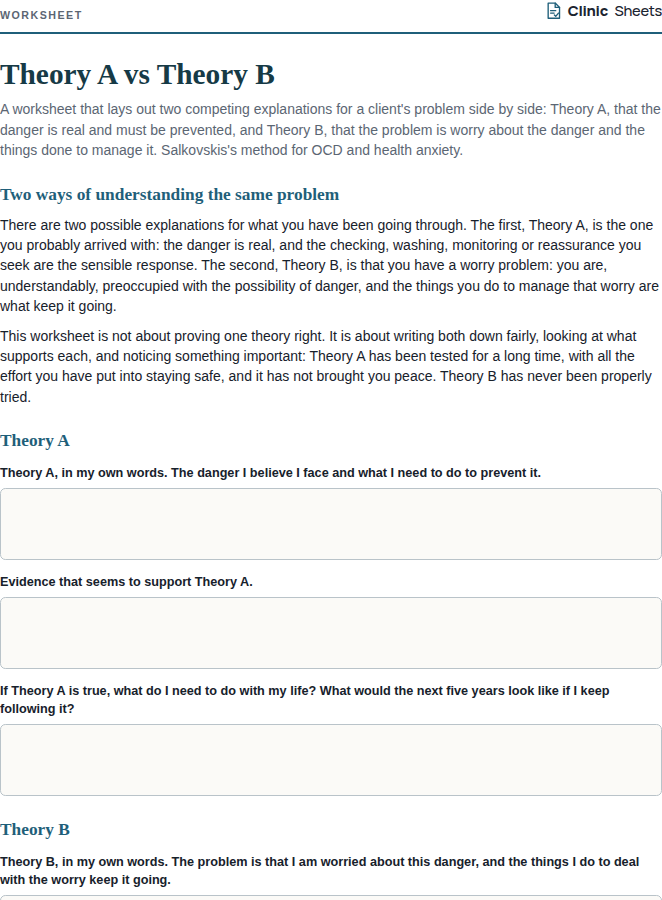
This protocol lays out a course of roughly ten to sixteen sessions, in the range used across the trials. The engagement phase is particularly important with health anxiety, because clients typically arrive convinced that they have a medical problem and that psychological treatment is a dismissal of it. The protocol therefore begins with a stance of shared enquiry: two alternative explanations of the client's experience are laid out and treatment is framed as a test of the second.
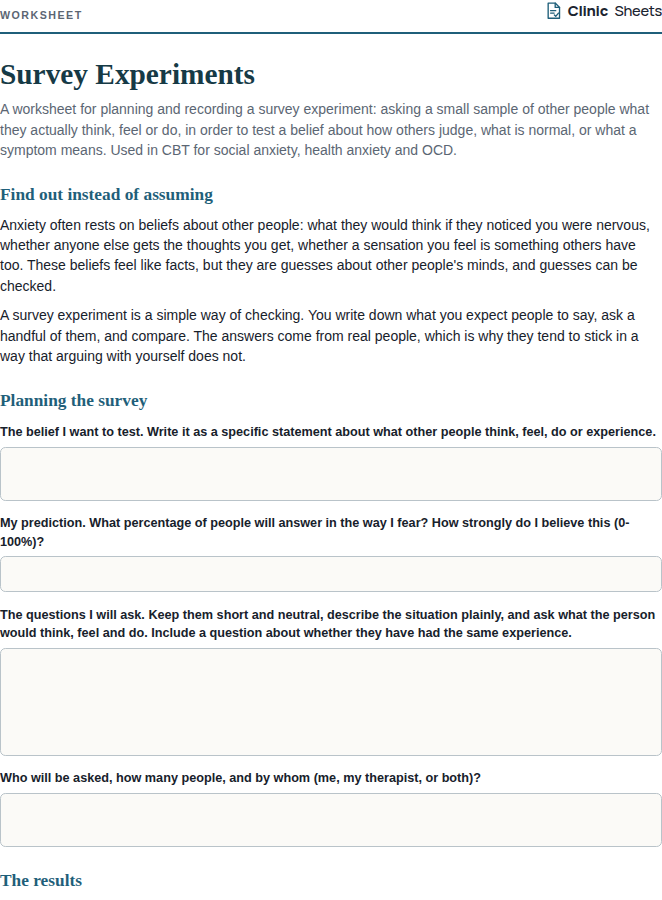
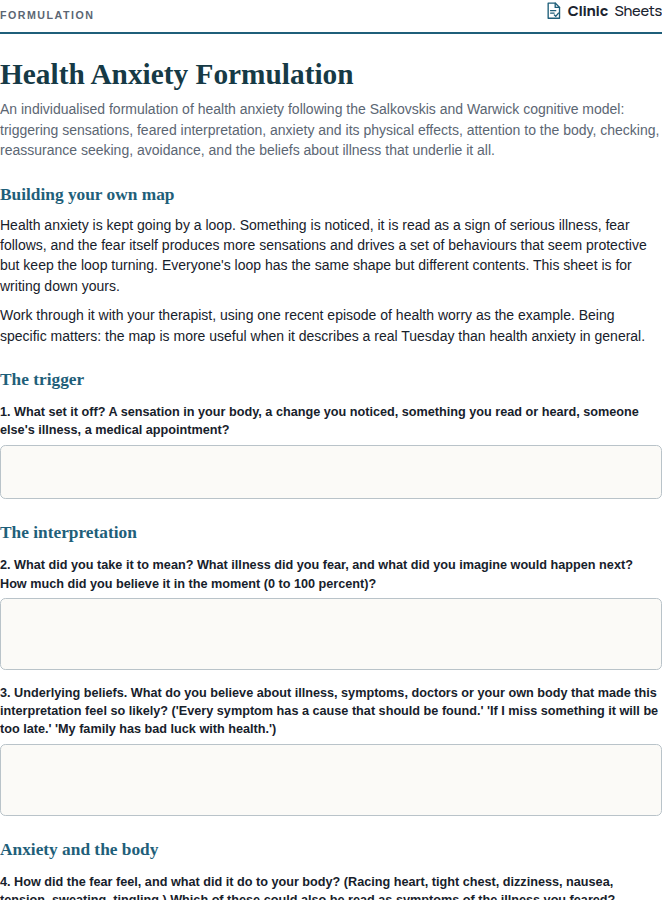
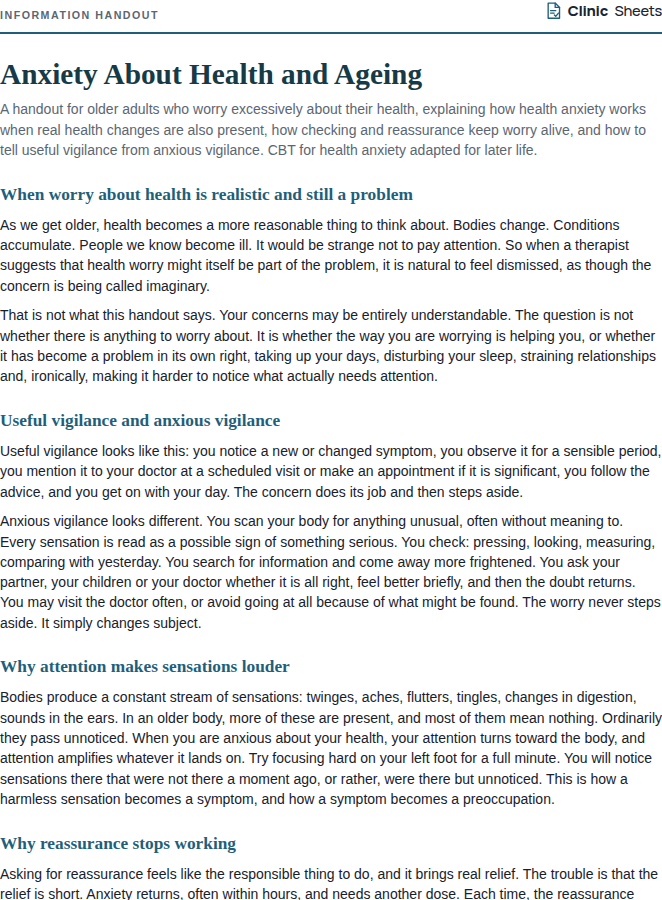
The professional version explains how to conduct the engagement conversation, how to handle the client who wants one more test, how to work with the family doctor to set a reassurance policy, and the experiments that reliably shift beliefs: attention focus, body checking, and the survey of symptom frequency in healthy people. It also notes when health anxiety coexists with a genuine medical condition and how the model still applies.
How to use it
- Confirm that health anxiety is the primary problem, review the medical history and recent investigations, and agree with the client and the family doctor that further investigation is not currently indicated. This agreement is the foundation of the treatment.
- Administer the Short Health Anxiety Inventory at baseline and at intervals through treatment, and a brief depression and anxiety measure weekly. Record belief ratings for the central feared illness.
- Spend the first two sessions on engagement and the individual formulation. Do not attempt to dispute the feared illness; instead build the alternative explanation and agree to test it.
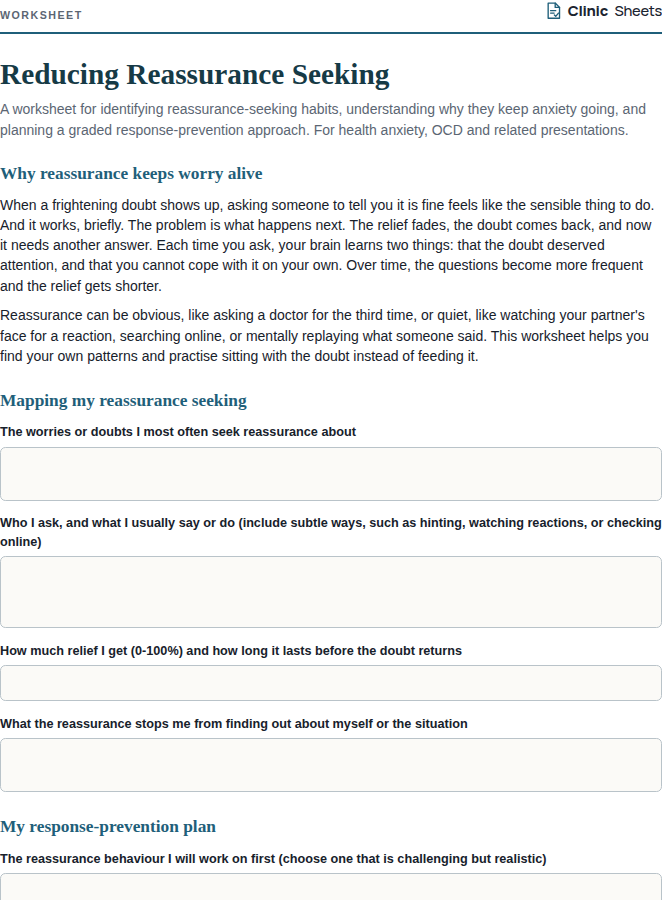
- From the third session, target reassurance seeking and checking directly and run behavioural experiments on attention and body checking. Involve the family doctor and family members in the reassurance plan.
- Address beliefs about illness, death and uncertainty in the later sessions, and reserve the final two sessions for the blueprint and booster planning.
References
- Salkovskis, P. M., & Warwick, H. M. C. (1986). Morbid preoccupations, health anxiety and reassurance: A cognitive-behavioural approach to hypochondriasis. Behaviour Research and Therapy, 24(5), 597-602.
- Warwick, H. M. C., & Salkovskis, P. M. (1990). Hypochondriasis. Behaviour Research and Therapy, 28(2), 105-117.
- Clark, D. M., Salkovskis, P. M., Hackmann, A., Wells, A., Fennell, M., Ludgate, J., Ahmad, S., Richards, H. C., & Gelder, M. (1998). Two psychological treatments for hypochondriasis: A randomised controlled trial. British Journal of Psychiatry, 173(3), 218-225.
- Salkovskis, P. M., Rimes, K. A., Warwick, H. M. C., & Clark, D. M. (2002). The Health Anxiety Inventory: Development and validation of scales for the measurement of health anxiety and hypochondriasis. Psychological Medicine, 32(5), 843-853.