Safe Place Imagery (Audio Script)
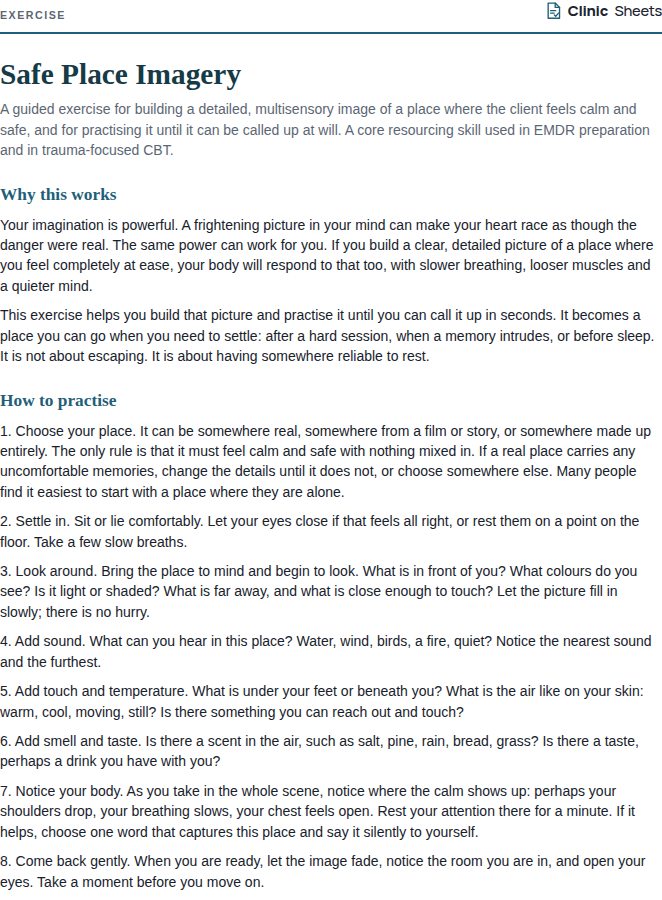
A read-aloud script for guiding a client to build and strengthen a vivid, multisensory image of a place where they feel calm and safe. Used as a stabilisation and resourcing exercise before and during trauma-focused work.
About this resource
Safe place imagery (sometimes called calm place or peaceful place imagery) is a stabilisation exercise used across trauma therapies. In EMDR it is one of the standard resource-development exercises in the preparation phase, taught so the client has a reliable way to bring arousal down between sets, at the end of an incomplete session, and between sessions. In trauma-focused CBT it serves the same purpose: it builds the client's confidence that distress can be regulated before any memory work begins.
The exercise works through guided imagery: the client constructs an image with sight, sound, touch, smell and temperature, notices the accompanying bodily sensations, and pairs the image with a cue word. With repetition the cue word alone can bring some of the calm back. In EMDR the image is typically strengthened with a few short, slow sets of bilateral stimulation; this script leaves an optional pause for that so it can be used with or without it.
This script is written to be recorded by the clinician or read aloud in session, at a slow, even pace. The professional version adds notes on choosing an image (imagined places are often better than real ones that carry mixed memories), on what to do if the image becomes contaminated by intrusive material, and on clients for whom safety itself is the trigger and for whom the word calm or peaceful is a better fit.
How to use it
- Before recording or reading, ask the client to choose a place. Steer them away from places tied to real relationships or events that could turn, and toward a place that is entirely theirs, real or imagined. Check that the image brings calm rather than sadness or longing.
- Read the script slowly. Each [pause] is a genuine pause; the exercise should take ten to twelve minutes. Match your pace to the client's breathing where you can see it.
- If using EMDR, add four to six slow, short sets of bilateral stimulation at the marked point, checking after each that the image is still positive. Stop bilateral stimulation if anything negative intrudes and return to the verbal description.
- Afterwards, ask what the client noticed and confirm the cue word. Ask them to practise with the recording daily for a week, and to try the cue word on its own in mildly stressful moments before relying on it in harder ones.
- If the image becomes contaminated by intrusive material, do not push through. Return to the present, then either repair the image together or build a new one in the next session.
References
- Shapiro, F. (2018). Eye Movement Desensitization and Reprocessing (EMDR) Therapy: Basic Principles, Protocols, and Procedures (3rd ed.). Guilford Press.
- Korn, D. L., & Leeds, A. M. (2002). Preliminary evidence of efficacy for EMDR resource development and installation in the stabilization phase of treatment of complex posttraumatic stress disorder. Journal of Clinical Psychology, 58(12), 1465-1487.
- Hackmann, A., Bennett-Levy, J., & Holmes, E. A. (2011). Oxford Guide to Imagery in Cognitive Therapy. Oxford University Press.