Safe Place Imagery
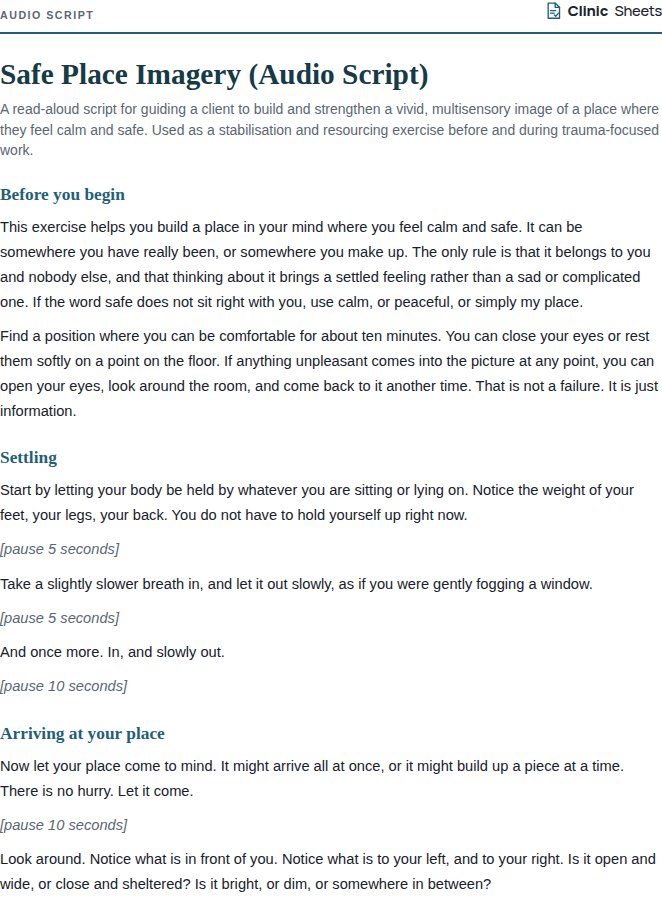
A guided exercise for building a detailed, multisensory image of a place where the client feels calm and safe, and for practising it until it can be called up at will. A core resourcing skill used in EMDR preparation and in trauma-focused CBT.
About this resource
Safe place imagery, sometimes called calm place or peaceful place imagery, is a self-regulation skill in which the client deliberately constructs a vivid mental image of a location associated with safety and calm, engaging as many senses as possible, and then practises returning to it. It is used in the preparation phase of EMDR, where Shapiro's protocol pairs the image with slow bilateral stimulation, and it appears across trauma-focused CBT, hypnotherapy and compassion-focused approaches as a way of giving the client a reliable means of settling arousal.
The rationale is straightforward. Imagery has a strong effect on emotion and on the body; a well-built image of safety produces a measurable settling of arousal in the same way that intrusive trauma images produce a surge of it. With repeated practice the image becomes easier to access and its calming effect becomes more reliable, so that the client has a tool for closing down a difficult session, managing intrusions between sessions, and returning to their window of tolerance after processing work.
The exercise usually takes ten to twenty minutes to build the first time. It is most effective when the client leads the choice of place and the clinician's role is to draw out sensory detail. The professional version includes the EMDR-style cue-word and bilateral stimulation enhancements, guidance on what to do when a client cannot find any place that feels safe (a common and clinically meaningful difficulty), and notes on avoiding places with mixed associations.
How to use it
- Explain the purpose: a place in the mind the client can go to whenever they need to settle. Emphasise that it is for calming, not for avoiding.
- Ask the client to choose a place, real or imagined, with no negative associations. If a real place has any mixed memories, adjust it or choose another. A place with no other people is often easiest.
- Guide the client through the senses one at a time, slowly, asking open questions: what do you see when you look around, what is beneath your feet, what can you hear, what does the air feel like, what do you smell. Let them describe it in their own words.
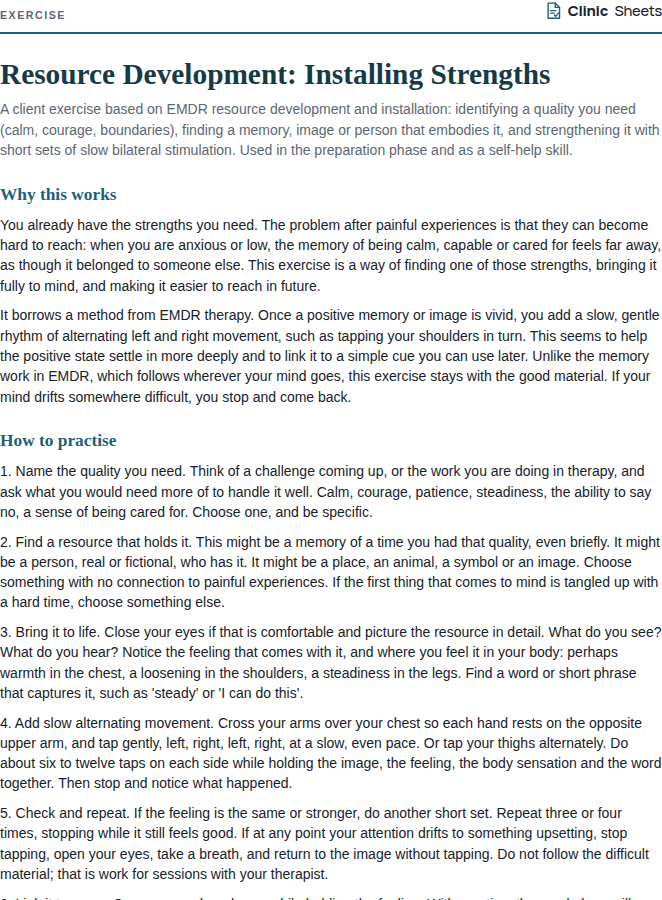
- Ask them to notice where the calm shows up in the body, and to stay with that for a minute. If using EMDR, add a cue word and a few slow sets of bilateral stimulation while they hold the image.
- Test it: ask the client to bring up a mildly unpleasant thought, then return to the safe place and notice the shift. If the image does not hold, strengthen it or choose another.
- Set daily practice for one to two weeks before relying on it in session. Review the practice log.
References
- Shapiro, F. (2018). Eye Movement Desensitization and Reprocessing (EMDR) Therapy: Basic Principles, Protocols, and Procedures (3rd ed.). Guilford Press.
- Hackmann, A., Bennett-Levy, J., & Holmes, E. A. (2011). Oxford Guide to Imagery in Cognitive Therapy. Oxford University Press.
- Korn, D. L., & Leeds, A. M. (2002). Preliminary evidence of efficacy for EMDR resource development and installation in the stabilization phase of treatment of complex posttraumatic stress disorder. Journal of Clinical Psychology, 58(12), 1465-1487.