Informed Consent: What to Expect from CBT
A plain-language handout given at the start of therapy that explains what CBT is, how sessions work, what will be expected of the client, the benefits and possible drawbacks, and the limits of confidentiality, so that consent to treatment is informed.
About this resource
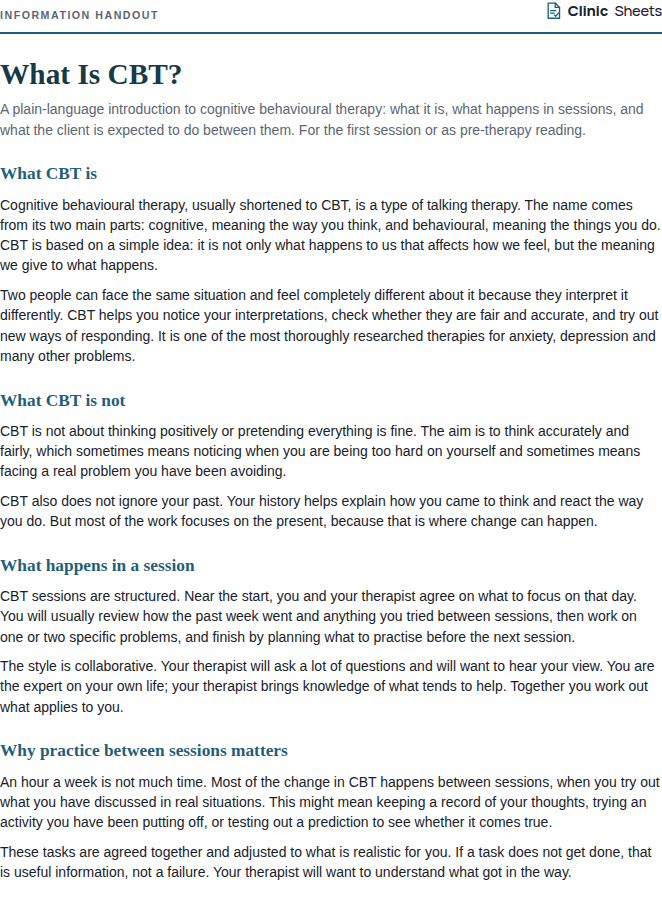
Informed consent to psychological treatment requires that the client understands what the treatment involves, what it is likely to achieve, what the alternatives are, what the risks and discomforts may be, and how their information will be handled. In practice this is often reduced to a signature on a form. A written explanation that the client can take away, read at their own pace and bring questions about does the job better and also begins the psychoeducation that CBT depends on.
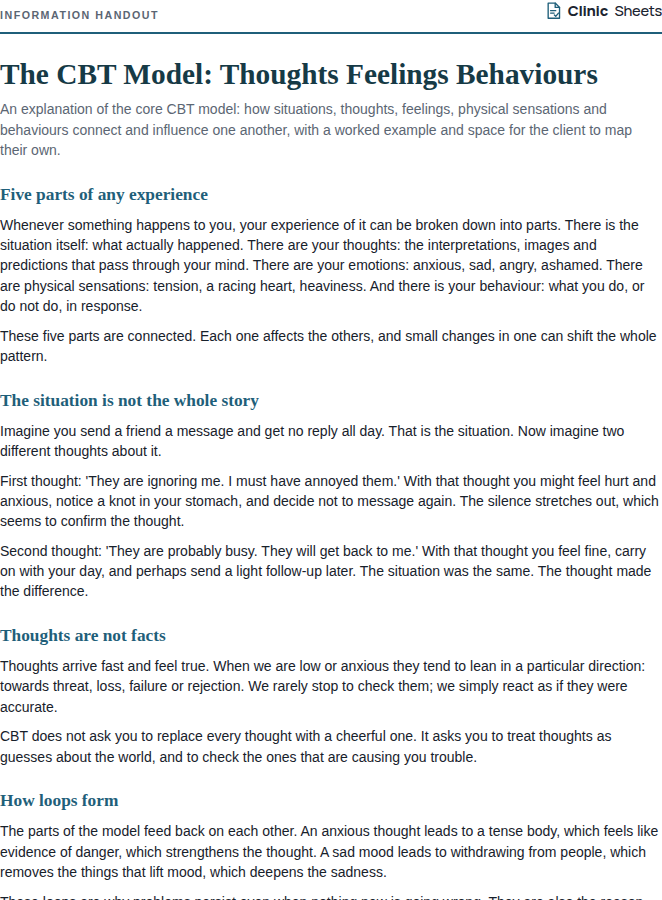
This handout explains CBT in accessible terms: the idea that thoughts, feelings and behaviours affect one another, the collaborative and structured nature of sessions, the central role of between-session practice, the typical length of treatment, and the evidence that it works for a range of problems. It is honest about the demands of the therapy and about the fact that some parts, such as facing feared situations, are uncomfortable by design. It closes with the limits of confidentiality in general terms, which the clinician should supplement with the specific requirements of their province and profession.
The professional version includes a checklist of consent elements, guidance on documenting the consent conversation, and notes on consent with adolescents and with clients who have limited capacity.
How to use it
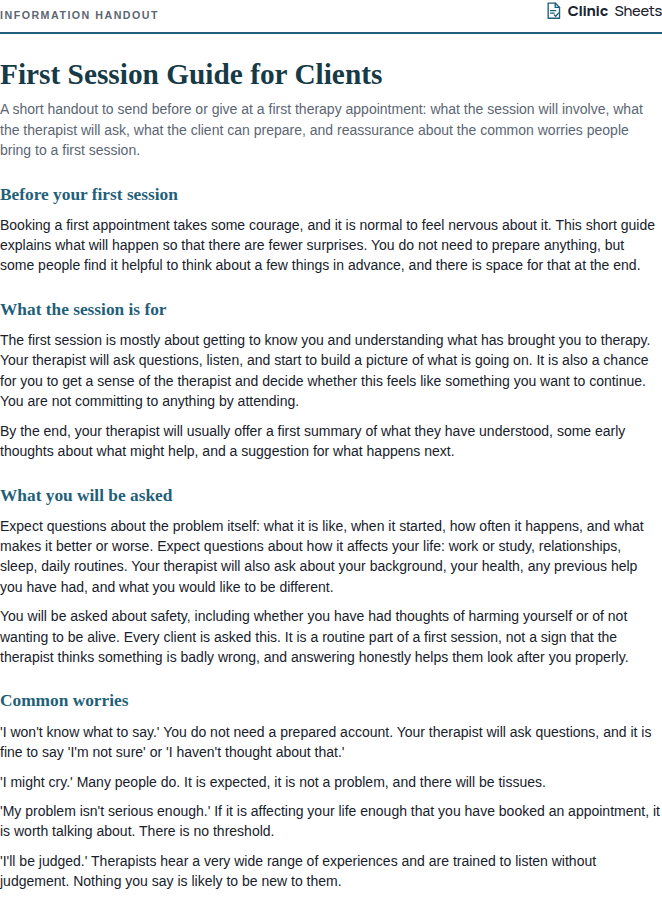
- Give the handout at or before the first session, alongside your practice's consent form and privacy notice. It does not replace either; it explains them.
- In the first session, go through the main points and ask what questions the client has. Pay particular attention to the sections on between-session work and on discomfort, since these are the points at which expectations most often diverge.
- Add the specific confidentiality limits that apply in your jurisdiction and profession, including duty to report and the circumstances in which records may be requested. Say them aloud as well as in writing.
- Ask the client to say back, in their own words, what they understand therapy will involve. This is the best check that consent is informed.
- Document the consent conversation, including any questions raised and how they were answered. Revisit consent if the treatment plan changes substantially.
References
- Beck, J. S. (2020). Cognitive Behavior Therapy: Basics and Beyond (3rd ed.). Guilford Press.
- Hofmann, S. G., Asnaani, A., Vonk, I. J. J., Sawyer, A. T., & Fang, A. (2012). The efficacy of cognitive behavioral therapy: A review of meta-analyses. Cognitive Therapy and Research, 36(5), 427-440.
- Kennerley, H., Kirk, J., & Westbrook, D. (2016). An Introduction to Cognitive Behaviour Therapy: Skills and Applications (3rd ed.). SAGE.