RCADS Child Anxiety and Depression Scale: Scoring and Interpretation Guide
A scoring and interpretation guide to the Revised Child Anxiety and Depression Scale (RCADS), the 47-item youth and parent questionnaire by Chorpita and colleagues. Covers the six subscales, T-score conversion and thresholds, the short form, and how to use the profile in treatment.
About this resource
The RCADS was developed by Bruce Chorpita and colleagues as a revision of Spence's Children's Anxiety Scale, adding a depression subscale so that the two most common presentations in child mental health could be measured together. The full version has 47 statements rated on a four-point frequency scale, and it yields six subscales aligned with DSM categories: separation anxiety, social phobia, generalised anxiety, panic, obsessive-compulsive symptoms, and major depression. There are youth and parent versions, and a 25-item short form. It is free to use, and it is one of the most commonly adopted outcome measures in child and youth services in Canada, the United Kingdom and Australia.
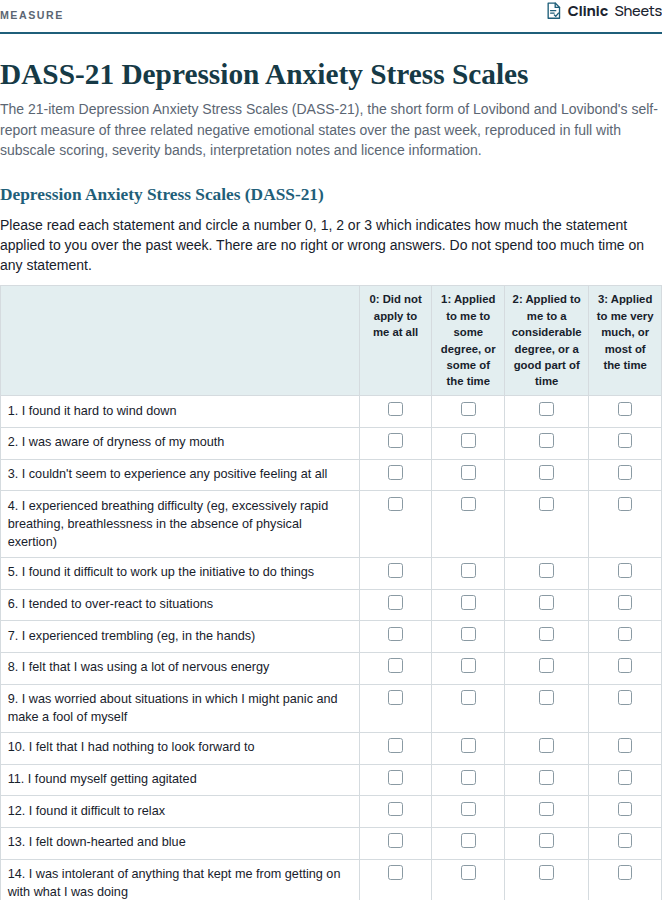
This resource is a scoring and interpretation guide. The RCADS is free to use, but we have not reproduced the 47 items because we could not verify every item's wording to the standard a faithful reproduction requires, and because the norm tables needed to convert raw scores to T-scores are part of the official scoring materials. Use the official questionnaires and scoring programme from the developers, and use this guide to understand and interpret what they produce.
The distinctive feature of the RCADS is that raw scores are converted to T-scores using norms by school grade and gender, so a score is interpreted relative to peers of the same age. A T-score of 65 or above marks the borderline clinical range and 70 or above the clinical range. For clinicians this gives a profile across anxiety and depression at once, which is helpful in adolescents where the two so often overlap. This professional version covers how to read that profile, when to use the short form, and how to feed results back to families.
How to use it
- Obtain the official RCADS youth version (and parent version, RCADS-P, where a caregiver is involved) and the scoring materials from the developers. Choose the full 47-item version for assessment and the 25-item short form for routine session-by-session monitoring.
- Have the young person complete it privately. Score each item 0 to 3 and add the items within each subscale using the official key. Add the five anxiety subscales for the Total Anxiety score, and all six for the Total Anxiety and Depression score.
- Convert raw scores to T-scores using the tables or scoring programme, selecting the young person's grade and gender. Record raw and T-scores for each subscale.
- Interpret using the thresholds in this guide: T of 65 to 69 is borderline, 70 and above is clinical. Read the profile, not just the totals: which subscales are elevated tells you what to assess and treat first.
- Feed the results back in plain language, agree targets, and repeat the measure (usually the short form) regularly to track change.
References
- Chorpita, B. F., Yim, L., Moffitt, C., Umemoto, L. A., & Francis, S. E. (2000). Assessment of symptoms of DSM-IV anxiety and depression in children: A revised child anxiety and depression scale. Behaviour Research and Therapy, 38(8), 835-855.
- Chorpita, B. F., Moffitt, C. E., & Gray, J. (2005). Psychometric properties of the Revised Child Anxiety and Depression Scale in a clinical sample. Behaviour Research and Therapy, 43(3), 309-322.
- Ebesutani, C., Reise, S. P., Chorpita, B. F., Ale, C., Regan, J., Young, J., Higa-McMillan, C., & Weisz, J. R. (2012). The Revised Child Anxiety and Depression Scale-Short Version: Scale reduction via exploratory bifactor modeling of the broad anxiety factor. Psychological Assessment, 24(4), 833-845.