Self-Harm: Understanding Functions and Alternatives (Clinician Guide)
A clinician guide to non-suicidal self-harm: the four-function model, how to assess function with chain analysis, and how to match alternative skills from DBT to the function the self-harm serves. Includes a functional assessment template.
About this resource
Self-harm without suicidal intent is common, particularly in adolescents and young adults, and it is one of the behaviours clinicians find hardest to work with. The most useful frame for treatment is functional: self-harm persists because it does something for the person. Nock and Prinstein's four-function model organises these functions along two dimensions. The reinforcement may be automatic (within the person) or social (involving others), and it may be negative (something unpleasant is removed) or positive (something is gained). Most self-harm is automatically negatively reinforced: it reduces intense emotion, tension or dissociation, quickly and reliably.
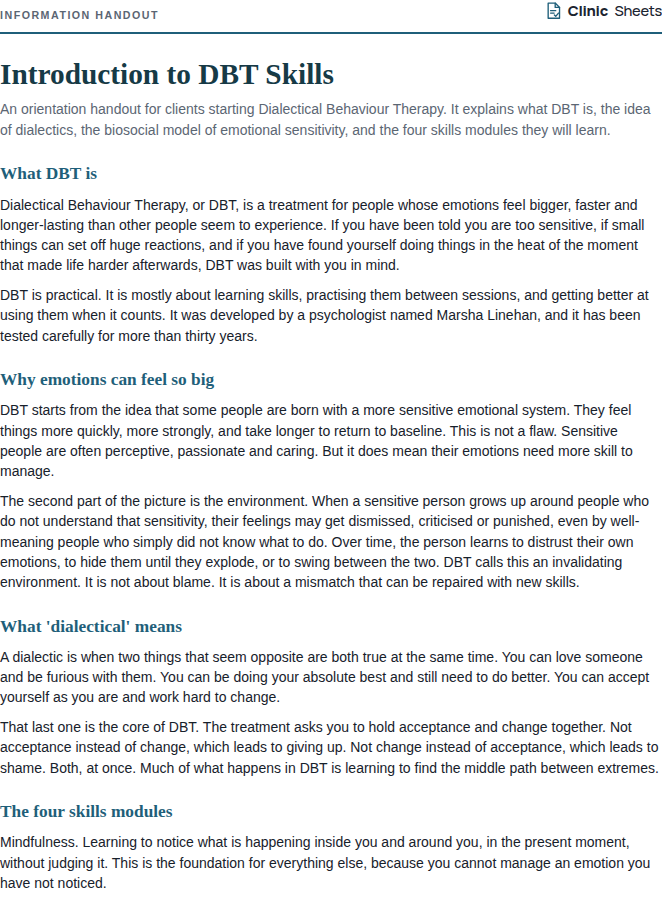
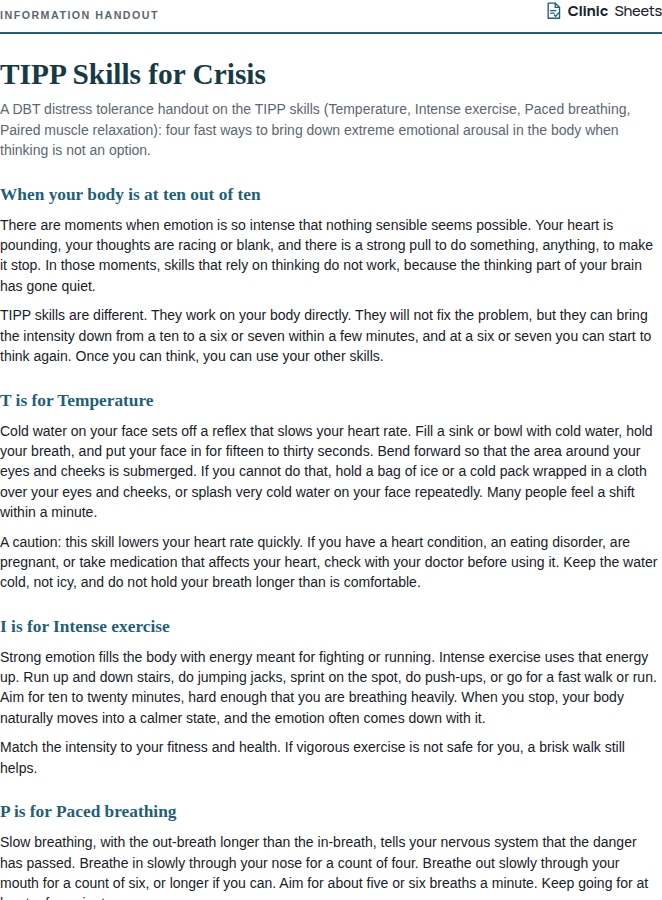
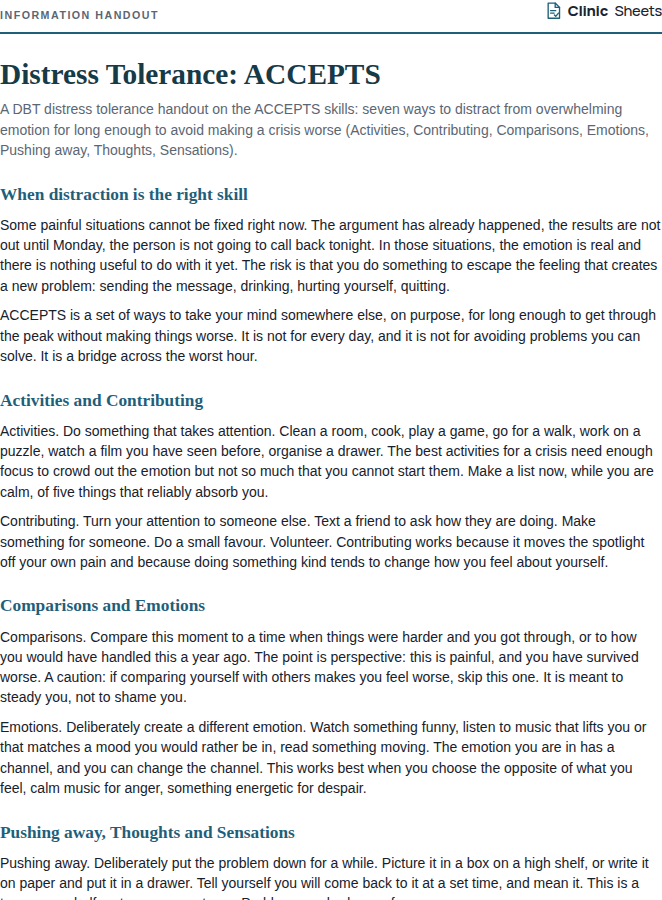
Once the function is understood for a particular person, treatment follows. The person needs other ways of achieving the same thing, and those ways need to be practised until they are available under pressure. DBT provides the largest body of such skills and the strongest evidence base: distress tolerance skills for surviving the moment, emotion regulation skills for reducing vulnerability and changing emotion, interpersonal skills for functions that involve other people, and chain analysis for understanding each episode in enough detail to intervene earlier next time. Experiential avoidance models add that self-harm is often part of a broader pattern of escaping internal experience, and that treatment should widen the person's willingness to feel.
This guide is written for the clinician. It explains the functional model, gives a structure for assessing function, and sets out which skills fit which function. It does not describe methods of self-harm, and the assessment should record only what is clinically necessary about method. The professional version includes guidance on the clinician's own reactions, on working with families, and on the relationship between non-suicidal self-harm and suicide risk.
How to use it
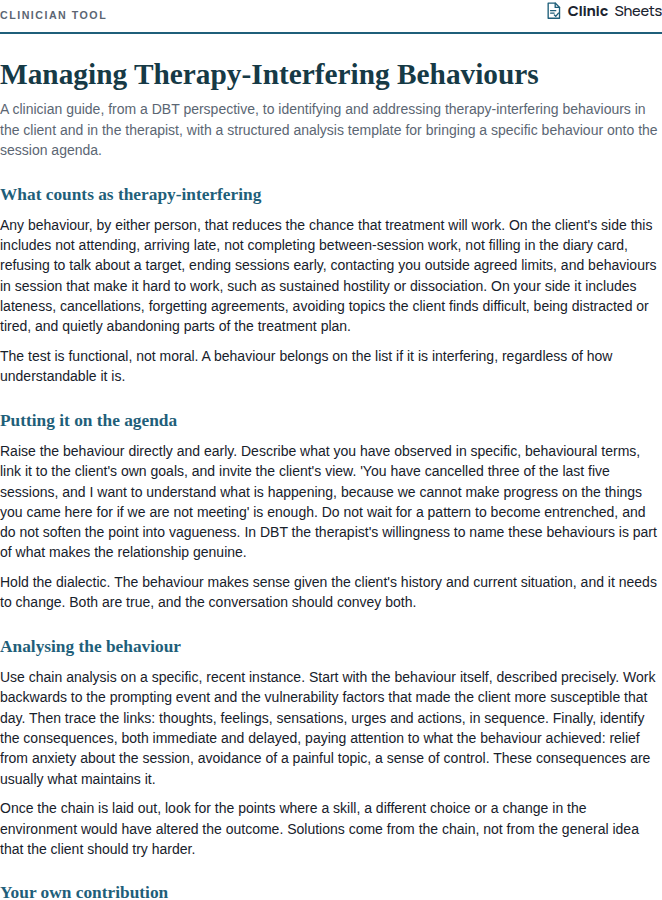
- Assess self-harm with the same calm directness as any other behaviour. Ask what happens before, during and after, and what it does for the person. Avoid expressions of shock or disapproval, which drive the behaviour underground.
- Assess suicide risk separately. Non-suicidal self-harm and suicidal behaviour are distinct, but a history of self-harm raises the risk of later suicide attempts, and the two can co-occur in the same person. Use a risk assessment record and complete a safety plan where indicated.
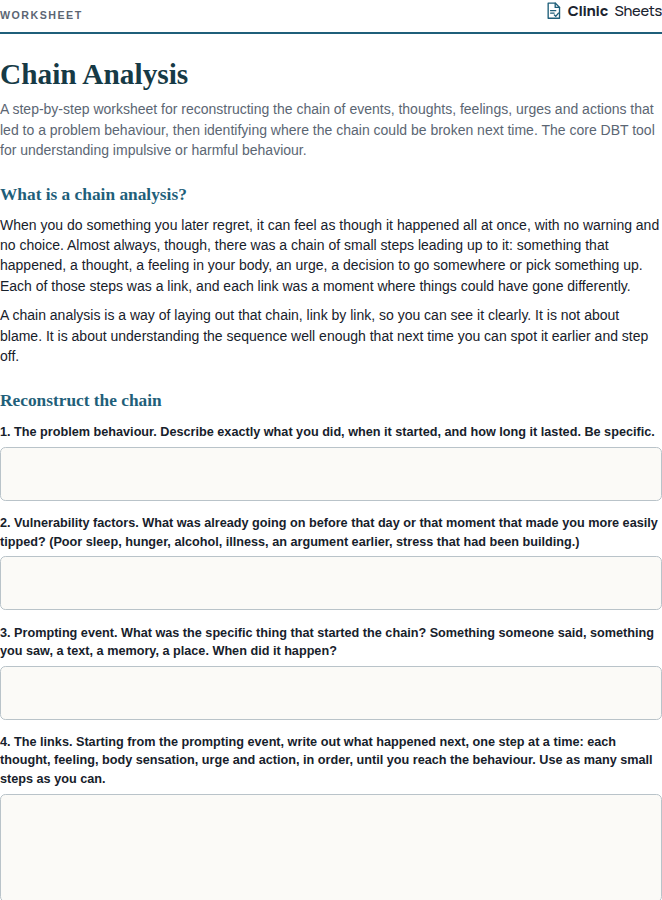
- Complete a chain analysis of a recent episode: the vulnerability factors, the prompting event, the links of thought, feeling, sensation and action leading to the behaviour, and the consequences. The consequences reveal the function.
- Name the function with the client, without judgement. Most people are relieved to hear that their self-harm makes sense and that there are other routes to the same end.
- Select and teach skills matched to the function. Practise them in session, plan when and where they will be used, and expect the first attempts to be only partly effective. Skills replace self-harm gradually, not at once.
- Involve family or partners where appropriate, with consent. Their reactions can strengthen or weaken the social functions, and they need to know what to do after an episode.
- Attend to your own reactions in supervision. Anxiety, frustration and the urge to control are common and, if unexamined, tend to damage the alliance.
References
- Nock, M. K., & Prinstein, M. J. (2004). A functional approach to the assessment of self-mutilative behavior. Journal of Consulting and Clinical Psychology, 72(5), 885-890.
- Nock, M. K. (2010). Self-injury. Annual Review of Clinical Psychology, 6, 339-363.
- Chapman, A. L., Gratz, K. L., & Brown, M. Z. (2006). Solving the puzzle of deliberate self-harm: The experiential avoidance model. Behaviour Research and Therapy, 44(3), 371-394.
- Linehan, M. M. (2015). DBT Skills Training Manual (2nd ed.). Guilford Press.