Mindfulness What and How Skills (DBT)
A handout on the DBT core mindfulness skills: the three 'what' skills (observe, describe, participate) and the three 'how' skills (non-judgementally, one-mindfully, effectively), with everyday ways to practise each.
About this resource
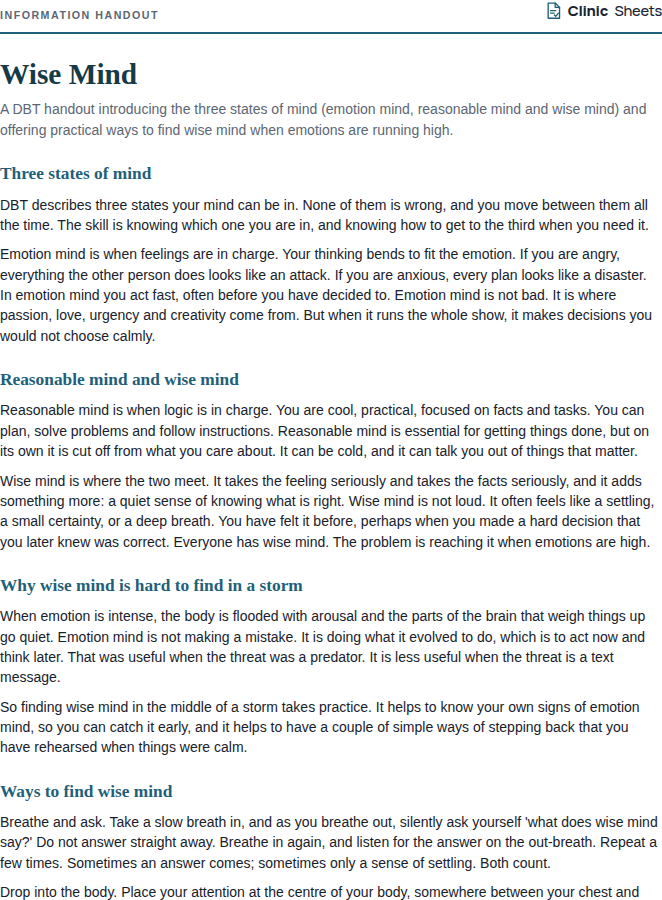
Mindfulness is the core module of Marsha Linehan's DBT skills training and is revisited at the start of every other module. Linehan broke mindfulness down into teachable components: the 'what' skills describe what a person does when being mindful (observe, describe, participate), and the 'how' skills describe the manner in which they do it (non-judgementally, one-mindfully, effectively). The 'what' skills are practised one at a time; the 'how' skills apply to all of them together.
The purpose in DBT is practical: to help clients step back from emotion mind, notice what is happening inside and around them without being swept along by it, and act with awareness. Mindfulness in this sense is a way of accessing wise mind. It underpins emotion regulation (you cannot regulate an emotion you have not noticed), distress tolerance (observing an urge without acting on it) and interpersonal effectiveness (attending to the situation rather than to assumptions).
The professional version adds guidance on teaching each skill with brief in-session exercises, on the common confusion between describing and judging, and on making 'effectively' concrete for clients who prioritise being right over getting what they need.
How to use it
- Teach the 'what' skills first, one per practice. Use short in-session exercises: observing sounds for one minute, describing an object without evaluative words, participating fully in a simple activity such as tossing a ball.
- Then teach the 'how' skills as the manner in which all three are done. Practise turning judgements into descriptions ('this is boring' becomes 'I notice the thought that this is boring, and an urge to check my phone').
- Assign brief daily practices, a few minutes each, and review them at the start of the following session. Ask what was observed rather than whether it 'worked'.
- Link the skills to the client's goals: observing an urge before acting on it, describing an emotion instead of being it, participating in an activity they usually avoid.
- Return to these skills throughout treatment. Each other module begins with a mindfulness practice for this reason.
References
- Linehan, M. M. (2015). DBT Skills Training Manual (2nd ed.). Guilford Press.
- Linehan, M. M. (2015). DBT Skills Training Handouts and Worksheets (2nd ed.). Guilford Press.
- Linehan, M. M. (1993). Cognitive-Behavioral Treatment of Borderline Personality Disorder. Guilford Press.