Mood and Early Warning Signs Monitor
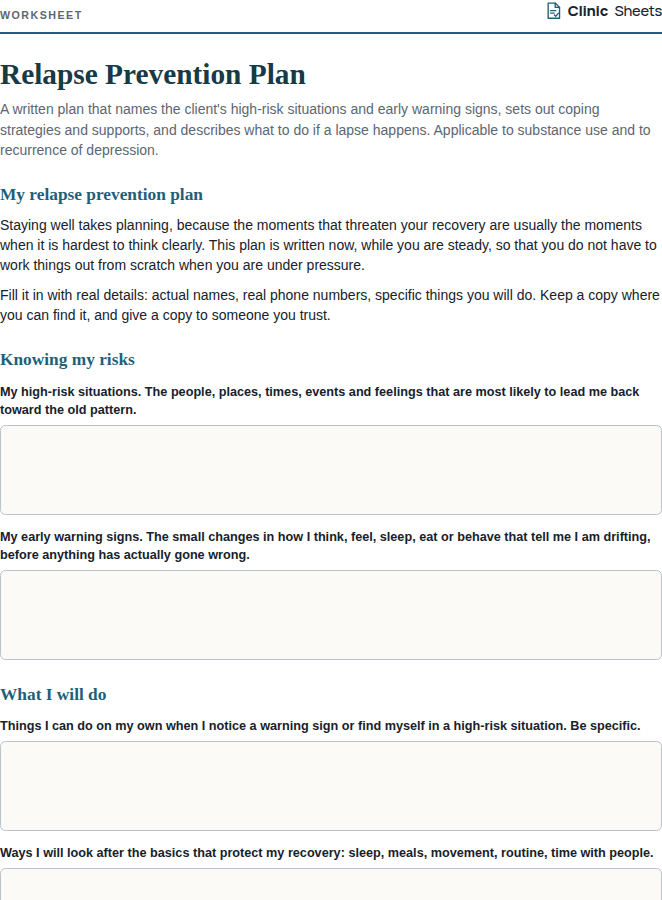
A relapse prevention worksheet for identifying the personal early warning signs of a mood episode, the triggers that tend to precede them, and the actions to take at each stage. For bipolar disorder and recurrent depression.
About this resource
Mood episodes rarely arrive without warning. In bipolar disorder and recurrent depression, most people can identify a characteristic sequence of changes in sleep, energy, thinking, behaviour and social contact that appears days or weeks before a full episode. These changes form a personal 'relapse signature'. Research on early warning sign monitoring, beginning with Perry and colleagues' work on manic prodromes, shows that people who learn their own signature and have a pre-agreed action plan have fewer and shorter episodes, and less time in hospital.
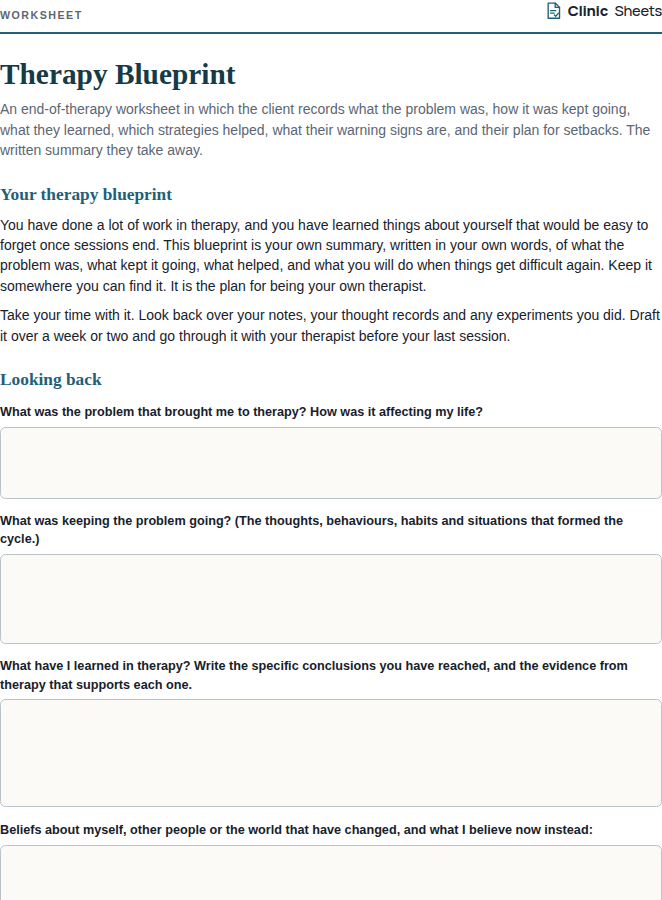
This worksheet guides the client through building that signature. It separates the earliest, subtlest signs from the later, more obvious ones, and links each stage to a concrete response: what the client will do, who they will contact, and what they will ask others to watch for. It covers both low mood and elevated mood so that a single sheet can serve people with bipolar disorder, and it includes a section on triggers because episodes are often preceded by identifiable stressors, sleep disruption or changes in routine.
Use it once the person is reasonably stable and can reflect on past episodes with some distance. It works best when completed across two sessions, with a family member or close friend contributing where the client consents. The professional version adds a clinician guide to distinguishing ordinary mood variation from prodromal change, a list of commonly reported early signs for mania and depression, and notes on integrating the plan with medication management and crisis services.
How to use it
- Review the client's history of episodes together. For the two or three most recent episodes, ask what changed first, what changed next, and what was noticed by others before the client noticed it themselves.
- Sort those changes into early signs (subtle, days to weeks ahead) and later signs (clear, closer to the episode). Keep the language concrete and specific to the client: 'sleeping five hours and feeling fine' rather than 'sleeping less'.
- Identify triggers. Common ones include disrupted sleep, shift work, travel across time zones, conflict, substance use, seasonal change and stopping medication. Record the ones that apply.
- Agree an action for each stage. Early actions are usually about restoring routine and sleep, reducing stimulation, and contacting the clinician. Later actions involve treatment changes and safety steps.
- With consent, invite a trusted person to review the sheet and add signs they notice. Agree how they will raise it, since being told 'you seem high' can be heard as criticism.
- Give the client a copy and revisit it every few months and after any episode, updating the signature with anything learned.
References
- Perry, A., Tarrier, N., Morriss, R., McCarthy, E., & Limb, K. (1999). Randomised controlled trial of efficacy of teaching patients with bipolar disorder to identify early symptoms of relapse and obtain treatment. BMJ, 318(7177), 149-153.
- Lam, D. H., Jones, S. H., & Hayward, P. (2010). Cognitive Therapy for Bipolar Disorder: A Therapist's Guide to Concepts, Methods and Practice (2nd ed.). Wiley-Blackwell.
- Morriss, R. K., Faizal, M. A., Jones, A. P., Williamson, P. R., Bolton, C., & McCarthy, J. P. (2007). Interventions for helping people recognise early signs of recurrence in bipolar disorder. Cochrane Database of Systematic Reviews, (1), CD004854.
- Basco, M. R., & Rush, A. J. (2005). Cognitive-Behavioral Therapy for Bipolar Disorder (2nd ed.). Guilford Press.