Needle and Blood Phobia: Applied Tension
A step-by-step exercise teaching applied tension, the muscle-tensing technique that prevents fainting in blood, injury and needle phobia, with a plan for combining it with graded exposure. For adults and adolescents.
About this resource
Blood-injection-injury phobia is unusual among phobias because it involves a distinctive physical response. Many people with this fear show an initial rise in heart rate and blood pressure followed by a sharp drop (a vasovagal response), which can lead to light-headedness and fainting. Standard relaxation-based approaches can make this worse because they lower blood pressure further. Applied tension, developed by Öst and Sterner, counters the drop by having the person tense the large muscles of the arms, torso and legs, which raises blood pressure and keeps blood flowing to the brain.
This exercise teaches the technique in the standard sequence: learning the tension cycle, practising it daily until it is automatic, learning to recognise the earliest signs of the blood pressure drop, and then applying it during graded exposure to blood, injections, medical settings and, where relevant, actual procedures. It is suitable for adults and adolescents and is often completed in a small number of sessions.
The professional version adds guidance on identifying whether the client has a fainting history (applied tension is most relevant when they do), on building the exposure hierarchy, and on liaising with medical staff for supervised needle exposures.
How to use it
- Assess the fainting history. Ask whether the client has fainted or felt close to fainting around blood, injections or injury. If yes, applied tension is the first-line technique. If the fear is present without any fainting tendency, standard graded exposure without tension is appropriate.
- Teach the tension cycle in session and watch the client do it. Common errors are tensing the face or holding the breath; the tension should be in the arms, chest, abdomen and legs, with normal breathing.
- Assign daily practice for about a week (five cycles, several times a day) before starting exposure, so that the technique is well learned when it is needed.
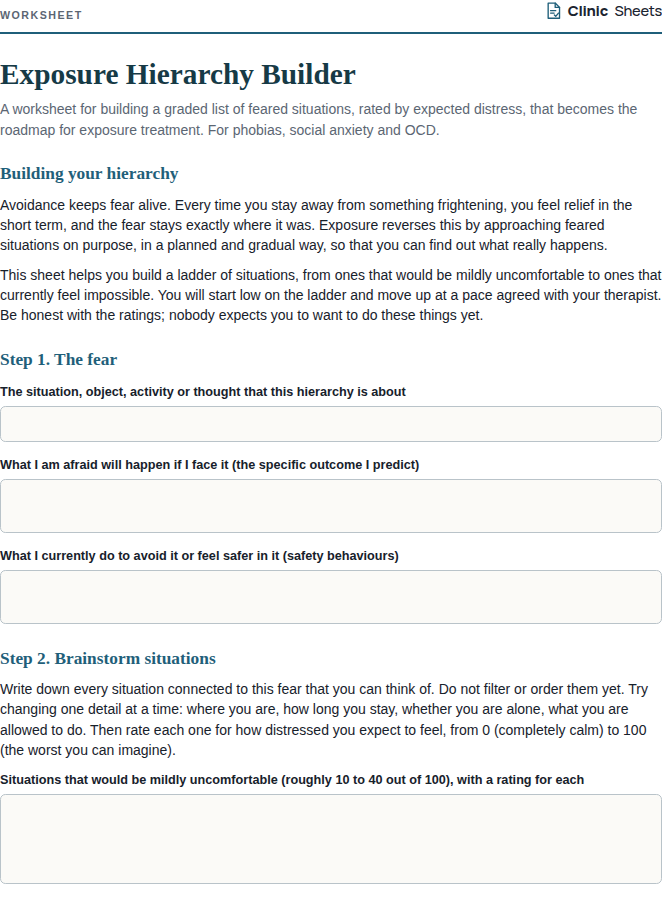
- Build a hierarchy from photographs and videos of blood and injections, through handling needles and visiting a clinic, to a blood draw or injection. Have the client apply tension at the first sign of light-headedness during each step.
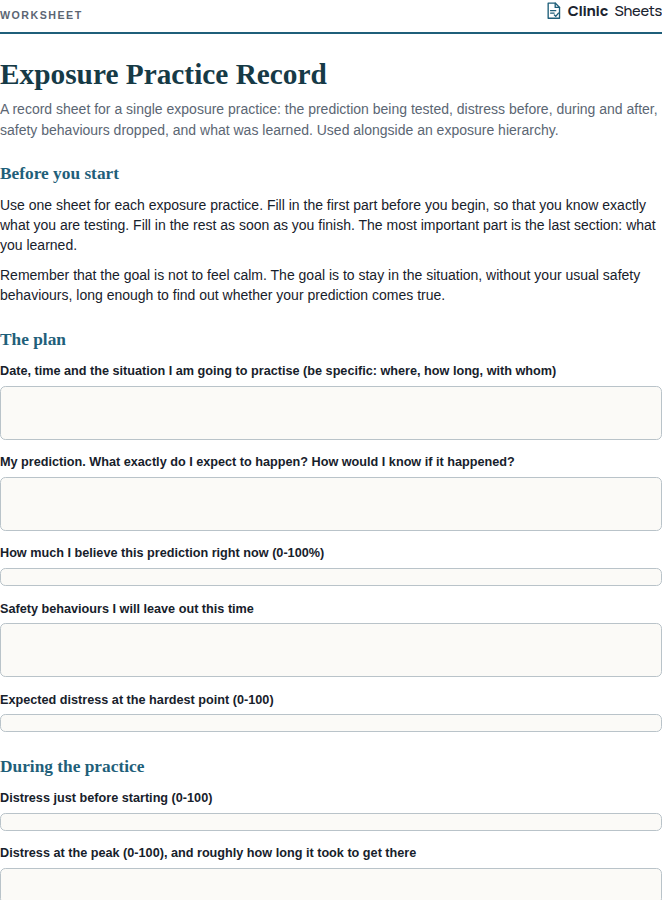
- Where possible, arrange a supervised final exposure such as a blood test or vaccination, and debrief afterwards using the practice log.
References
- Öst, L.-G., & Sterner, U. (1987). Applied tension: A specific behavioral method for treatment of blood phobia. Behaviour Research and Therapy, 25(1), 25-29.
- Öst, L.-G., Fellenius, J., & Sterner, U. (1991). Applied tension, exposure in vivo, and tension-only in the treatment of blood phobia. Behaviour Research and Therapy, 29(6), 561-574.
- Abramowitz, J. S., Deacon, B. J., & Whiteside, S. P. H. (2019). Exposure Therapy for Anxiety: Principles and Practice (2nd ed.). Guilford Press.