PC-PTSD-5 Screener
The Primary Care PTSD Screen for DSM-5 (PC-PTSD-5), a five-item yes/no screen with a trauma exposure gate, reproduced in full with the recommended cut-off, interpretation notes and source information.
About this resource
The PC-PTSD-5 is a brief screen for probable posttraumatic stress disorder designed for primary care and other busy settings. It begins with a single question establishing whether the person has ever experienced a traumatic event, with examples. If they have not, the screen ends with a score of zero. If they have, five yes/no items ask about the past month: intrusion, avoidance, hyperarousal, numbing or detachment, and guilt or blame. The total is the number of 'yes' answers, from 0 to 5.
The screen was developed and validated by Prins and colleagues (2016) in a sample of US veterans attending primary care, against a structured diagnostic interview. In that study a cut-off of 3 was recommended as optimally sensitive for identifying probable PTSD, with a cut-off of 4 providing the best overall efficiency. Services may choose between them depending on whether missing cases or generating false positives is the greater concern.
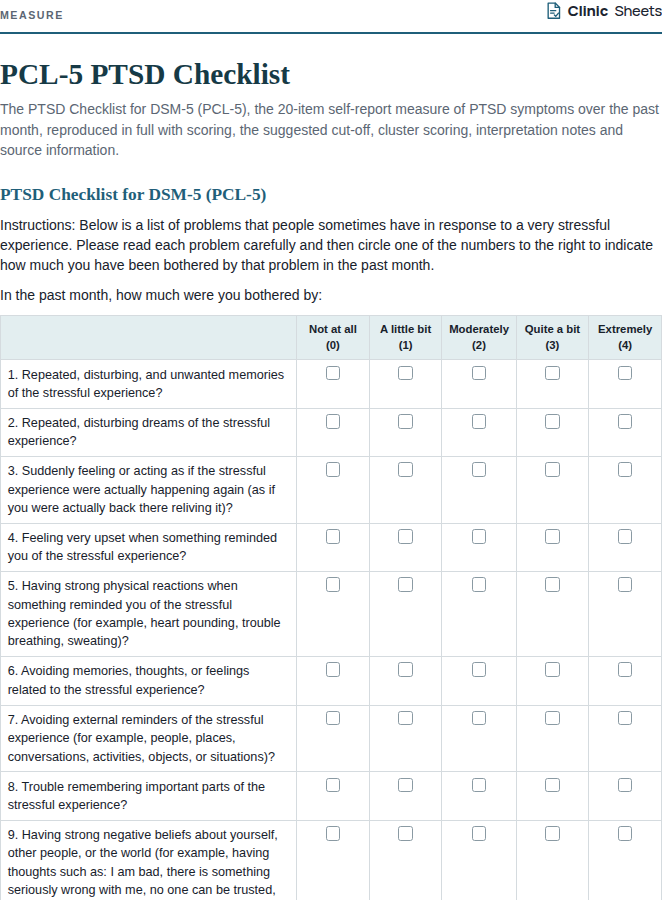
The professional version adds the scoring table, guidance on the two-stage screening approach (PC-PTSD-5, then PCL-5 and interview), and the limitations of a five-item screen. It replaces the earlier four-item PC-PTSD, which was based on DSM-IV.
The instrument is reproduced here because it was developed by US government employees and is in the public domain.
How to use it
- Ask the trauma exposure question first. If the answer is no, record a score of 0 and stop. If yes, ask the five items about the past month.
- Score one point for each 'yes'. The total ranges from 0 to 5.
- Treat a score of 3 or more as a positive screen. Follow a positive screen with the PCL-5 and a clinical interview; do not diagnose PTSD from the screen alone.
- If your service prefers fewer false positives, a cut-off of 4 can be used, at some cost to sensitivity.
- A positive screen or a disclosure of trauma should prompt a sensitive conversation about what happened, how the person is coping now, and any current risk, including suicidal thoughts.
References
- Prins, A., Bovin, M. J., Smolenski, D. J., Marx, B. P., Kimerling, R., Jenkins-Guarnieri, M. A., Kaloupek, D. G., Schnurr, P. P., Kaiser, A. P., Leyva, Y. E., & Tiet, Q. Q. (2016). The Primary Care PTSD Screen for DSM-5 (PC-PTSD-5): Development and evaluation within a veteran primary care sample. Journal of General Internal Medicine, 31(10), 1206-1211.
- Weathers, F. W., Litz, B. T., Keane, T. M., Palmieri, P. A., Marx, B. P., & Schnurr, P. P. (2013). The PTSD Checklist for DSM-5 (PCL-5). National Center for PTSD.