Window of Tolerance
A handout explaining the window of tolerance: the zone of arousal in which a person can think, feel and function, and the hyperarousal and hypoarousal states that lie outside it. Helps clients recognise where they are and understand the goal of regulation skills.
About this resource
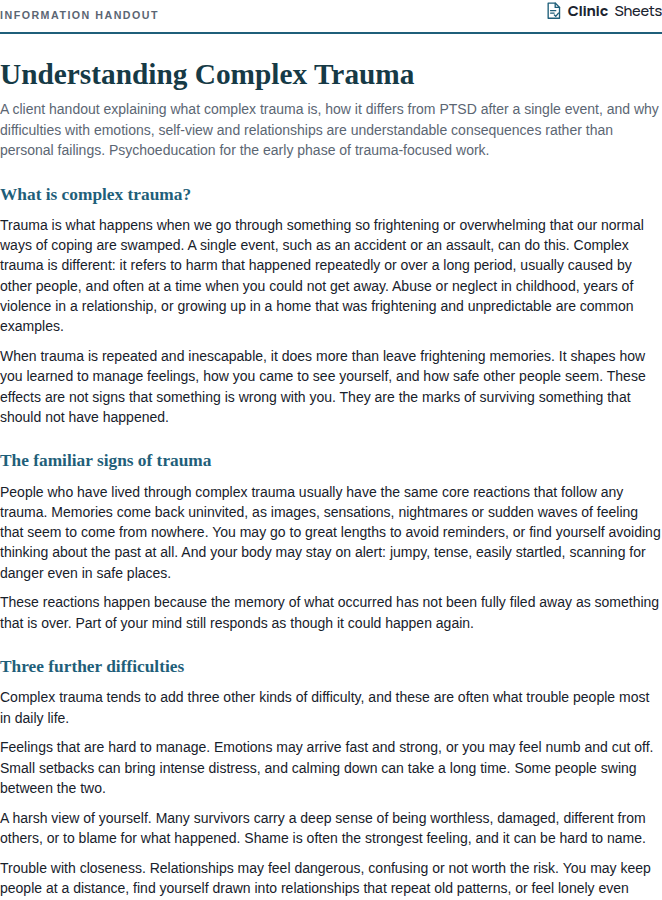
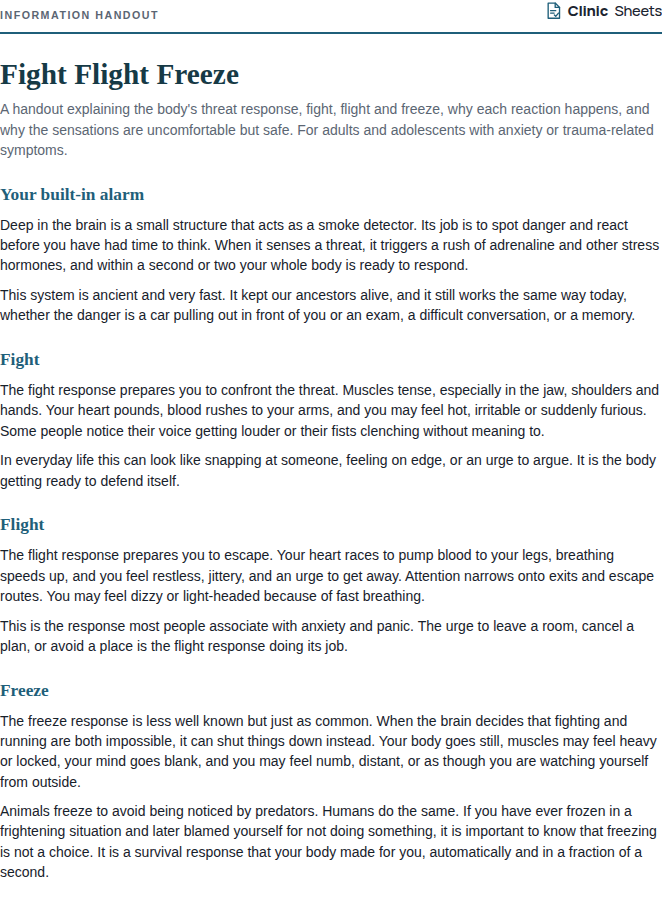
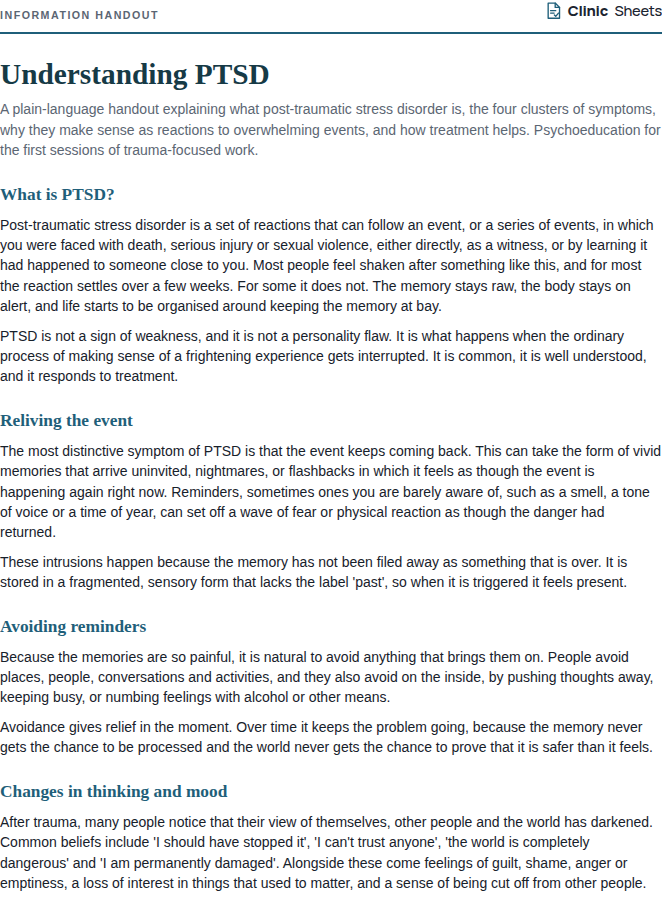
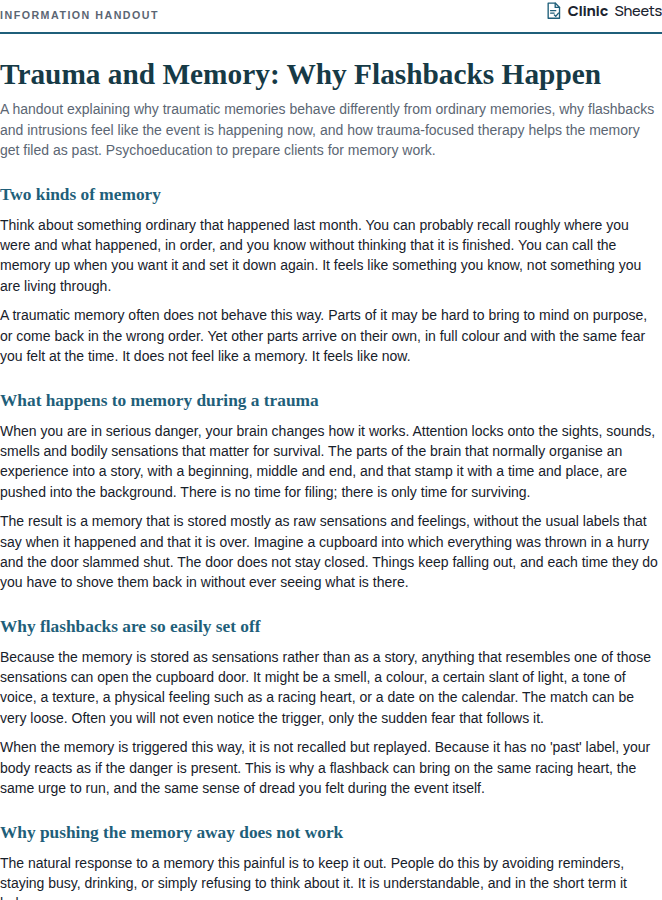
The window of tolerance, a term introduced by Daniel Siegel and developed within trauma treatment by Pat Ogden and others, describes the band of physiological and emotional arousal within which a person can process information and respond flexibly to what is happening. Above the window is hyperarousal: the fight-or-flight state of racing thoughts, panic, anger, and the urge to act. Below the window is hypoarousal: the shutdown state of numbness, fogginess, disconnection, and collapse. Both are survival responses, and both make reflection, learning and connection very difficult.
Trauma tends to narrow the window and to make the person leave it more easily and more often. Clients often experience these shifts as unpredictable and shameful. Presenting the three-zone model gives them a map. They can begin to name which state they are in, notice the early signs of leaving the window, and understand that different states call for different skills: settling techniques for hyperarousal, activating techniques for hypoarousal. It also gives the clinician and client a shared language for pacing trauma work, which should take place at the edge of the window rather than outside it.
The handout is written for adults with trauma histories or emotion regulation difficulties and pairs naturally with Grounding Techniques and with DBT distress tolerance skills. The professional version adds notes on tracking arousal in session, on the mixed states that clients sometimes describe, and on using the model to explain why memory processing is paced the way it is.
How to use it
- Introduce the model in the stabilisation phase, before trauma processing. Draw the three zones on paper or a whiteboard as you explain them.
- Ask the client to describe what each zone looks and feels like for them, in their own words, and write their descriptions on the diagram. Personalised markers make the map usable.
- Identify the early warning signs of leaving the window in each direction, and pair each direction with two or three skills the client already has or will learn.
- Use the model in session: check in on where the client is at the start, and when arousal shifts during difficult material, name it and pause to regulate before continuing.
- Ask the client to track their zone a few times a day for a week, noting what pushed them out and what helped them back. Review the patterns together.
References
- Siegel, D. J. (2020). The Developing Mind: How Relationships and the Brain Interact to Shape Who We Are (3rd ed.). Guilford Press.
- Ogden, P., Minton, K., & Pain, C. (2006). Trauma and the Body: A Sensorimotor Approach to Psychotherapy. W. W. Norton.
- Corrigan, F. M., Fisher, J. J., & Nutt, D. J. (2011). Autonomic dysregulation and the window of tolerance model of the effects of complex emotional trauma. Journal of Psychopharmacology, 25(1), 17-25.