Understanding Complex Trauma
A client handout explaining what complex trauma is, how it differs from PTSD after a single event, and why difficulties with emotions, self-view and relationships are understandable consequences rather than personal failings. Psychoeducation for the early phase of trauma-focused work.
About this resource
Complex trauma refers to exposure to repeated or prolonged traumatic events, typically interpersonal and often beginning in childhood, from which escape was difficult or impossible: abuse or neglect within the family, long-term domestic violence, captivity, or sustained exposure to violence. Complex PTSD, recognised in ICD-11, describes the presentation that can follow: the core PTSD symptoms of re-experiencing, avoidance and a persistent sense of current threat, together with three additional 'disturbances in self-organisation': difficulty regulating emotions, a persistently negative view of the self marked by shame and worthlessness, and difficulty feeling close to others.
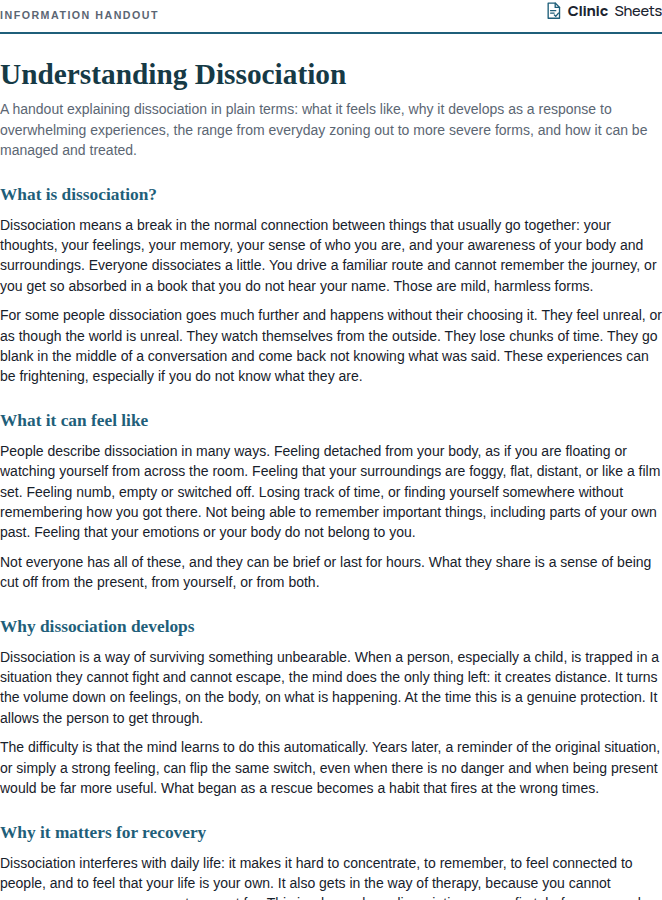
This handout explains these features to the client in ordinary language and frames each one as an adaptation to an environment that was unsafe. It also introduces dissociation as a common survival response and normalises the mixed feelings many survivors have towards people who harmed them. The aim is to give the client a coherent account of their difficulties that reduces shame and makes the rationale for phased treatment (stabilisation and skills, memory-focused work, reconnection) understandable.
The professional version notes that complex PTSD is a formulation to be reached carefully, that many clients with these histories do well in standard trauma-focused CBT or EMDR without a lengthy stabilisation phase, and that the decision about pacing should rest on current risk, dissociation and the client's ability to stay present rather than on history alone.
How to use it
- Use after assessment, once you have a shared understanding of the client's history and current difficulties and have discussed the general plan of treatment.
- Read it together or ask the client to read it before the next session. Invite them to mark which parts fit and which do not. Not every feature applies to every person, and the handout should be adapted rather than imposed.
- Use the 'survival responses' section to open a discussion about how the client's current difficulties once made sense. This is often the moment shame begins to shift.
- Link the handout to the treatment plan: which skills will come first, when memory work will begin, and how the client will keep a say in the pace.
- Return to the handout when the client blames themselves for symptoms, as a reminder of the model you agreed together.
References
- Cloitre, M., Garvert, D. W., Brewin, C. R., Bryant, R. A., & Maercker, A. (2013). Evidence for proposed ICD-11 PTSD and complex PTSD: A latent profile analysis. European Journal of Psychotraumatology, 4, 20706.
- Courtois, C. A., & Ford, J. D. (Eds.). (2009). Treating Complex Traumatic Stress Disorders: An Evidence-Based Guide. Guilford Press.
- Herman, J. L. (1992). Trauma and Recovery: The Aftermath of Violence, from Domestic Abuse to Political Terror. Basic Books.
- Ehlers, A., & Clark, D. M. (2000). A cognitive model of posttraumatic stress disorder. Behaviour Research and Therapy, 38(4), 319-345.