Perceived Stress Scale: Scoring and Interpretation Guide
A clinician's guide to scoring and interpreting Sheldon Cohen's Perceived Stress Scale (PSS), the most widely used measure of how stressful a person appraises their life to be. Covers the 10-, 14- and 4-item versions, reverse scoring, norms, the commonly used bands, and use in stress and burnout work.
About this resource
The Perceived Stress Scale was published by Sheldon Cohen, Tom Kamarck and Robin Mermelstein in 1983. Its premise comes from the transactional model of stress: what matters for health is not the number of events a person faces but the degree to which they appraise their life as unpredictable, uncontrollable and overloaded. The items ask how often, over the last month, the person has felt that way, with a mix of negatively worded items (feeling upset, unable to control important things, nervous and stressed, overwhelmed by difficulties) and positively worded items (feeling confident about handling problems, on top of things, that things were going their way). The original scale had 14 items; the 10-item version (PSS-10) is now the standard, and a 4-item version exists for very brief use.
This resource is a scoring and interpretation guide. The PSS is copyrighted by Dr. Cohen, who permits its use without charge for non-commercial academic research and educational purposes; it is not reproduced here. The guide covers the response format, reverse scoring (the most common source of error), the general population norms published by Cohen and Williamson (1988), and the low, moderate and high bands that many services use. It is important to know that those bands are conventions, not validated clinical cut-offs: the PSS was never designed as a diagnostic screen and has no published diagnostic threshold.
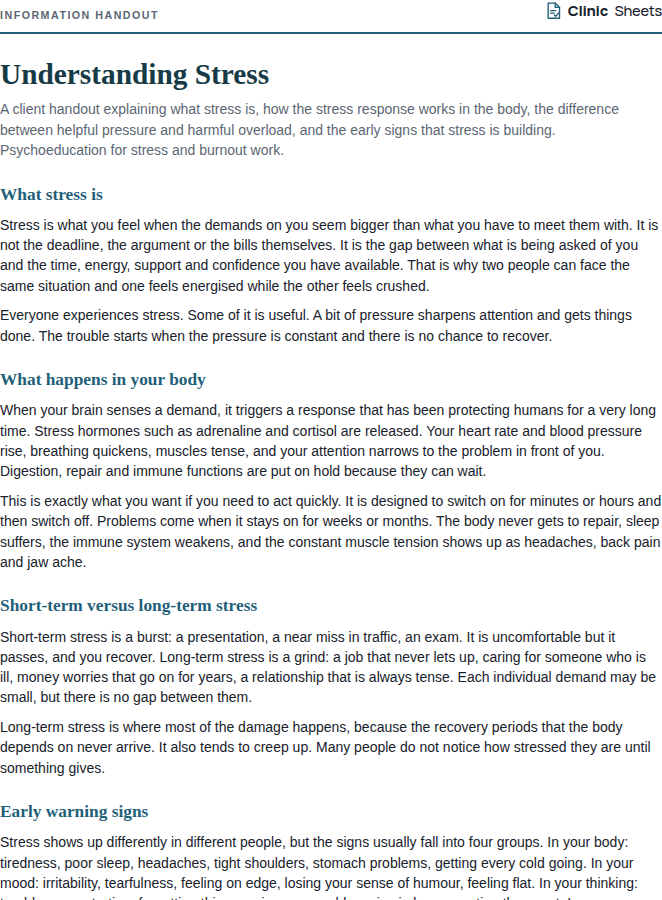
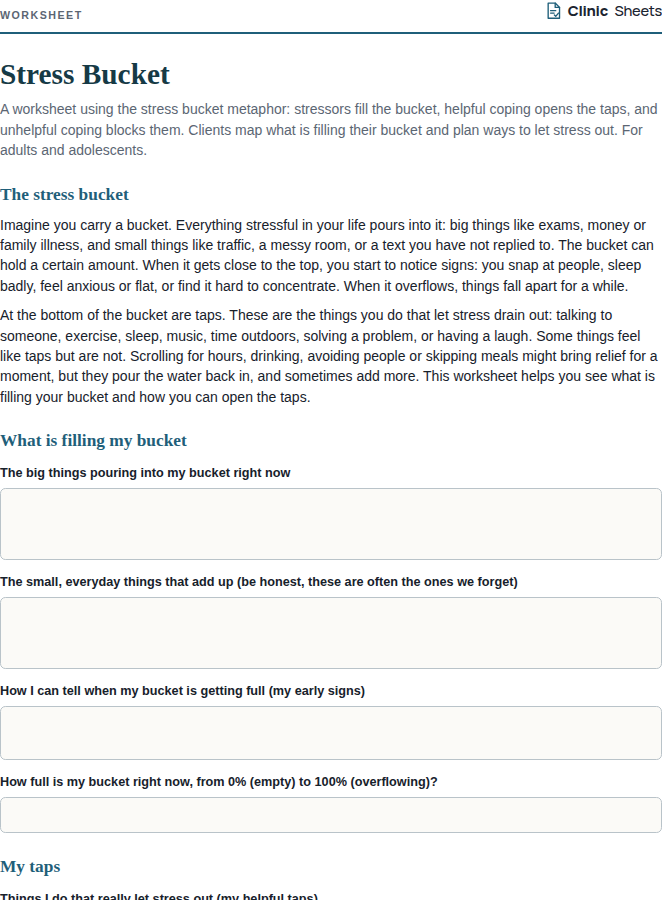
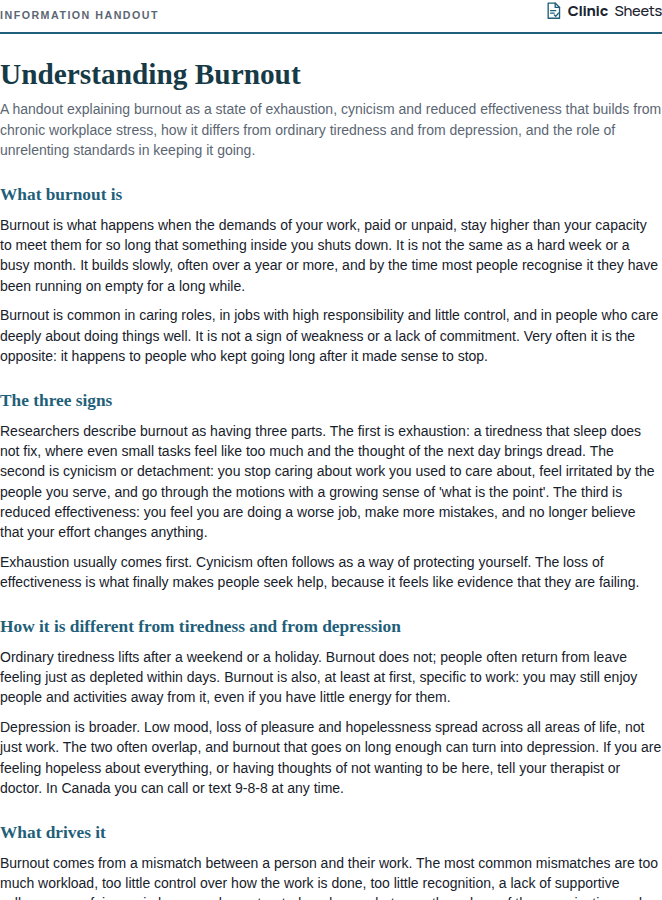
For clinicians working with stress and burnout, the PSS is a good measure of appraisal and a good way to track whether stress-management work is changing how the person experiences their load. It pairs well with a measure of mood, since perceived stress and depression overlap substantially, and with the WHO-5 as a positive counterpart.
How to use it
- Obtain the official PSS-10 from Dr. Cohen's laboratory at Carnegie Mellon University. Give it at assessment and again every few weeks during stress or burnout work.
- Score carefully. Four of the ten items are positively worded and must be reversed before adding (0 becomes 4, 1 becomes 3, and so on). The official scoring instructions identify which items. Total range is 0 to 40.
- Compare the total to the norms and bands in this guide, and explain to the client that the score describes how out of control and overloaded life has felt over the past month, not whether they have a disorder.
- Use the individual items to open the conversation: which situations felt uncontrollable, and what would 'on top of things' look like? These map directly onto problem-solving, boundaries and cognitive work.
- Repeat and plot the score. Because the scale asks about the last month, allow at least four weeks between administrations for a meaningful comparison.
References
- Cohen, S., Kamarck, T., & Mermelstein, R. (1983). A global measure of perceived stress. Journal of Health and Social Behavior, 24(4), 385-396.
- Cohen, S., & Williamson, G. M. (1988). Perceived stress in a probability sample of the United States. In S. Spacapan & S. Oskamp (Eds.), The social psychology of health (pp. 31-67). Sage.
- Lazarus, R. S., & Folkman, S. (1984). Stress, appraisal, and coping. Springer.