Stress Bucket
A worksheet using the stress bucket metaphor: stressors fill the bucket, helpful coping opens the taps, and unhelpful coping blocks them. Clients map what is filling their bucket and plan ways to let stress out. For adults and adolescents.
About this resource
The stress bucket is a widely used teaching metaphor derived from the stress-vulnerability model described by Zubin and Spring and later adapted for clinical education by Brabban and Turkington. Each person has a bucket of a certain size, representing their capacity to carry stress. Life events, daily hassles and ongoing pressures pour in. Coping strategies act as taps at the bottom that let stress drain out. When the water rises above the rim, symptoms appear: irritability, poor sleep, anxiety, low mood, or a return of an earlier problem. Some coping strategies, such as drinking, avoidance or overworking, seem to open a tap but actually recirculate water back into the bucket.
The metaphor works because it is simple, visual and non-blaming. It explains why a small event can tip someone over when the bucket is already full, why a person may cope with a great deal at one time and very little at another, and why reducing input and improving drainage are both legitimate targets. It is easily understood by adolescents and is a useful shared language between client, family and clinician.
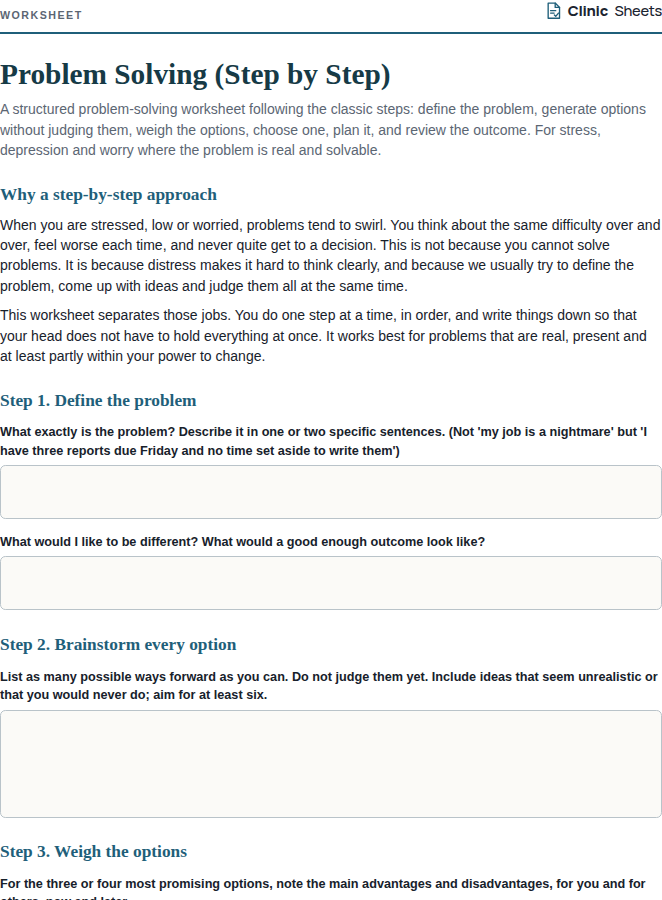
The professional version includes a drawn bucket for in-session use, notes on adapting the language for younger clients, and guidance on using the worksheet to introduce problem solving (for stressors that can be changed) and relaxation or acceptance skills (for those that cannot).
How to use it
- Draw a bucket on paper or a whiteboard and explain the metaphor briefly: what goes in, what lets it out, and what happens when it overflows.
- Ask the client to list what is currently filling their bucket. Include the small daily hassles as well as the big things; the small ones are often forgotten and add up.
- Ask what their bucket looks like when it is overflowing. This becomes their personal early warning list.
- List the taps they already use. Distinguish those that really let stress out from those that feel like relief but pour water back in.
- Agree one input to reduce and one tap to open more often in the coming week. Keep it small and specific.
- For adolescents, invite them to draw their own bucket and use their own words for the inputs and taps. Parents can complete one alongside if useful.
References
- Zubin, J., & Spring, B. (1977). Vulnerability: A new view of schizophrenia. Journal of Abnormal Psychology, 86(2), 103-126.
- Brabban, A., & Turkington, D. (2002). The search for meaning: Detecting congruence between life events, underlying schema and psychotic symptoms. In A. P. Morrison (Ed.), A Casebook of Cognitive Therapy for Psychosis (pp. 59-75). Brunner-Routledge.
- Lazarus, R. S., & Folkman, S. (1984). Stress, Appraisal, and Coping. Springer.