Understanding Stress
A client handout explaining what stress is, how the stress response works in the body, the difference between helpful pressure and harmful overload, and the early signs that stress is building. Psychoeducation for stress and burnout work.
About this resource
Stress is best understood not as a property of events but as a relationship between the demands a person faces and the resources they believe they have to meet them. This is the core of Lazarus and Folkman's transactional model: the same deadline is exhilarating to one person and crushing to another, and the difference lies in appraisal. The physiological stress response itself is adaptive in the short term, mobilising energy and attention, but when it is switched on for weeks or months without recovery it begins to erode sleep, mood, concentration, immune function and relationships.
This handout gives clients a clear, non-alarming account of what happens in the body under stress, distinguishes acute from chronic stress, and introduces the demands-and-resources idea so that the client can start to see their situation as something with adjustable parts rather than a fixed burden. It also lists the common early warning signs across body, mood, thinking and behaviour so that the client can recognise their own pattern.
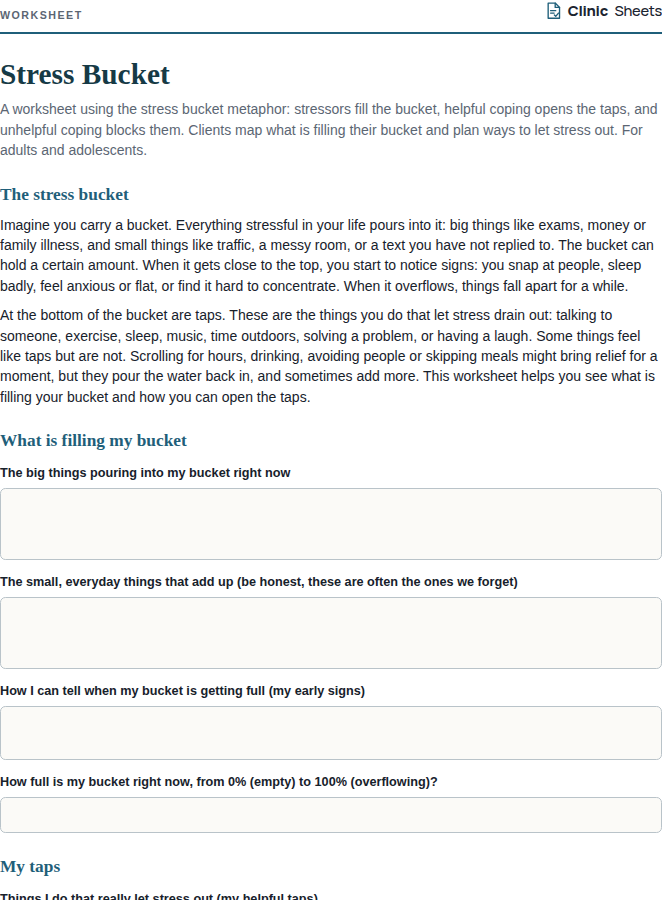
The professional version adds notes on differentiating chronic stress from anxiety disorders and depression, guidance on screening for burnout in clients who present with 'just stress', and prompts for exploring the client's appraisals and coping style. It pairs naturally with the Stress Bucket worksheet and Problem Solving (Step by Step).
How to use it
- Use early in treatment for clients presenting with stress, overload or early burnout, ideally after they have described their current demands.
- Read the section on the stress response together and ask the client which physical signs they recognise. Many clients have been attributing these to illness or personal weakness.
- Introduce the demands-and-resources idea and ask the client to list both sides for their own situation. This becomes the basis for the Stress Bucket worksheet.
- Use the warning signs section to agree an early-detection plan: which two or three signs will tell the client that stress is building before it becomes a crisis?
- Follow with problem solving for demands that can be changed, and with acceptance or relaxation work for those that cannot.
References
- Lazarus, R. S., & Folkman, S. (1984). Stress, Appraisal, and Coping. Springer.
- McEwen, B. S. (1998). Protective and damaging effects of stress mediators. New England Journal of Medicine, 338(3), 171-179.
- Sapolsky, R. M. (2004). Why Zebras Don't Get Ulcers (3rd ed.). Henry Holt.
- Cohen, S., Janicki-Deverts, D., & Miller, G. E. (2007). Psychological stress and disease. JAMA, 298(14), 1685-1687.