Perfectionism Behavioural Experiments
A worksheet for designing, running and reviewing behavioural experiments that test perfectionistic predictions: what actually happens when a standard is deliberately lowered, a check is skipped, or a task is done to 'good enough'.
About this resource
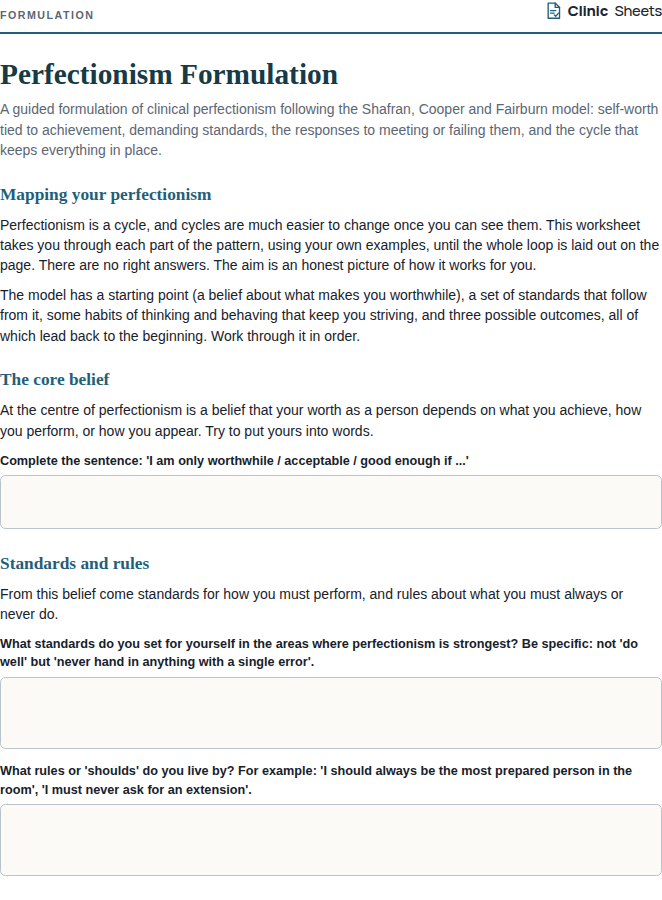
Behavioural experiments are the most powerful component of cognitive-behavioural treatment for perfectionism. The maintaining cycle depends on predictions that are never tested: that a small error will be noticed and judged, that a task done to eighty percent will be a disaster, that stopping work before it is perfect will lead to catastrophe. Because the person always meets the standard, avoids the task or criticises themselves into compliance, these predictions remain intact. A behavioural experiment deliberately creates the feared situation in a controlled way and collects real data on the outcome.
Typical experiments include sending an email without re-reading it, leaving a deliberate minor error in a piece of work, stopping a task at a pre-agreed time rather than when it feels finished, asking for help, or doing something at an ordinary standard and observing the reaction. The experiment is set up so that the specific prediction is written in advance with a confidence rating, the outcome is recorded factually, and the client draws a conclusion about what the result means for the belief. Surveys (asking other people what they actually think of small errors) are a second type of experiment that is particularly useful for perfectionism.
The professional version adds a menu of experiment ideas graded by difficulty, guidance on getting the prediction specific enough to be falsifiable, and notes on the common outcome in which the experiment goes well but the client discounts it ('it was only a small thing').
How to use it
- Design the first experiment in session, drawing on the Perfectionism Formulation. Choose a prediction that is central to the cycle but where the client's anxiety is moderate rather than overwhelming.
- Make the prediction concrete and observable. 'It will go badly' cannot be tested; 'my manager will comment on the typo within a day' can.
- Agree exactly what the client will do, when, and how they will know what happened. Record belief in the prediction as a percentage before the experiment.
- Anticipate discounting. Ask in advance: if the feared outcome does not happen, what will your mind say to explain it away? Write that down so it can be recognised afterwards.
- Review the experiment at the next session using the worksheet. Focus on what the client learned about the belief, not only on whether the outcome was tolerable.
- Build a series of experiments of increasing difficulty over several weeks. One experiment rarely shifts a belief; a pattern of results does.
References
- Shafran, R., Cooper, Z., & Fairburn, C. G. (2002). Clinical perfectionism: A cognitive-behavioural analysis. Behaviour Research and Therapy, 40(7), 773-791.
- Egan, S. J., Wade, T. D., Shafran, R., & Antony, M. M. (2014). Cognitive-Behavioral Treatment of Perfectionism. Guilford Press.
- Bennett-Levy, J., Butler, G., Fennell, M., Hackmann, A., Mueller, M., & Westbrook, D. (Eds.). (2004). Oxford Guide to Behavioural Experiments in Cognitive Therapy. Oxford University Press.