Session-by-Session Protocol: CBT for Perfectionism
A session-by-session clinician protocol for cognitive behavioural therapy for clinical perfectionism, following the Shafran, Cooper and Fairburn model and the Egan, Wade, Shafran and Antony treatment: individual formulation, self-monitoring, behavioural experiments on standards and performance, broadening self-evaluation, addressing all-or-nothing thinking and procrastination, self-criticism, and relapse prevention.
About this resource
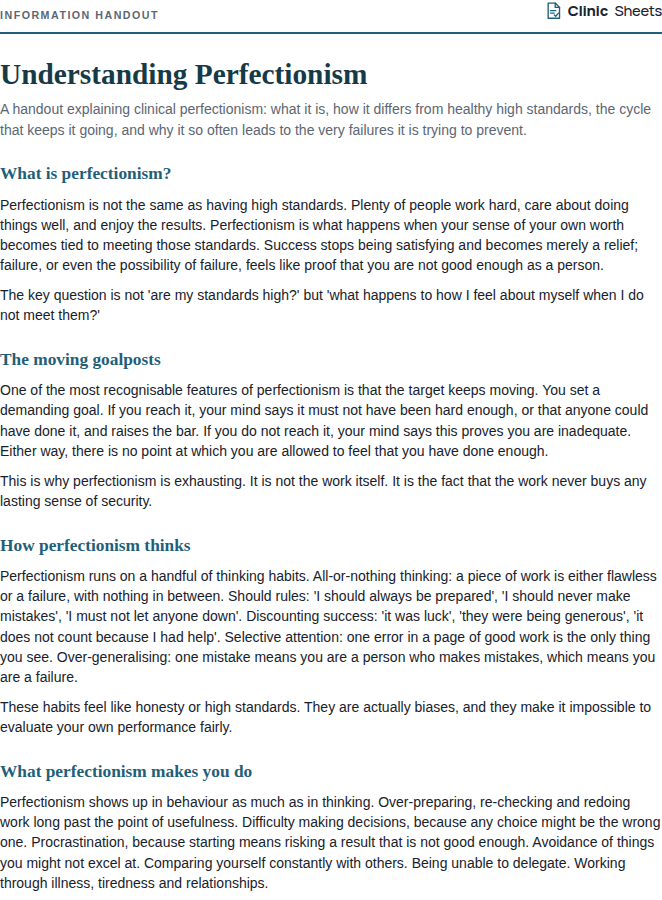
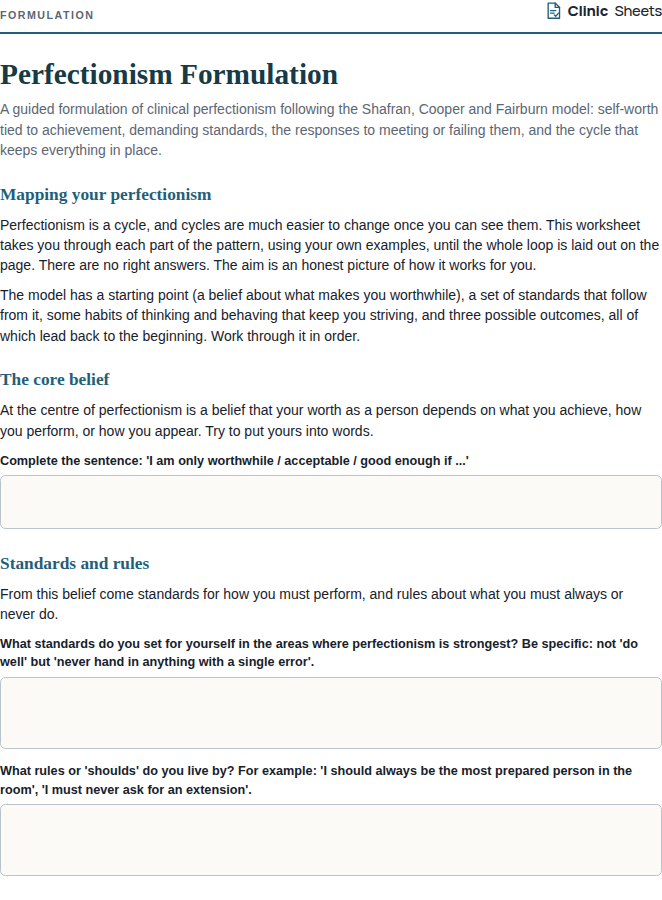
Clinical perfectionism, as defined by Shafran, Cooper and Fairburn, is the overdependence of self-evaluation on the determined pursuit of personally demanding standards in at least one domain, despite adverse consequences. The person judges their worth by achievement, sets standards that are hard to meet, reacts to falling short with self-criticism, and reacts to meeting the standard by dismissing it or raising it. Maintaining processes include all-or-nothing thinking, selective attention to failure, checking and reassurance, avoidance and procrastination, and a narrowing of life around the domain of striving. Clinical perfectionism is transdiagnostic: it maintains eating disorders, depression, anxiety disorders and OCD, and treating it directly improves those problems.
This protocol follows the treatment described in Egan, Wade, Shafran and Antony's clinician guide and evaluated in a preliminary trial by Riley and colleagues, which delivered ten sessions over eight weeks. The sequence is: building an individual formulation, psychoeducation and self-monitoring, behavioural experiments that test beliefs about standards and about the consequences of lowering them, broadening the basis of self-evaluation, addressing cognitive biases (particularly all-or-nothing thinking), tackling procrastination and time management, and working with self-criticism, ending with relapse prevention.
The professional version explains how to engage a client who values their perfectionism and fears that treatment means becoming mediocre, how to design experiments that lower the standard without lowering performance, how to use the pie chart of self-worth, and how to sequence the work when perfectionism coexists with an eating disorder or OCD.
How to use it
- Assess whether perfectionism is a maintaining factor for the presenting problem and whether the client is willing to consider changing it. Administer the Clinical Perfectionism Questionnaire or the Frost Multidimensional Perfectionism Scale at baseline and end, and a weekly depression and anxiety measure.
- Build the individual formulation in session one and use it as the map for the rest of the treatment. Return to it whenever the client questions the point of an intervention.
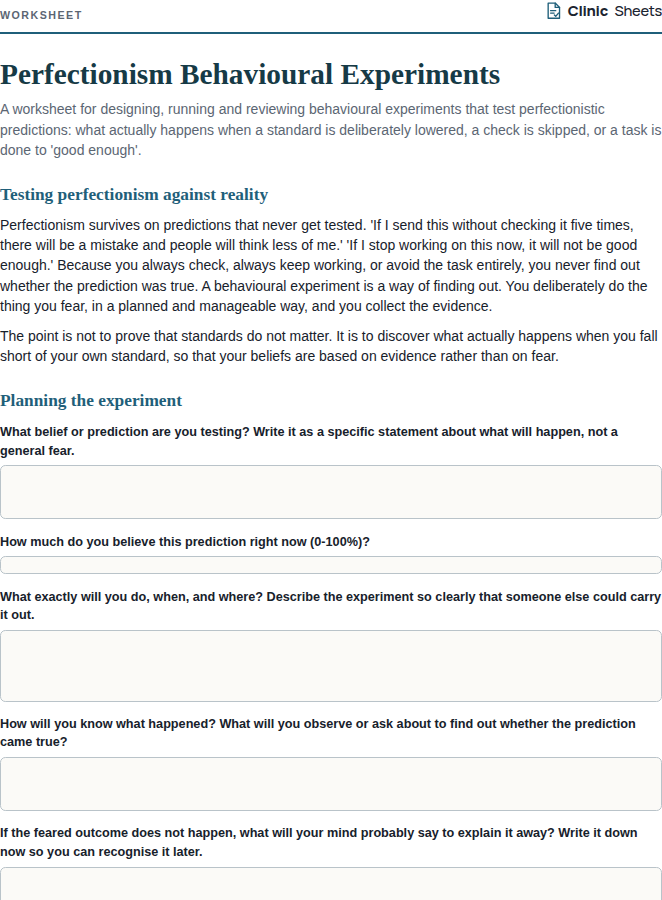
- Begin self-monitoring and psychoeducation immediately, and start behavioural experiments by the third session. Experiments are the main engine of change and should feature in every session from then on.
- Address self-evaluation, cognitive biases, procrastination and self-criticism in the middle sessions, each with its own experiments and written work.
- Reserve the final session for a written relapse prevention plan that names the situations in which perfectionism is likely to return.
References
- Shafran, R., Cooper, Z., & Fairburn, C. G. (2002). Clinical perfectionism: A cognitive-behavioural analysis. Behaviour Research and Therapy, 40(7), 773-791.
- Egan, S. J., Wade, T. D., Shafran, R., & Antony, M. M. (2014). Cognitive-Behavioral Treatment of Perfectionism. Guilford Press.
- Riley, C., Lee, M., Cooper, Z., Fairburn, C. G., & Shafran, R. (2007). A randomised controlled trial of cognitive-behaviour therapy for clinical perfectionism: A preliminary study. Behaviour Research and Therapy, 45(9), 2221-2231.
- Shafran, R., Egan, S., & Wade, T. (2018). Overcoming Perfectionism: A Self-Help Guide Using Scientifically Supported Cognitive Behavioural Techniques (2nd ed.). Robinson.