Understanding Perfectionism
A handout explaining clinical perfectionism: what it is, how it differs from healthy high standards, the cycle that keeps it going, and why it so often leads to the very failures it is trying to prevent.
About this resource
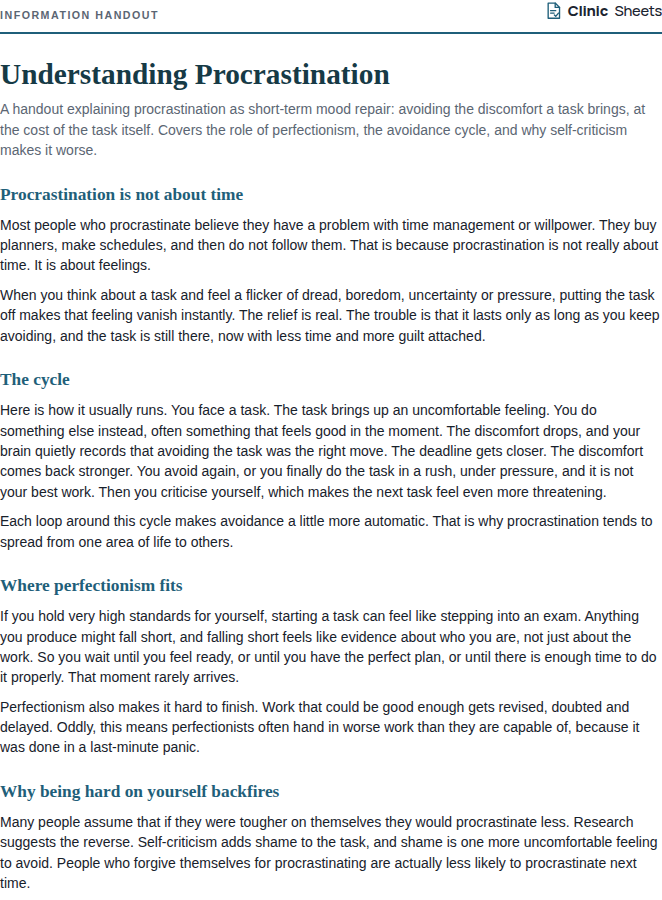
Clinical perfectionism, as defined by Shafran, Cooper and Fairburn, is the overdependence of self-worth on the pursuit and achievement of personally demanding standards, despite adverse consequences. The defining feature is not high standards themselves but the way self-evaluation is tied to them. Success is discounted or leads to the standard being raised; failure, or the fear of it, is taken as evidence of inadequacy. The result is a self-perpetuating cycle in which the person can never rest, and in which avoidance, procrastination, over-checking and burnout are common.
This handout introduces the model in plain language. It draws the distinction between striving that serves the person and striving that the person serves, describes the cognitive biases involved (all-or-nothing thinking, discounting success, 'should' rules, selective attention to mistakes), and lays out the maintaining cycle. It is designed to be used at the start of treatment to build a shared understanding before formulation and behavioural experiments.
The professional version includes notes on distinguishing perfectionism from OCD and from healthy conscientiousness, on the common transdiagnostic presentation alongside eating disorders, anxiety and depression, and on handling the client's fear that treatment means becoming mediocre.
How to use it
- Use in the first or second session when perfectionism has been identified as a maintaining factor, whether or not it is the presenting problem.
- Read the handout together and ask the client which parts they recognise. Most identify strongly with the 'moving goalposts' description.
- Address the fear of lowering standards early and directly. The aim is not to care less; it is to stop self-worth depending on the outcome.
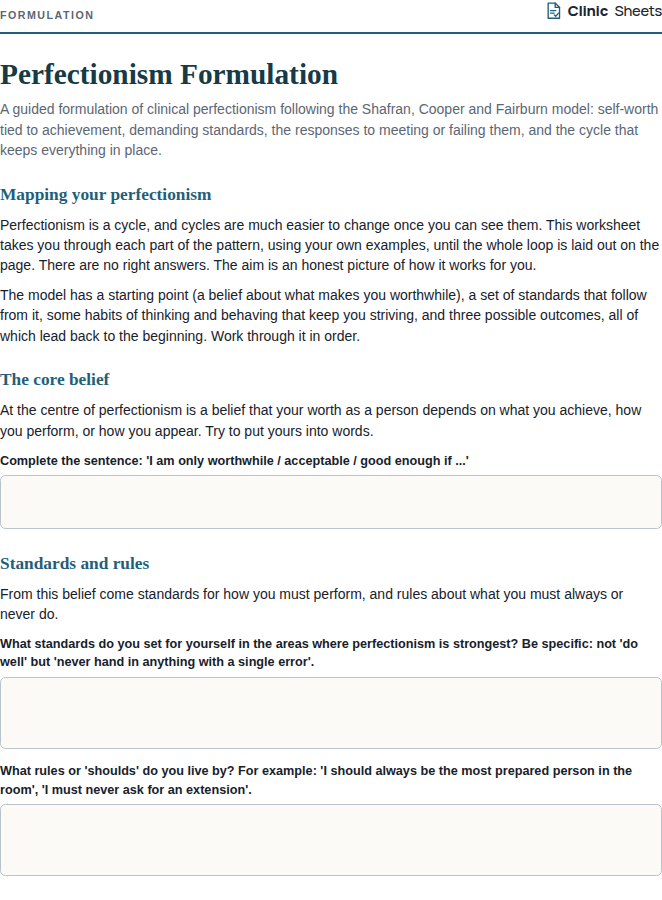
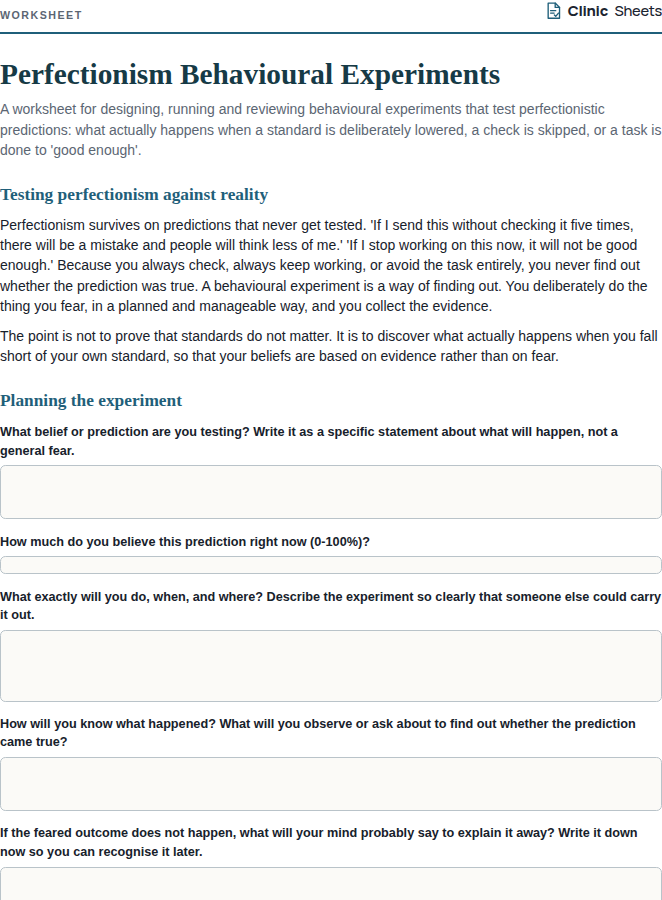
- Follow with the Perfectionism Formulation to map the client's own cycle, then behavioural experiments to test the predictions that hold it in place.
- Return to the cost-benefit section when motivation for change wavers.
References
- Shafran, R., Cooper, Z., & Fairburn, C. G. (2002). Clinical perfectionism: A cognitive-behavioural analysis. Behaviour Research and Therapy, 40(7), 773-791.
- Shafran, R., Egan, S., & Wade, T. (2018). Overcoming Perfectionism (2nd ed.). Robinson.
- Egan, S. J., Wade, T. D., & Shafran, R. (2011). Perfectionism as a transdiagnostic process: A clinical review. Clinical Psychology Review, 31(2), 203-212.
- Egan, S. J., Wade, T. D., Shafran, R., & Antony, M. M. (2014). Cognitive-Behavioral Treatment of Perfectionism. Guilford Press.