Perfectionism Formulation
A guided formulation of clinical perfectionism following the Shafran, Cooper and Fairburn model: self-worth tied to achievement, demanding standards, the responses to meeting or failing them, and the cycle that keeps everything in place.
About this resource
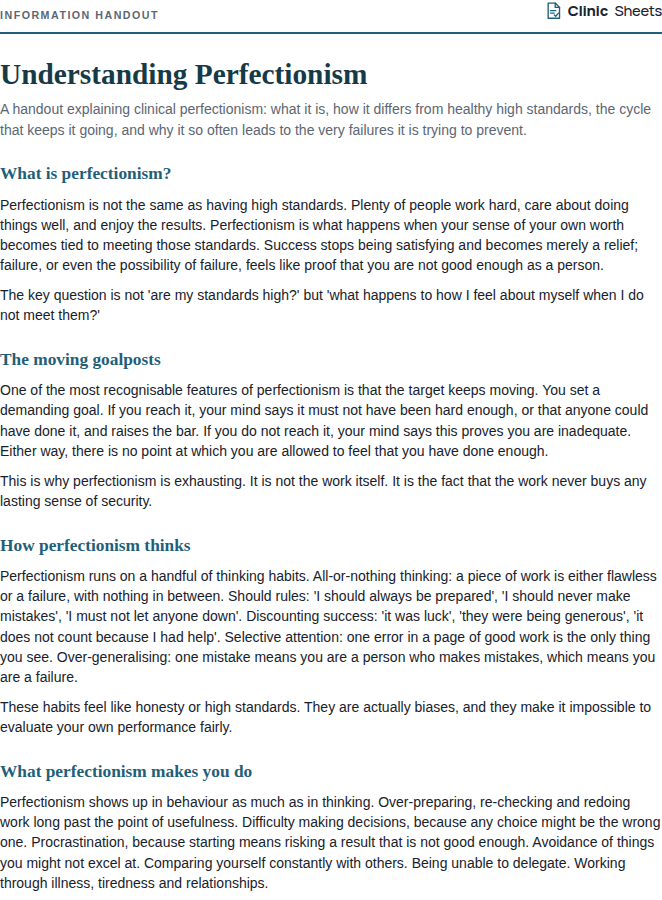
The cognitive-behavioural model of clinical perfectionism places one belief at the centre: that self-worth depends on striving for and achieving demanding standards. From this belief flow inflexible standards, rules and 'shoulds'; a set of cognitive biases that make fair self-evaluation impossible; and a range of performance-related behaviours, including over-checking, procrastination and avoidance. The model then traces three outcomes. When standards are met, success is discounted and the standards are raised. When standards are not met, the person engages in self-criticism, which confirms the core belief. When the task is avoided, the failure to try is itself taken as further proof. All three routes feed back to the starting point.
This worksheet walks the client through each component of the model with their own material, producing a personalised diagram in words. The value of a written formulation is that it makes the cycle visible: clients typically see for the first time that their success and their failure produce the same conclusion, and that the only untested possibility is falling short of a standard and surviving it. That insight sets up behavioural experiments directly.
The professional version includes a worked example, guidance on eliciting the core belief when the client frames perfectionism as simply how they are, and notes on integrating the formulation with a wider case conceptualisation where perfectionism sits alongside an eating disorder, OCD or depression.
How to use it
- Complete after the client has read Understanding Perfectionism and recognises the pattern. Allow a full session.
- Start with a specific recent example rather than the general pattern. Work through the model with that example, then ask whether the same sequence happens elsewhere.
- Draw the cycle on paper or a whiteboard as you go, using the client's words. The worksheet records it, but the drawing makes the loop visible.
- Pay particular attention to the three outcome branches. Ask directly: what did you conclude about yourself when it went well? When it did not? When you avoided it?
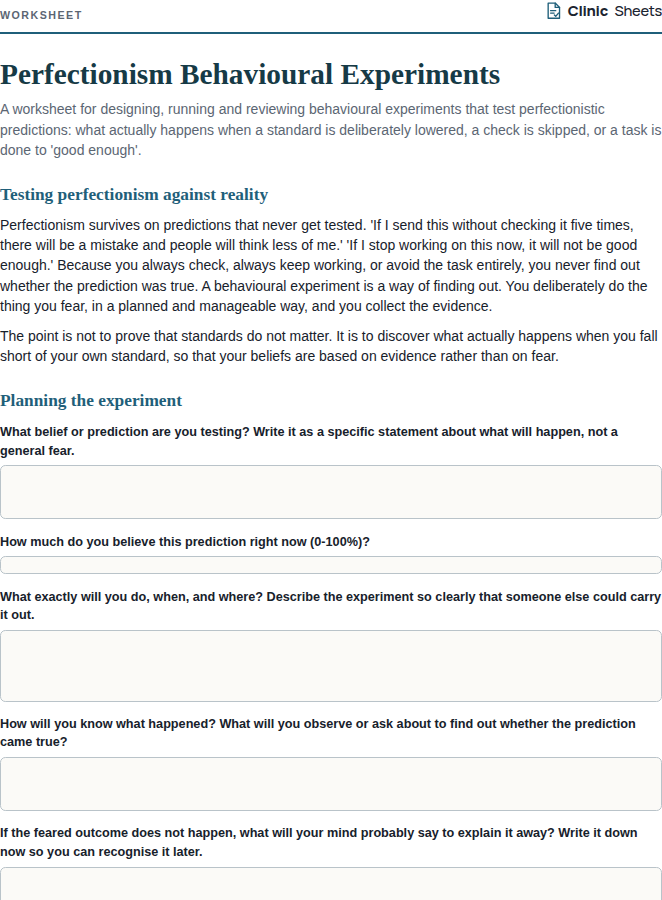
- End by asking what the cycle never allows the client to find out. This becomes the target for behavioural experiments.
- Revisit the formulation as treatment proceeds and update it as experiments produce new evidence.
References
- Shafran, R., Cooper, Z., & Fairburn, C. G. (2002). Clinical perfectionism: A cognitive-behavioural analysis. Behaviour Research and Therapy, 40(7), 773-791.
- Egan, S. J., Wade, T. D., Shafran, R., & Antony, M. M. (2014). Cognitive-Behavioral Treatment of Perfectionism. Guilford Press.
- Shafran, R., Egan, S., & Wade, T. (2018). Overcoming Perfectionism (2nd ed.). Robinson.