Rosenberg Self-Esteem Scale
Morris Rosenberg's ten-item Self-Esteem Scale, reproduced in full with scoring instructions and interpretation. The most widely used brief measure of global self-worth, suitable for adolescents and adults.
About this resource
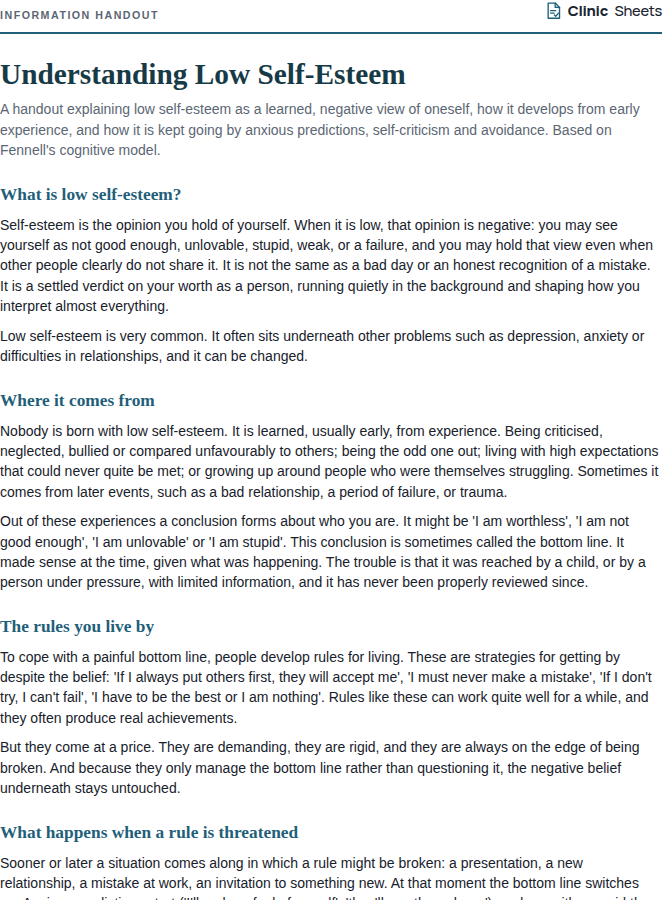
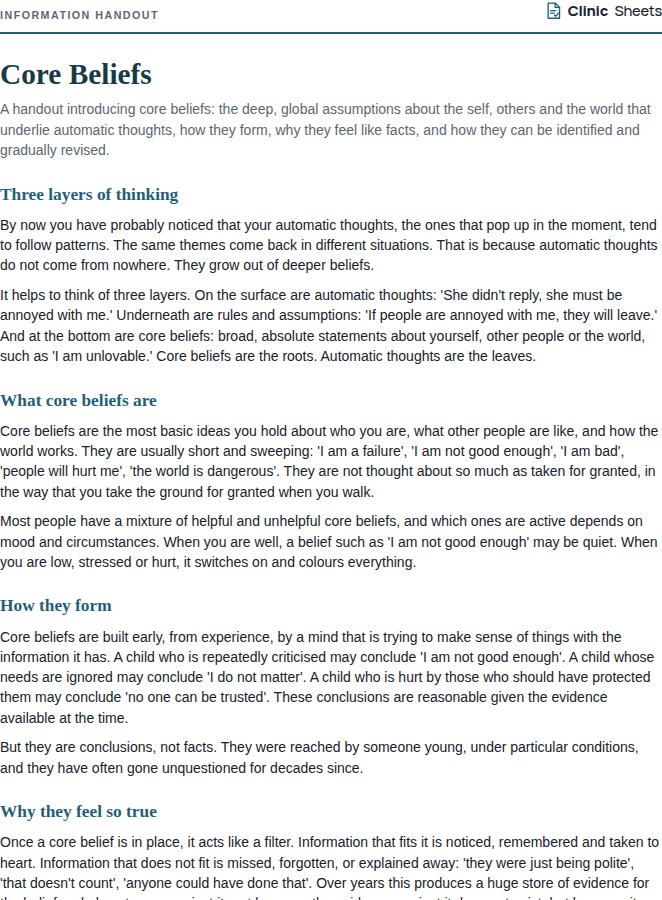
The Rosenberg Self-Esteem Scale (RSES) was published in 1965 as part of a large study of adolescents and has since become the standard brief measure of global self-esteem in research and practice. It consists of ten statements about the self, half worded positively and half negatively, each rated on a four-point agreement scale. Its brevity, readability and decades of psychometric support make it a practical choice for a first session, for tracking change during work on low self-esteem, and for research.
The scale is reproduced here because it is in the public domain and may be used without permission. Two scoring conventions exist. The original Guttman scoring is rarely used today. The common convention, and the one used here, sums the items on a 0 to 3 scale after reversing the five negatively worded items, giving a total from 0 to 30 where higher scores mean higher self-esteem. Some studies score the items 1 to 4 instead (range 10 to 40); when comparing to published norms, check which convention was used.
There are no diagnostic cut-offs, because self-esteem is not a disorder. Scores below 15 on the 0 to 30 convention are widely treated as suggesting low self-esteem, with the range of 15 to 25 described as typical. In clinical work the most informative use is repeated administration: a rising score over the course of therapy for low self-esteem, alongside behavioural change, is good evidence that the work is having its intended effect. This professional version adds notes on the two scoring conventions, on the pattern of responses (not just the total), and on using the measure within Fennell's cognitive model of low self-esteem.
How to use it
- Give the scale at assessment, before introducing any self-esteem work, so that you have a baseline. It takes two to three minutes.
- Score it as described in the Scoring section. Reverse items 2, 5, 6, 8 and 9 before adding. Check the arithmetic; reversal errors are the most common mistake.
- Read the individual answers as well as the total. Strong agreement with 'I certainly feel useless at times' or 'I wish I could have more respect for myself' points to specific beliefs worth eliciting in the client's own words.
- Repeat every four to six sessions and at the end of treatment. Discuss the change (or lack of it) openly; a flat score alongside real behavioural gains is a useful conversation about how the client judges themself.
- Do not present the score as a diagnosis or a fixed trait. Frame it as a snapshot of how the person is relating to themself at the moment.
References
- Rosenberg, M. (1965). Society and the adolescent self-image. Princeton University Press.
- Fennell, M. J. V. (1997). Low self-esteem: A cognitive perspective. Behavioural and Cognitive Psychotherapy, 25(1), 1-25.
- Blascovich, J., & Tomaka, J. (1991). Measures of self-esteem. In J. P. Robinson, P. R. Shaver, & L. S. Wrightsman (Eds.), Measures of personality and social psychological attitudes (pp. 115-160). Academic Press.