Understanding Low Self-Esteem
A handout explaining low self-esteem as a learned, negative view of oneself, how it develops from early experience, and how it is kept going by anxious predictions, self-criticism and avoidance. Based on Fennell's cognitive model.
About this resource
Low self-esteem is not a diagnosis but a pervasive negative belief about one's own worth, competence or acceptability that colours perception, drives behaviour and underlies many presenting problems, including depression, social anxiety and relationship difficulties. Melanie Fennell's cognitive model describes it as a 'bottom line' (a core belief such as 'I am not good enough') formed from early experience, protected by rules for living ('as long as I never let anyone down, I will be all right'), and activated whenever those rules are at risk of being broken. Activation produces anxious predictions, safety behaviours and avoidance, and, when things go badly, self-critical thinking and low mood, each of which confirms the bottom line.
This handout walks the client through the model in plain language, distinguishing between the origins of low self-esteem (which are usually understandable given the person's history) and the processes that keep it going now (which can be changed). This distinction is central: clients often assume that because their negative view has deep roots, it must be true and permanent. Showing that it is maintained by present-day habits of thought and action opens the door to change.
The handout is intended for the first sessions of self-esteem work and prepares the client for thought records, behavioural experiments, and positive data logs. The professional version includes guidance on eliciting the client's bottom line and rules without forcing premature disclosure, and a note on recognising when low self-esteem is secondary to another disorder that should be treated first.
How to use it
- Use in the first or second session once the client has described the problem. Ask them to read each section and mark what fits.
- Draw the model on paper as you go: early experience, bottom line, rules for living, trigger, anxious predictions and self-criticism, confirmation. Fill it in with the client's own examples where they are willing.
- Emphasise the two halves: how it started, and what keeps it going. Ask which half the client thinks therapy can change.
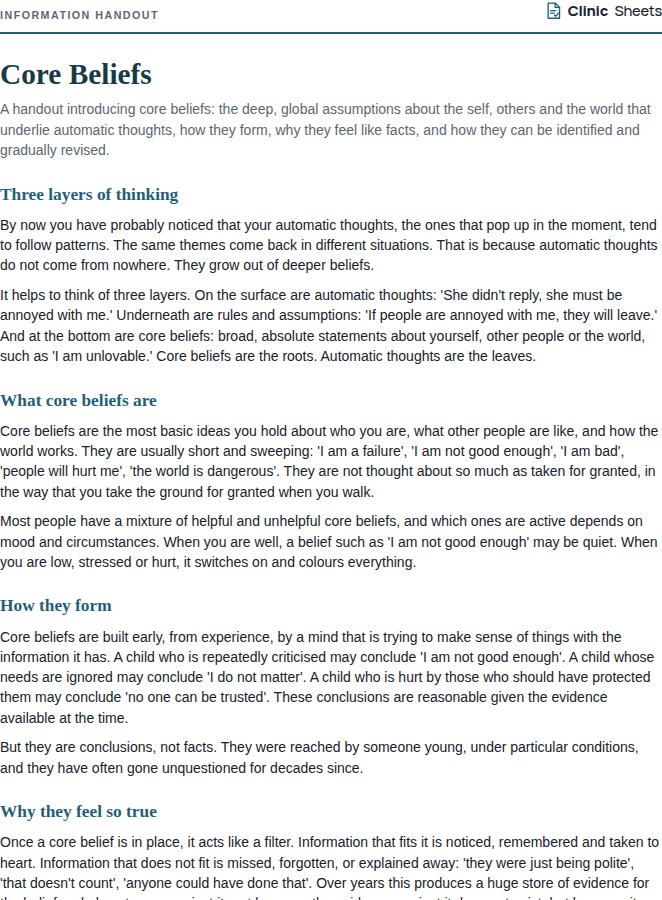
- Introduce the idea that the bottom line is an opinion formed under particular conditions, not a fact, and that the work ahead is about gathering evidence and testing rules.
- Follow with Core Beliefs, then with thought records and behavioural experiments targeting anxious predictions, and a positive data log for building an alternative view.
References
- Fennell, M. J. V. (1997). Low self-esteem: A cognitive perspective. Behavioural and Cognitive Psychotherapy, 25(1), 1-25.
- Fennell, M. J. V. (2016). Overcoming Low Self-Esteem: A Self-Help Guide Using Cognitive Behavioural Techniques (2nd ed.). Robinson.
- Waite, P., McManus, F., & Shafran, R. (2012). Cognitive behaviour therapy for low self-esteem: A preliminary randomized controlled trial in a primary care setting. Journal of Behavior Therapy and Experimental Psychiatry, 43(4), 1049-1057.