Understanding Imposter Feelings
A handout explaining imposter feelings: the persistent belief that your success is undeserved and you will be found out. Covers where the pattern comes from, the cycle that keeps it going, and the first steps to loosening it.
About this resource
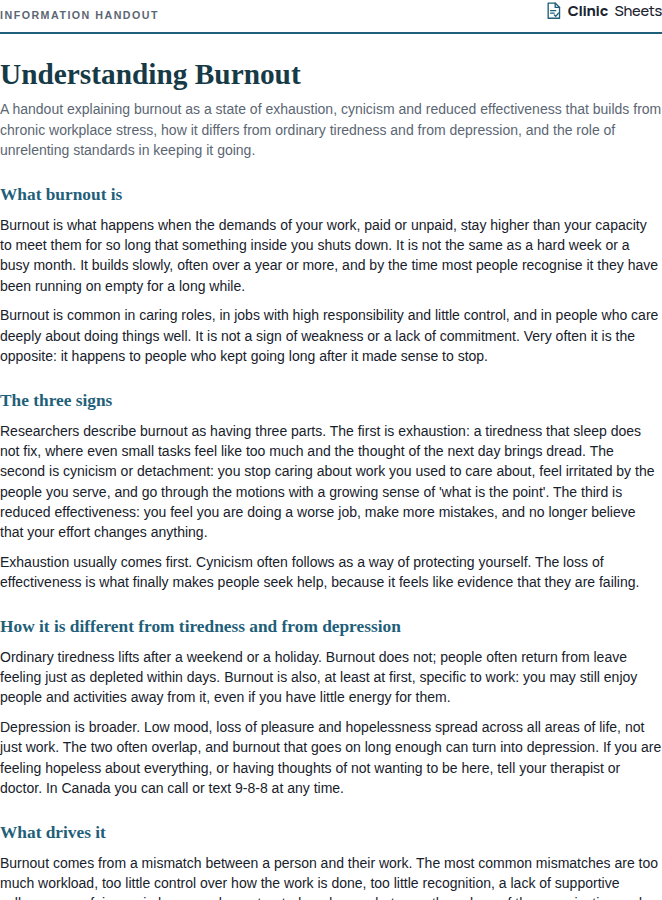
The imposter phenomenon was first described by Clance and Imes in 1978 in their work with high-achieving women, and has since been documented across genders, professions and career stages. It refers to a persistent sense that one's accomplishments are the result of luck, timing, charm or overwork rather than ability, together with a fear of being exposed as a fraud. It is not a diagnosis, but it is strongly associated with anxiety, low mood, burnout and perfectionism, and a systematic review by Bravata and colleagues found it common in both students and working professionals.
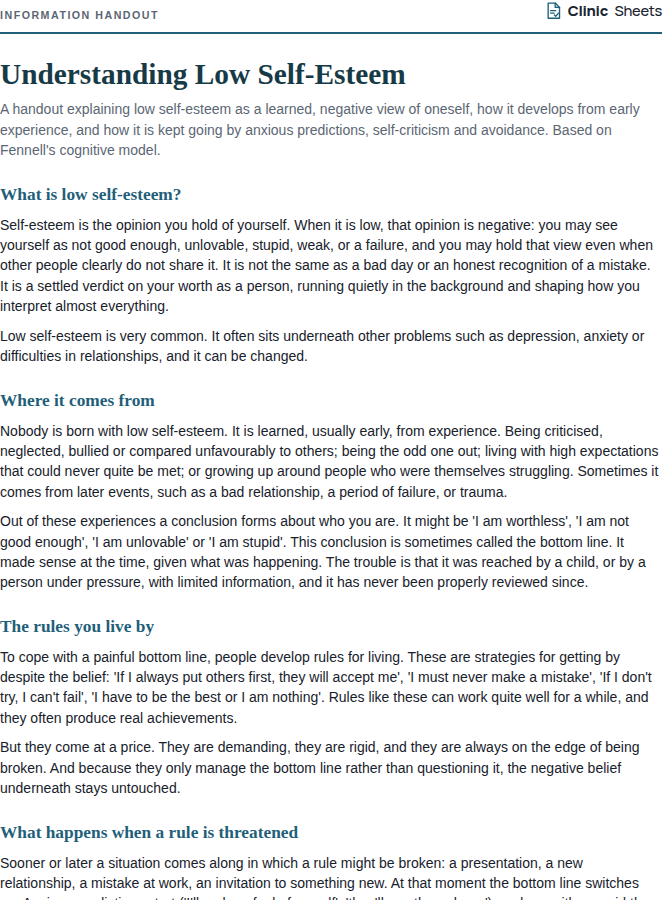
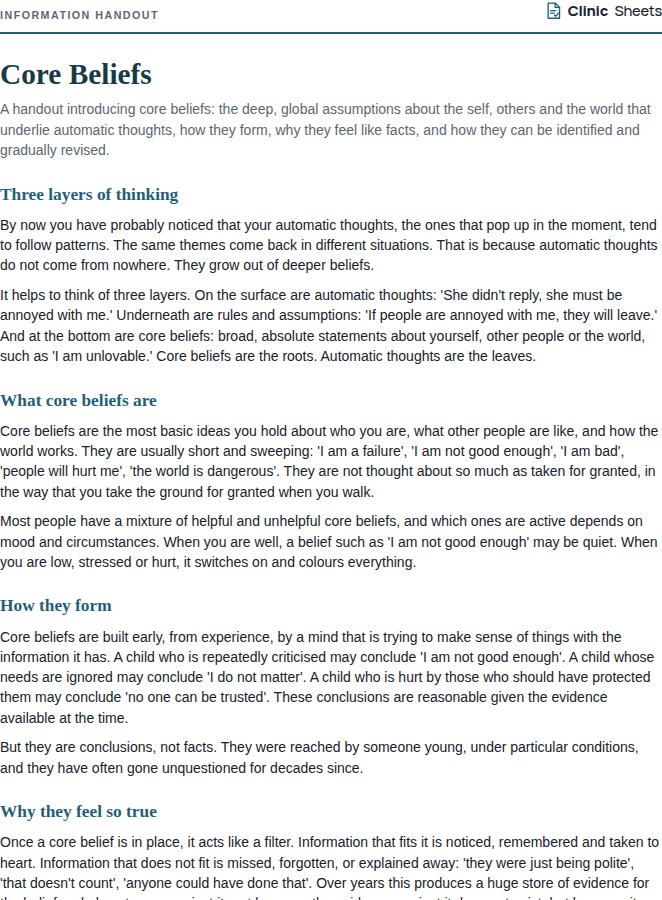
From a CBT perspective, imposter feelings are best understood as a core belief about the self ('I am not good enough') held in place by a self-maintaining cycle. Success is discounted or attributed externally, so it never updates the belief; failure or criticism is taken as confirmation. Perfectionistic over-preparation and, less obviously, procrastination both function as safety behaviours: if the work succeeds after enormous effort, the effort explains it; if it succeeds after last-minute scrambling, luck explains it. Either way the person is protected from testing whether they are, in fact, competent.
This handout explains the pattern in plain language, describes the cycle, and offers initial steps: noticing the discounting, collecting a fairer record of the evidence, and experimenting with doing slightly less than perfect preparation. The professional version links the handout to Fennell's low self-esteem model, suggests using positive data logs and behavioural experiments, and notes when imposter feelings sit within a broader picture of depression, social anxiety or minority stress that needs its own attention.
How to use it
- Use when a client describes their achievements as luck, worries about being exposed, or dismisses positive feedback. Read the cycle section together and ask them to map their own version.
- Follow with a positive data log (see Positive Data Log) to begin counteracting the discounting of evidence.
- Set up behavioural experiments around over-preparation: what happens if they prepare to a 'good enough' standard rather than an exhaustive one? Predictions and outcomes should be written down.
- Where the belief is longstanding and global, treat it as core belief work using Fennell's model rather than expecting the handout alone to shift it.
- Be alert to context. Imposter feelings are more common where a person is under-represented in their field or has been treated as an outsider. Acknowledge this rather than framing everything as distorted thinking.
References
- Clance, P. R., & Imes, S. A. (1978). The imposter phenomenon in high achieving women: Dynamics and therapeutic intervention. Psychotherapy: Theory, Research and Practice, 15(3), 241-247.
- Bravata, D. M., Watts, S. A., Keefer, A. L., Madhusudhan, D. K., Taylor, K. T., Clark, D. M., Nelson, R. S., Cokley, K. O., & Hagg, H. K. (2020). Prevalence, predictors, and treatment of impostor syndrome: A systematic review. Journal of General Internal Medicine, 35(4), 1252-1275.
- Fennell, M. (2016). Overcoming Low Self-Esteem (2nd ed.). Robinson.