Core Beliefs
A handout introducing core beliefs: the deep, global assumptions about the self, others and the world that underlie automatic thoughts, how they form, why they feel like facts, and how they can be identified and gradually revised.
About this resource
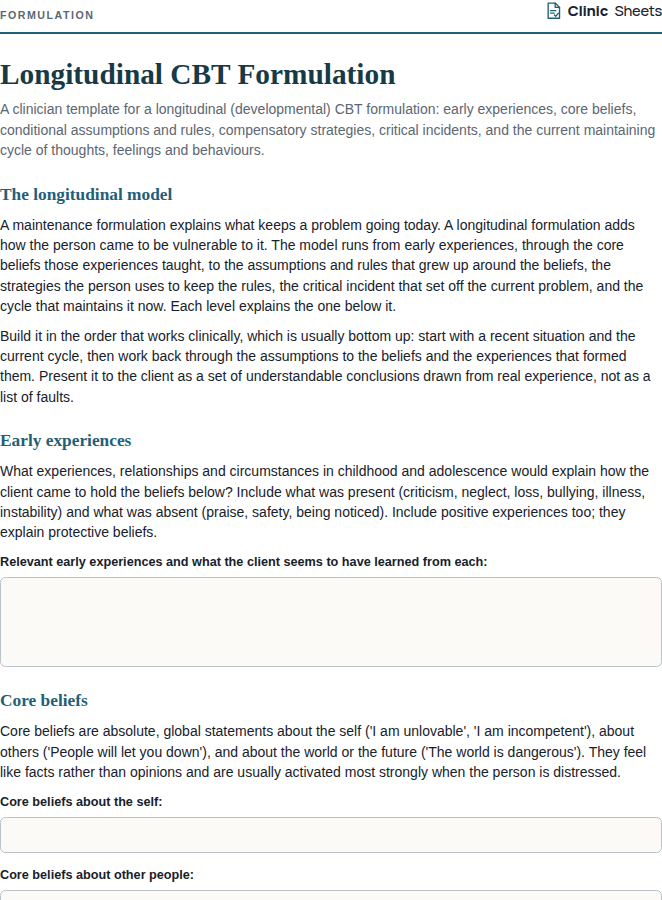
In the cognitive model, cognition is organised in layers. At the surface are automatic thoughts, the moment-to-moment interpretations captured in a thought record. Beneath them are intermediate beliefs: the rules, attitudes and conditional assumptions that shape those thoughts. At the deepest level are core beliefs: absolute, global statements about the self ('I am unlovable'), others ('people cannot be trusted') and the world ('nothing is safe'). Aaron Beck and Judith Beck describe core beliefs as developing in childhood from the person's attempts to make sense of experience, and as operating like schemas that filter incoming information so that confirming evidence is admitted and disconfirming evidence is discounted.
Jeffrey Young's schema therapy extends the concept, describing early maladaptive schemas as broad patterns of memory, emotion, cognition and bodily sensation that form when core emotional needs are not met and that are perpetuated through schema maintenance, avoidance and overcompensation. This handout draws on both traditions to give clients a working understanding of what core beliefs are, why they feel so convincing, and why identifying them matters for treatment of depression and low self-esteem, where negative core beliefs about the self are typically central.
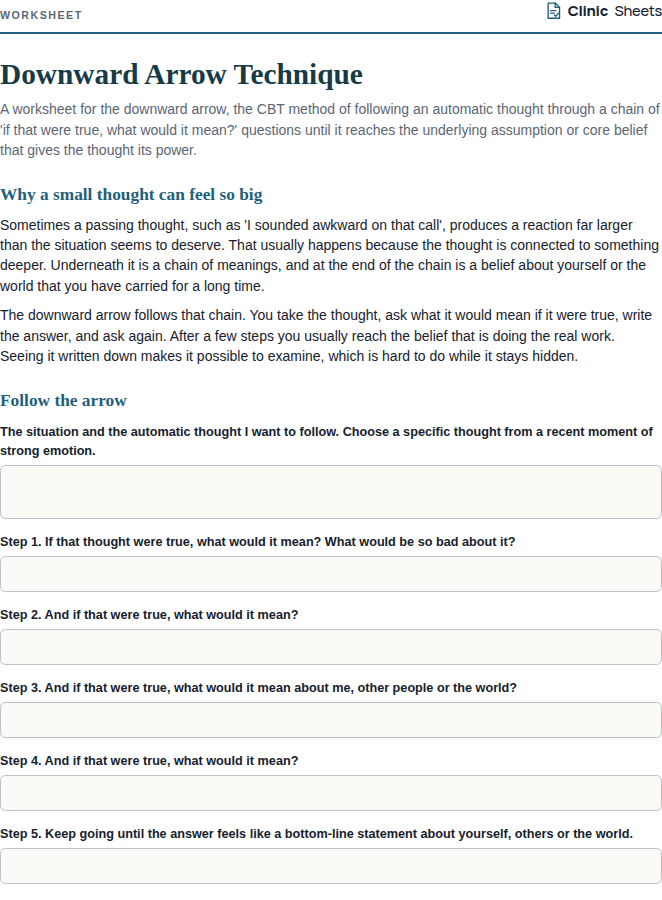
It is a bridge between thought-level work and belief-level work. Use it once the client is comfortable with thought records and has begun to notice recurring themes. The professional version includes the downward arrow technique for identifying core beliefs from automatic thoughts, cautions about timing (belief-level work is usually reserved for later in treatment, when the client is less acutely distressed), and an overview of belief-change methods including continua, historical review, and positive data logs.
How to use it
- Introduce the handout after several thought records, when recurring themes across situations have become visible to both of you.
- Explain the three layers with a diagram: situation and automatic thought at the top, rules in the middle, core belief at the bottom. Use one of the client's own thought records as the example.
- Use the downward arrow in session: 'If that thought were true, what would it mean about you?' Repeat gently until a global statement about the self emerges. Stop if distress rises sharply.
- Ask the client to rate how much they believe the core belief, both when calm and when upset. The difference is itself evidence that the belief is a state-dependent opinion rather than a fact.
- Explain how the belief filters evidence, and introduce the plan for revising it: gathering evidence over time rather than arguing it away in one session.
- Follow with a positive data log, a belief continuum, or historical review of the evidence, depending on the client and the formulation.
References
- Beck, J. S. (2020). Cognitive Behavior Therapy: Basics and Beyond (3rd ed.). Guilford Press.
- Beck, A. T., Rush, A. J., Shaw, B. F., & Emery, G. (1979). Cognitive Therapy of Depression. Guilford Press.
- Young, J. E., Klosko, J. S., & Weishaar, M. E. (2003). Schema Therapy: A Practitioner's Guide. Guilford Press.
- Padesky, C. A. (1994). Schema change processes in cognitive therapy. Clinical Psychology and Psychotherapy, 1(5), 267-278.