Understanding Schemas (Early Maladaptive Schemas)
A handout introducing early maladaptive schemas: what they are, where they come from, how they are grouped, and how they keep themselves going through surrender, avoidance and overcompensation. Psychoeducation for the opening phase of schema therapy.
About this resource
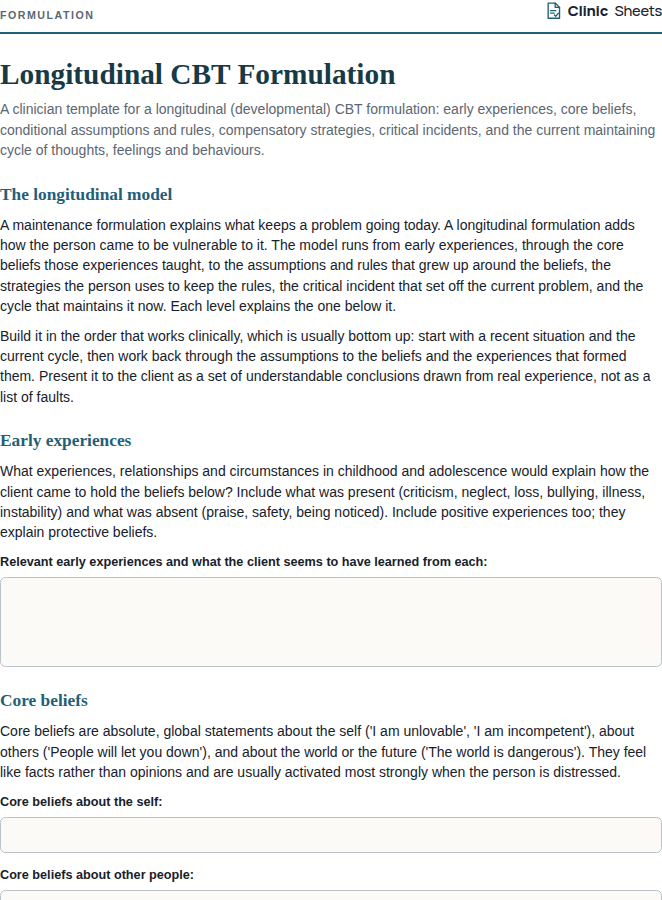
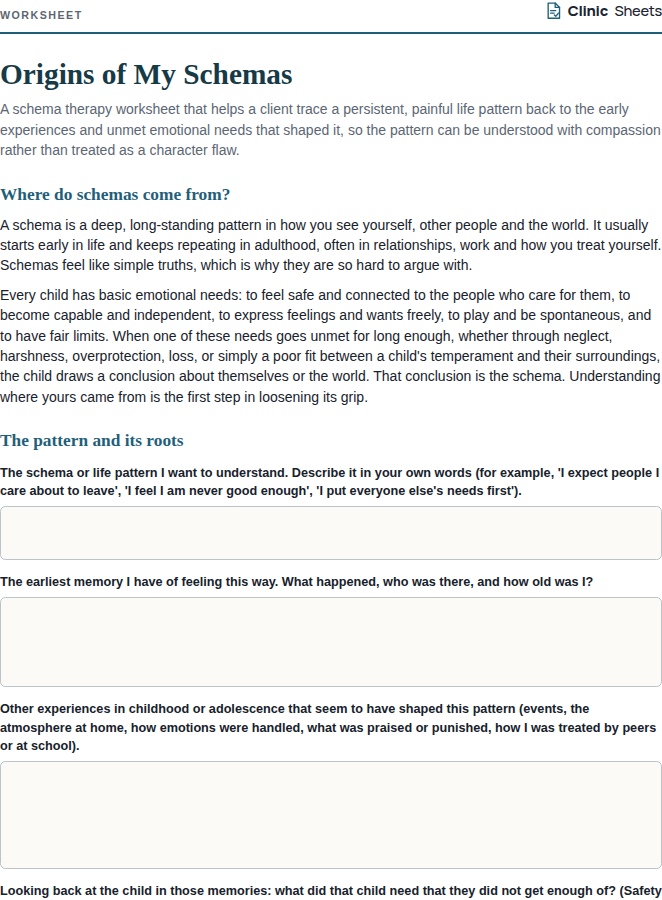
Early maladaptive schemas, as described by Jeffrey Young, are broad, enduring patterns of memory, emotion, bodily sensation and belief about oneself and one's relationships that develop in childhood or adolescence when core emotional needs go unmet, and that are elaborated across the lifespan. Young identified eighteen schemas, grouped into five domains corresponding to unmet needs: secure attachment, autonomy and competence, realistic limits, freedom to express needs and emotions, and spontaneity and play. Schemas are maintained by three characteristic coping styles: surrender, avoidance and overcompensation.
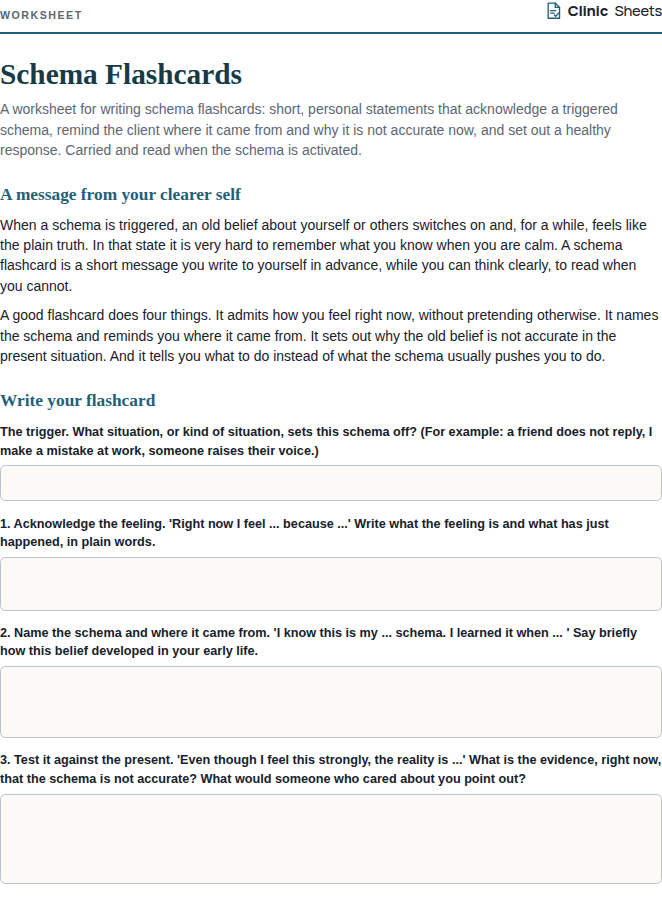
This handout translates the model into plain language for clients. It explains schemas as lenses that were once adaptive, gives brief descriptions of the most commonly encountered schemas, and introduces the three coping styles with everyday examples. The aim is to give the client a framework for recognising their own patterns before the more emotionally demanding experiential work of schema therapy begins, and to make the link between present difficulties and early experience without blaming parents or the client.
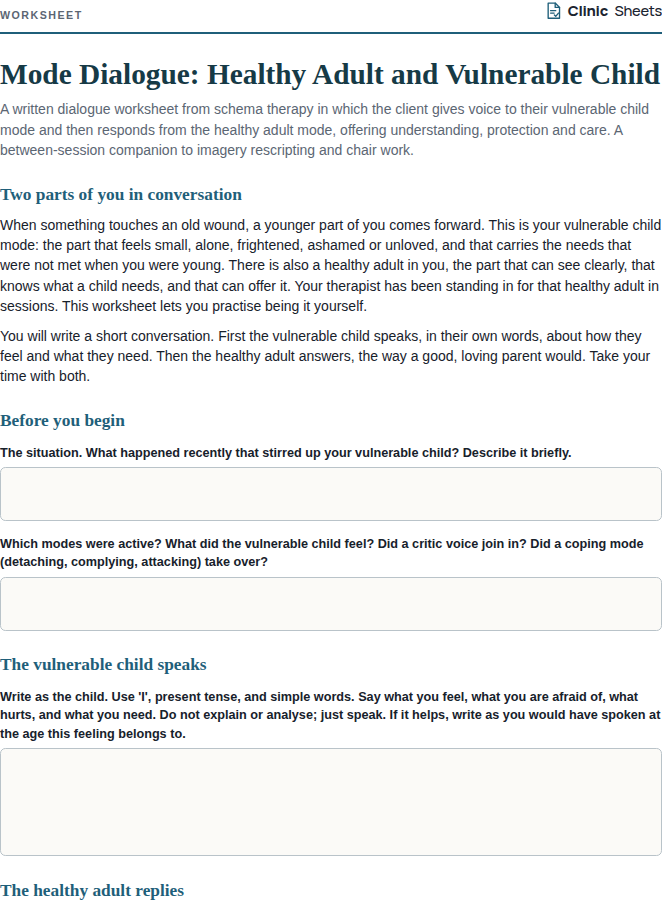
It suits adults with long-standing relationship difficulties, chronic low self-esteem, or personality difficulties, and is often given alongside the Young Schema Questionnaire. The professional version adds a full list of the eighteen schemas with clinical descriptions, guidance on distinguishing schemas from the modes that express them (see Schema Modes), and notes on pacing psychoeducation for clients who find the model activating.
How to use it
- Introduce the handout after the assessment phase, once you have a sense of which two or three schemas are most relevant. Read it together and highlight those rather than expecting the client to absorb the whole list.
- Link each highlighted schema to specific memories and current situations the client has already described. Schemas become real when tied to lived examples.
- Explore coping styles with curiosity. Ask which of surrender, avoidance and overcompensation the client recognises, and whether they use different styles in different relationships.
- Use the reflection section as homework. It seeds the schema diary work that follows.
- If the client becomes distressed reading about origins, slow down, validate, and return to the idea that schemas made sense as adaptations. This is not a moment to push for insight.
References
- Young, J. E., Klosko, J. S., & Weishaar, M. E. (2003). Schema Therapy: A Practitioner's Guide. Guilford Press.
- Young, J. E., & Klosko, J. S. (1994). Reinventing Your Life. Plume.
- Arntz, A., & Jacob, G. (2013). Schema Therapy in Practice: An Introductory Guide to the Schema Mode Approach. Wiley-Blackwell.
- Bach, B., Lockwood, G., & Young, J. E. (2018). A new look at the schema therapy model: Organization and role of early maladaptive schemas. Cognitive Behaviour Therapy, 47(4), 328-349.