Box Breathing
A simple four-part breathing exercise, breathing in, holding, breathing out and holding again for equal counts, to settle the body during anxiety, panic or stress. Written for adults, adolescents and children, with a note for parents and caregivers.
About this resource
Box breathing, also called square breathing or four-square breathing, is a paced breathing technique in which each phase of the breath (inhale, hold, exhale, hold) lasts the same number of counts, typically four. It slows the breathing rate to around four to six breaths per minute, which is the range at which vagal tone and heart rate variability increase and the parasympathetic nervous system is most effectively engaged. The holds also give the mind a simple counting task, which interrupts the escalation of anxious thought. The technique is widely taught in stress-management, athletic and first-responder settings because it is easy to remember and can be done anywhere without anyone noticing.
In a CBT context, box breathing is best introduced as a way of lowering physical arousal so that the client can think and act rather than as a way of preventing feared sensations. The distinction matters in panic disorder, where breathing exercises can become safety behaviours that maintain the belief that sensations are dangerous. Used as a general-purpose settling skill, and taught with the message that anxiety is uncomfortable but not harmful, it is a valuable tool for children, adolescents and adults alike.
The professional version includes a visual box for tracing with a finger, guidance on adjusting the count for younger children or for clients with respiratory conditions, and notes on when to use box breathing versus diaphragmatic breathing or grounding.
How to use it
- Demonstrate the exercise in session first, counting aloud. Then do a round together, then have the client lead a round.
- Start with a count of four for adults and adolescents. For children under about ten, a count of three is often more comfortable, and the holds can be shortened or dropped if they cause strain.
- Ask the client to practise twice daily when calm for a week before using it in stressful moments. Skills learned calm are much easier to reach under pressure.
- Offer the finger-tracing version for children and for anyone who finds counting alone hard to hold on to.
- In panic work, agree explicitly on the purpose: to settle the body, not to stop sensations. Review whether it is being used as a safety behaviour.
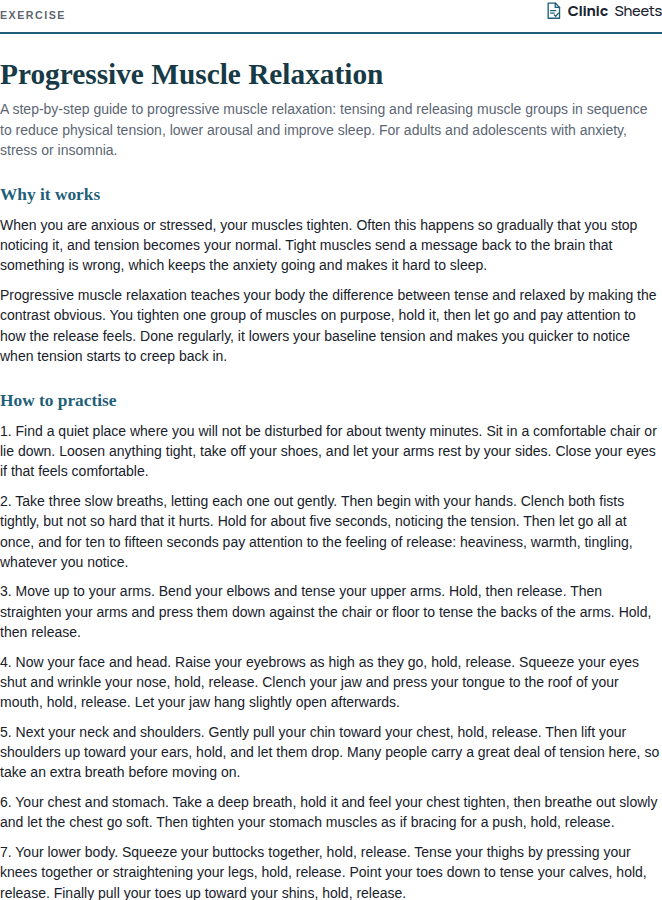
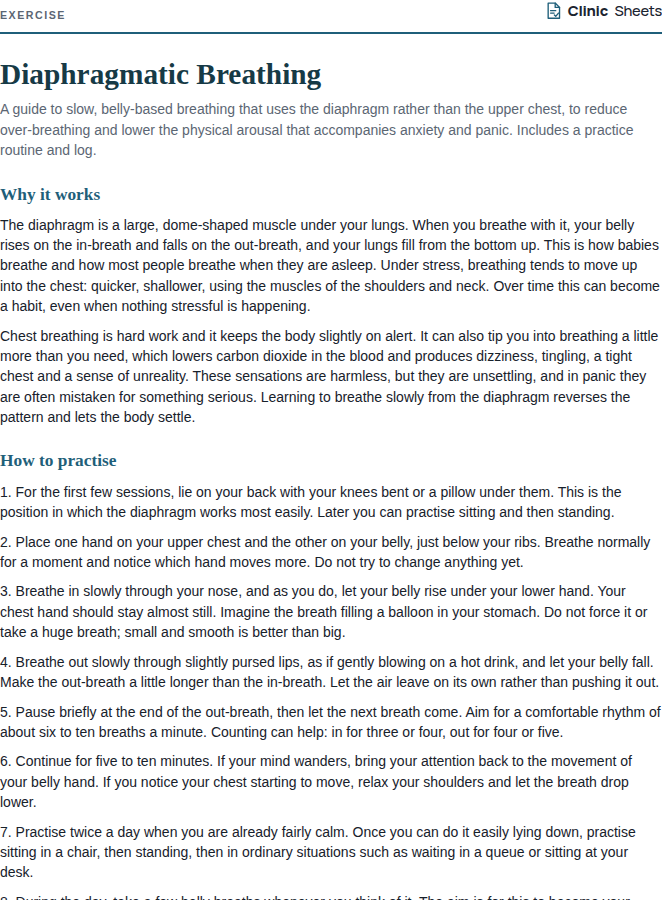
- Check that the client is breathing into the belly rather than the upper chest. If not, teach diaphragmatic breathing first.
References
- Zaccaro, A., Piarulli, A., Laurino, M., Garbella, E., Menicucci, D., Neri, B., & Gemignani, A. (2018). How breath-control can change your life: A systematic review on psycho-physiological correlates of slow breathing. Frontiers in Human Neuroscience, 12, 353.
- Lehrer, P. M., & Gevirtz, R. (2014). Heart rate variability biofeedback: How and why does it work? Frontiers in Psychology, 5, 756.
- Clark, D. M. (1986). A cognitive approach to panic. Behaviour Research and Therapy, 24(4), 461-470.