Session-by-Session Protocol: Exposure for Specific Phobia
A session-by-session clinician protocol for exposure therapy for specific phobia, following Öst's rapid treatment and the Craske, Antony and Barlow programme: assessment with a behavioural approach test, building a hierarchy, therapist-guided in vivo exposure with belief testing, applied tension for blood-injection-injury phobia, home practice, and relapse prevention.
About this resource
Specific phobia is among the most treatable of the anxiety disorders. Exposure-based treatment, in which the person repeatedly and systematically confronts the feared object or situation without escape, produces large and durable reductions in fear, and Öst's one-session treatment showed that a single prolonged session of therapist-guided exposure can be sufficient for many phobias. The mechanism has been described in terms of habituation and, more recently, inhibitory learning: the person forms a new safety association that competes with the old fear association, and that new learning is strongest when expectations are violated clearly and repeatedly in varied contexts.
This protocol lays out a short course: an assessment session including a behavioural approach test and a hierarchy, one to five exposure sessions depending on the phobia and the client, and a follow-up session. It follows the approach of Öst and of Craske, Antony and Barlow's Mastering Your Fears and Phobias, and incorporates the inhibitory learning principles set out by Craske and colleagues: expectancy violation, dropping safety behaviours, variability, and multiple contexts. Blood-injection-injury phobia has its own section because the fainting response requires applied tension alongside exposure.
The professional version explains how to plan a prolonged exposure session, how to keep exposure moving through the hierarchy within one session, how to handle disgust as well as fear, how to obtain the feared stimulus (animals, needles, heights, enclosed spaces) safely and ethically, and how to structure home practice so that gains generalise.
How to use it
- Confirm specific phobia and its type (animal, natural environment, blood-injection-injury, situational, other). Establish the feared consequence: harm from the object, being overwhelmed by fear, fainting, or disgust. Rule out panic disorder or agoraphobia as the primary problem.
- Conduct a behavioural approach test at assessment and repeat it at the end. Administer a phobia-specific questionnaire where one exists and record the client's belief in the feared consequence.
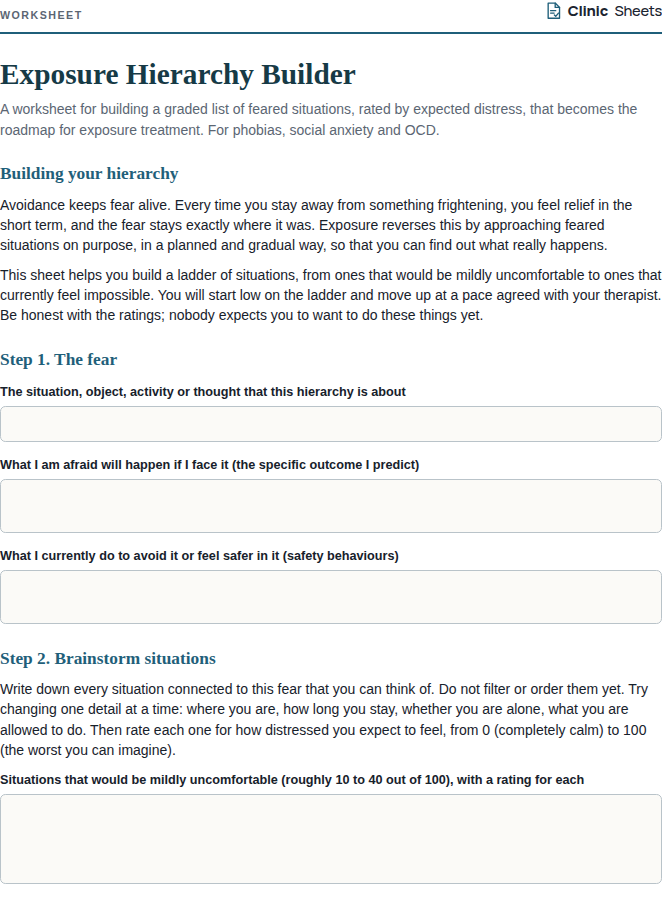
- Build a hierarchy of ten to fifteen steps and plan the exposure sessions. Aim for a first exposure session of up to three hours for a single-session format, or ninety minutes for a multi-session format.
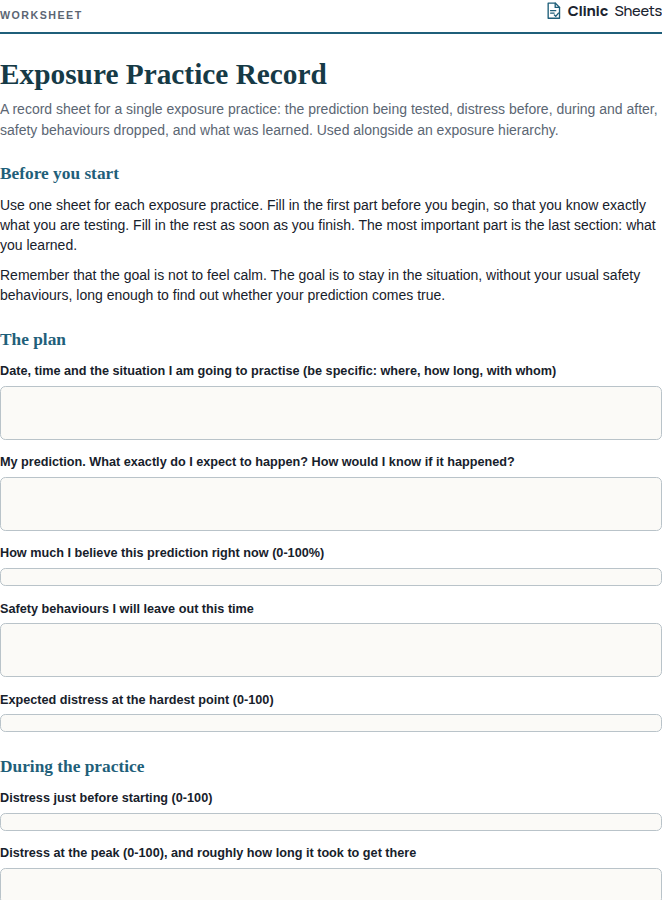
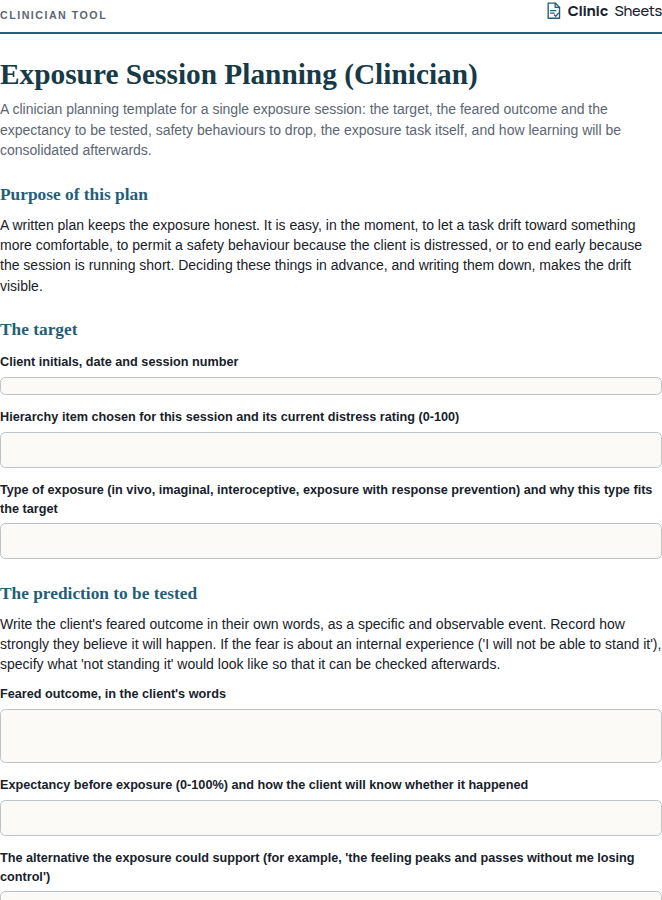
- In each exposure, obtain a prediction, conduct the step until the prediction has been clearly tested, then move to the next step. Model each step first. Keep safety behaviours out and vary the stimulus and context as you go.
- Assign daily home practice between and after sessions and schedule a follow-up session at one month.
References
- Öst, L.-G. (1989). One-session treatment for specific phobias. Behaviour Research and Therapy, 27(1), 1-7.
- Craske, M. G., Antony, M. M., & Barlow, D. H. (2006). Mastering Your Fears and Phobias: Therapist Guide (2nd ed.). Oxford University Press.
- Craske, M. G., Treanor, M., Conway, C. C., Zbozinek, T., & Vervliet, B. (2014). Maximizing exposure therapy: An inhibitory learning approach. Behaviour Research and Therapy, 58, 10-23.
- Öst, L.-G., & Sterner, U. (1987). Applied tension: A specific behavioral method for treatment of blood phobia. Behaviour Research and Therapy, 25(1), 25-29.