Session-by-Session Protocol: Interpersonal Therapy for Depression
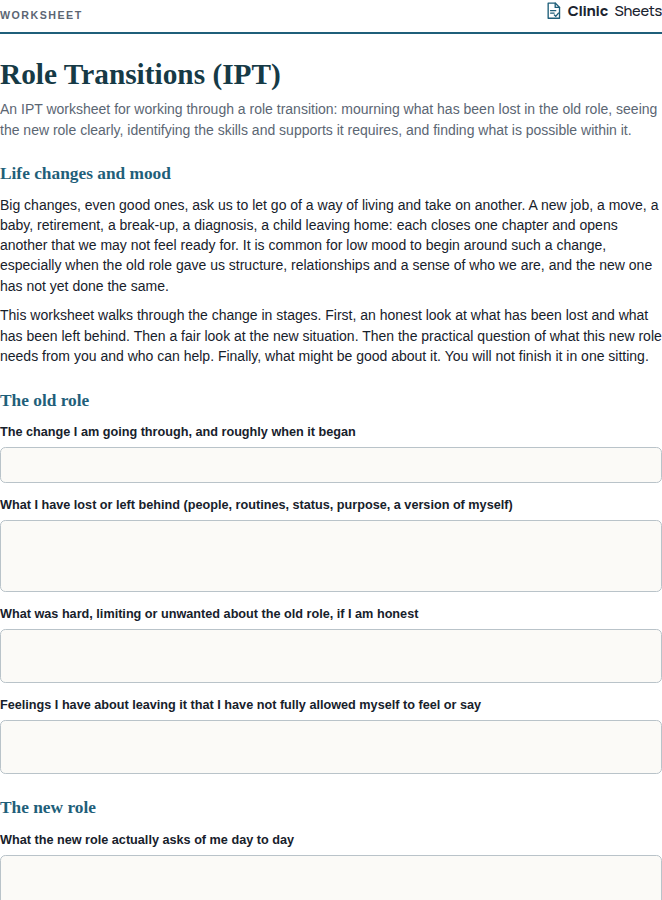
A session-by-session clinician protocol for interpersonal psychotherapy (IPT) for depression, following Klerman and Weissman's manual: the initial phase with the interpersonal inventory and choice of focus area (grief, role dispute, role transition or interpersonal deficits), the middle phase working on that focus with communication analysis, decision analysis and role play, and the termination phase.
About this resource
Interpersonal psychotherapy was developed by Gerald Klerman, Myrna Weissman and colleagues as a time-limited treatment for major depression. It rests on the observation that depression, whatever its causes, occurs in an interpersonal context and that improving the person's relationships and social functioning relieves the depression. IPT does not attribute depression to interpersonal problems; it uses them as the point of leverage. The treatment was a comparison arm in the NIMH Treatment of Depression Collaborative Research Program and has since been supported in many trials for depression across the lifespan and in perinatal populations.
This protocol follows the structure set out in Klerman, Weissman, Rounsaville and Chevron's manual and its updated form in Weissman, Markowitz and Klerman's guide. IPT runs for twelve to sixteen weekly sessions in three phases. The initial phase (sessions one to three) confirms the diagnosis, gives the client the sick role, completes the interpersonal inventory and agrees one of four problem areas as the focus. The middle phase works on that area using IPT's techniques: exploration of affect, communication analysis, decision analysis, role play and, throughout, linking mood to interpersonal events. The termination phase consolidates gains and addresses the end of treatment as a role transition in its own right.
The professional version explains how to conduct the interpersonal inventory efficiently, how to choose between problem areas when several apply, what each problem area's strategies actually consist of, and how to keep the treatment focused when the client brings other material. It also notes the measures and the adaptations for adolescents, older adults and perinatal depression.
How to use it
- Confirm major depression, assess risk and administer a depression measure (PHQ-9 or the Hamilton Depression Rating Scale) at baseline and at regular intervals. Explain the diagnosis, the time limit and the interpersonal focus in the first session.
- Complete the interpersonal inventory across sessions one to three: every significant relationship, its quality, what the client wants from it and what is wrong. Use it to choose the focus area and present the formulation to the client in interpersonal terms.
- In the middle phase, open every session with 'How have things been since we last met?' and link the week's mood to interpersonal events. Keep the work on the agreed focus area; note other problems and return to the focus.
- Use communication analysis, decision analysis and role play as the main techniques, and encourage the expression of affect about the focal problem.
- Begin discussing termination two to four sessions before the end, review progress against the initial formulation, and plan for future depressive episodes.
References
- Klerman, G. L., Weissman, M. M., Rounsaville, B. J., & Chevron, E. S. (1984). Interpersonal Psychotherapy of Depression. Basic Books.
- Weissman, M. M., Markowitz, J. C., & Klerman, G. L. (2018). The Guide to Interpersonal Psychotherapy (Updated and expanded ed.). Oxford University Press.
- Elkin, I., Shea, M. T., Watkins, J. T., Imber, S. D., Sotsky, S. M., Collins, J. F., Glass, D. R., Pilkonis, P. A., Leber, W. R., Docherty, J. P., Fiester, S. J., & Parloff, M. B. (1989). National Institute of Mental Health Treatment of Depression Collaborative Research Program: General effectiveness of treatments. Archives of General Psychiatry, 46(11), 971-982.
- Cuijpers, P., Donker, T., Weissman, M. M., Ravitz, P., & Cristea, I. A. (2016). Interpersonal psychotherapy for mental health problems: A comprehensive meta-analysis. American Journal of Psychiatry, 173(7), 680-687.