Rumination Log and Interruption Plan
A two-part worksheet: a log for recording episodes of rumination (trigger, content, duration, effect) and a personal plan for catching rumination early and shifting into concrete problem solving or absorbing activity.
About this resource
Rumination-focused approaches to depression treat rumination as a learned habit with identifiable triggers, cues and consequences. Watkins's rumination-focused CBT uses functional analysis to identify when rumination starts, what sets it off and what it achieves, and then trains the client in alternative responses that compete with it: concrete, specific problem solving; absorbing activity; and brief attention-shifting exercises. The first step in all of this is self-monitoring, because most clients are unaware of how much they ruminate, how long episodes last, or what triggers them.
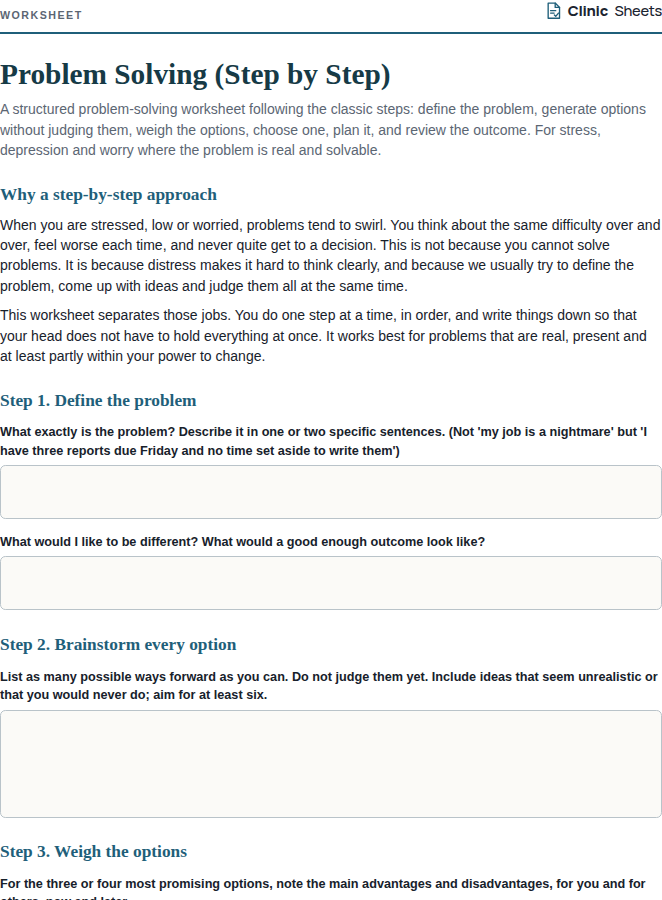
This worksheet combines the two stages. The log captures individual episodes with enough detail to see patterns: time of day, situation, the opening question or thought, how long it went on, mood before and after, and what eventually ended it. The interruption plan uses those patterns to create a personal set of early warning signs and pre-decided responses, so that in the moment the client does not have to invent a solution but can follow a plan. The plan emphasises the shift from abstract 'why' questions to concrete 'what' and 'how' questions, and the use of problem solving where a problem actually exists.
The professional version includes guidance on completing the functional analysis in session, a list of concrete alternatives graded by how much energy they require, and notes on clients who use the interruption plan as a new form of avoidance.
How to use it
- Introduce after Understanding Rumination. Ask the client to complete the log for one week before building the plan, so the plan rests on real data.
- Review the log at the next session. Look for patterns in timing, triggers and opening thoughts. Ask what ended each episode; this often reveals what works.
- Build the interruption plan collaboratively. The early warning signs should be the client's own, specific and observable (a particular phrase, a physical feeling, a time of day).
- Practise the abstract-to-concrete shift in session with a logged example. Ask the client to rewrite the opening 'why' question as a 'what' or 'how' question and follow it to an action.
- Agree two or three concrete alternatives for the plan, including at least one that requires very little energy, for low-mood days.
- Continue logging while the plan is in use. Track whether episodes become shorter and less frequent over the following weeks.
References
- Watkins, E. R. (2016). Rumination-Focused Cognitive-Behavioral Therapy for Depression. Guilford Press.
- Watkins, E. R. (2008). Constructive and unconstructive repetitive thought. Psychological Bulletin, 134(2), 163-206.
- Nolen-Hoeksema, S., Wisco, B. E., & Lyubomirsky, S. (2008). Rethinking rumination. Perspectives on Psychological Science, 3(5), 400-424.
- Nezu, A. M., Nezu, C. M., & D'Zurilla, T. J. (2013). Problem-Solving Therapy: A Treatment Manual. Springer.