Session-by-Session Protocol: Parent-Led CBT for Child Anxiety
A session-by-session clinician protocol for guided parent-led CBT for anxiety in children aged roughly five to twelve, following Creswell and colleagues' approach: the clinician coaches the parent through psychoeducation, goal setting, graded step plans (exposure), encouraging independence, problem solving, managing the parent's own responses, and relapse prevention.
About this resource
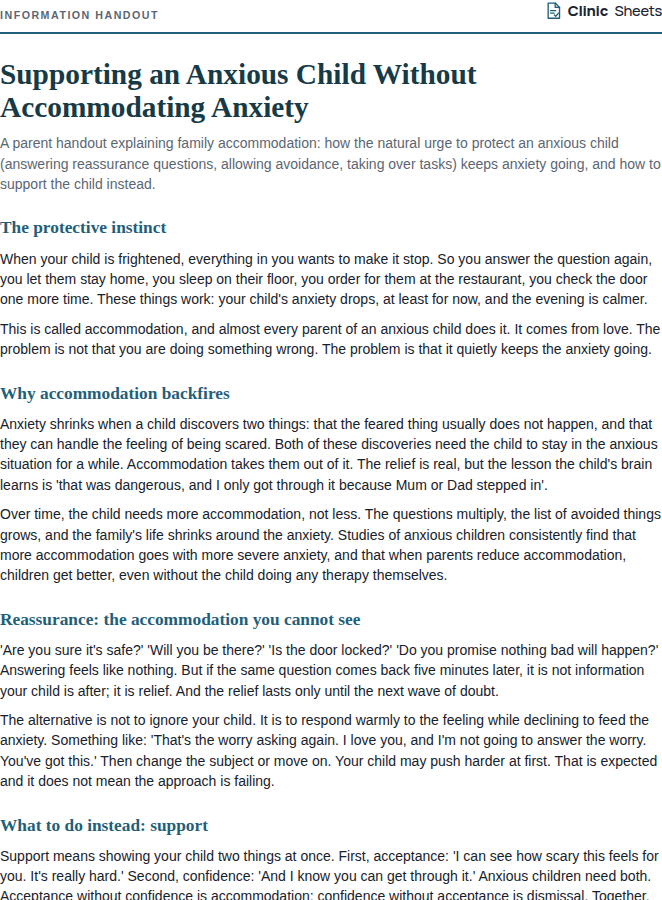
In parent-led CBT the parent, not the child, is the main recipient of the treatment. The clinician teaches the parent the cognitive behavioural principles and supports them to apply them at home: helping the child face fears in graded steps, responding to anxiety in ways that promote independence rather than accommodation, and using problem solving. The approach draws on the finding that parents of anxious children often, understandably, provide reassurance and allow avoidance, and that changing these responses can be as effective as working directly with the child. In the Thirlwall et al. (2013) randomised trial, a guided version of the treatment delivered in around eight contacts (a mix of face-to-face and telephone sessions) led to recovery in a substantial proportion of children compared with a waiting list.
This protocol follows the structure set out by Creswell, Parkinson, Thirlwall and Willetts, which pairs a parent workbook with brief clinician sessions. It is organised as eight contacts: four face-to-face sessions alternating with four telephone or video reviews. The parent reads a chapter before each contact and the session is spent on applying it to their child, troubleshooting, and planning the week's tasks. The child does not usually attend.
The professional version explains how to keep the parent in the role of the child's therapist rather than reporting to the clinician for advice, how to help parents build step plans that are small enough to succeed, how to address reassurance and accommodation without blaming the parent, and what to do when the parent's own anxiety gets in the way. It also notes the age range and presentations for which this format is and is not suitable.
How to use it
- Confirm an anxiety disorder in a child aged roughly five to twelve and screen for conditions that need a different approach. Administer a parent-report anxiety measure (for example the Spence Children's Anxiety Scale, parent version, or the RCADS parent version) at baseline and end, and set two or three goals with the parent that are rated at each contact.
- Give the parent the psychoeducation material before the first session and structure each session around applying it: what did you try, what happened, what will you try next.
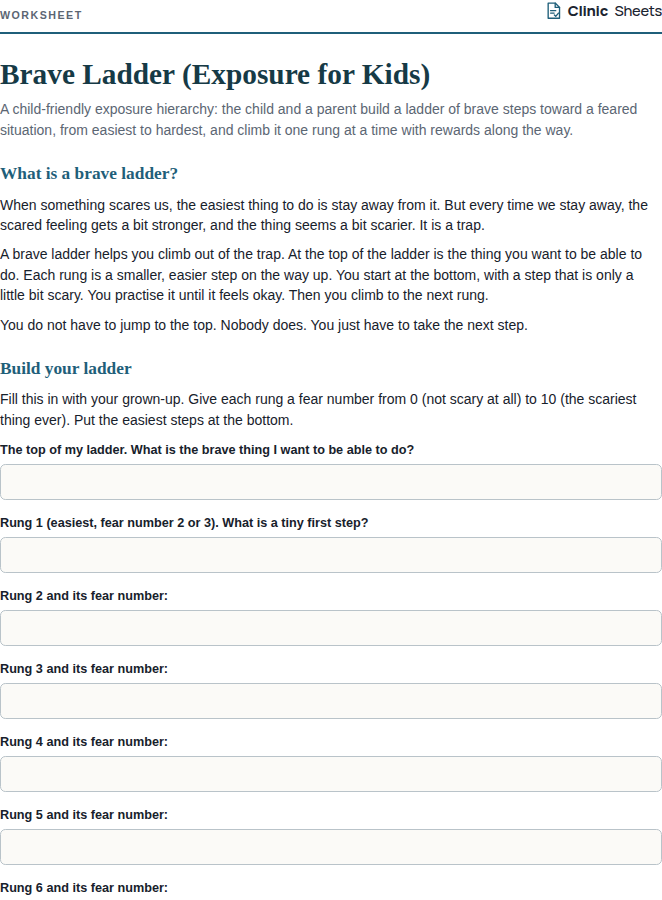
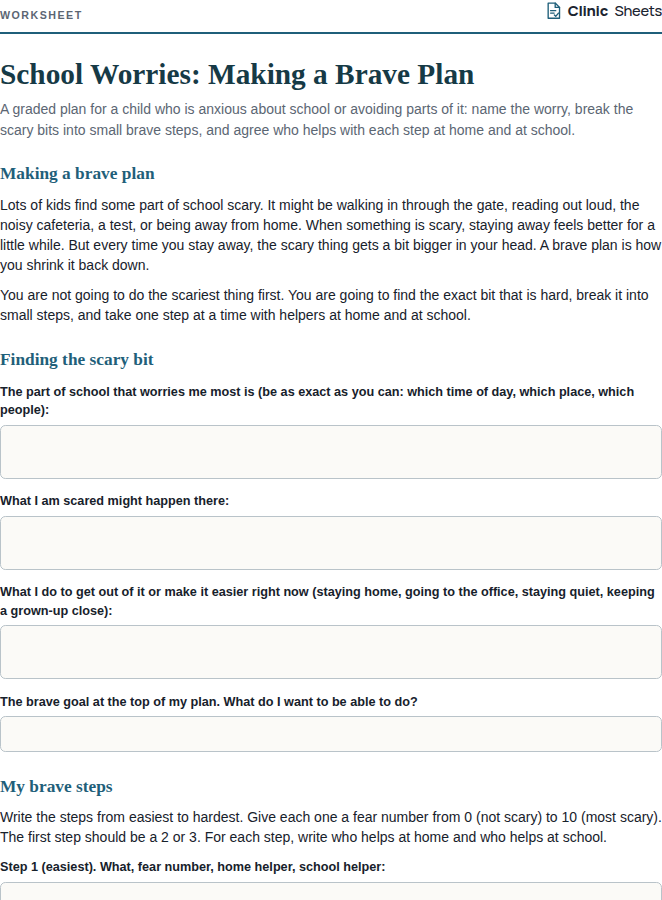
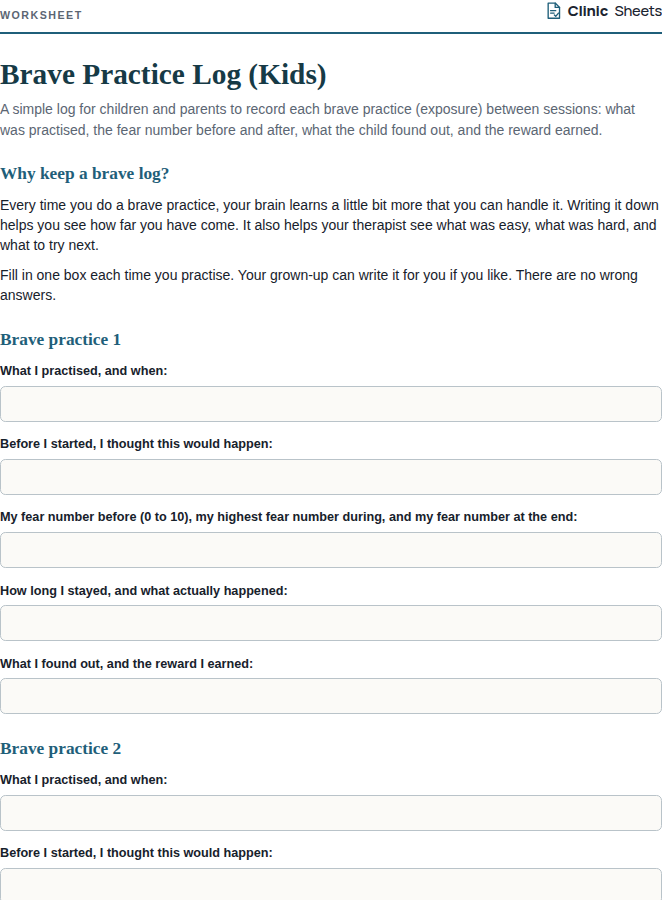
- Introduce the step plan by the second session. Every subsequent contact reviews the steps taken, adjusts the plan and sets the next steps. This is the core of the treatment.
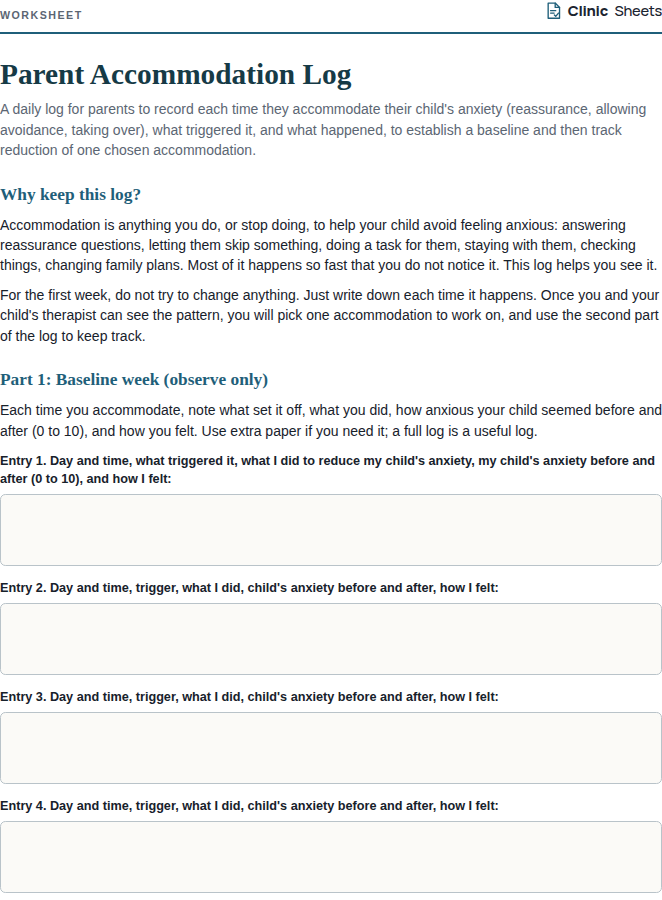
- Address the parent's own responses (reassurance, accommodation, taking over) explicitly and without judgement, framing them as natural reactions that can be changed.
- Use the final session for relapse prevention and give the parent a written plan for future fears.
References
- Creswell, C., Parkinson, M., Thirlwall, K., & Willetts, L. (2017). Parent-Led CBT for Child Anxiety: Helping Parents Help Their Kids. Guilford Press.
- Thirlwall, K., Cooper, P. J., Karalus, J., Voysey, M., Willetts, L., & Creswell, C. (2013). Treatment of child anxiety disorders via guided parent-delivered cognitive-behavioural therapy: Randomised controlled trial. British Journal of Psychiatry, 203(6), 436-444.
- Creswell, C., & Willetts, L. (2019). Helping Your Child with Fears and Worries: A Self-Help Guide for Parents (2nd ed.). Robinson.
- Rapee, R. M., Wignall, A., Spence, S. H., Cobham, V., & Lyneham, H. (2022). Helping Your Anxious Child: A Step-by-Step Guide for Parents (3rd ed.). New Harbinger.