Supporting an Anxious Child Without Accommodating Anxiety
A parent handout explaining family accommodation: how the natural urge to protect an anxious child (answering reassurance questions, allowing avoidance, taking over tasks) keeps anxiety going, and how to support the child instead.
About this resource
Family accommodation refers to the changes parents make to their own behaviour to reduce a child's anxiety in the moment: answering the same reassurance question repeatedly, speaking for the child, letting them skip school or sleep in the parents' bed, avoiding places or foods, or participating in rituals. Accommodation is nearly universal in families of anxious children, and it is well-intentioned. But research led by Eli Lebowitz and colleagues shows that higher accommodation is associated with more severe anxiety and poorer treatment outcomes, and that reducing accommodation, on its own, produces improvements in child anxiety comparable to child-focused CBT. Accommodation works through the same mechanism as avoidance: it removes the child's chance to learn that they can tolerate the feeling and that the feared outcome does not happen.
This handout helps parents recognise accommodation in their own home, understand why it backfires despite feeling kind, and replace it with a stance Lebowitz describes as supportive: showing the child both acceptance ('I know this is really hard for you') and confidence ('and I know you can handle it'). It covers reassurance seeking specifically, since it is the most common and most invisible form of accommodation, and gives parents a way to respond warmly without answering the anxiety's question. It also addresses the expected increase in distress when accommodation is reduced and how to hold steady through it.
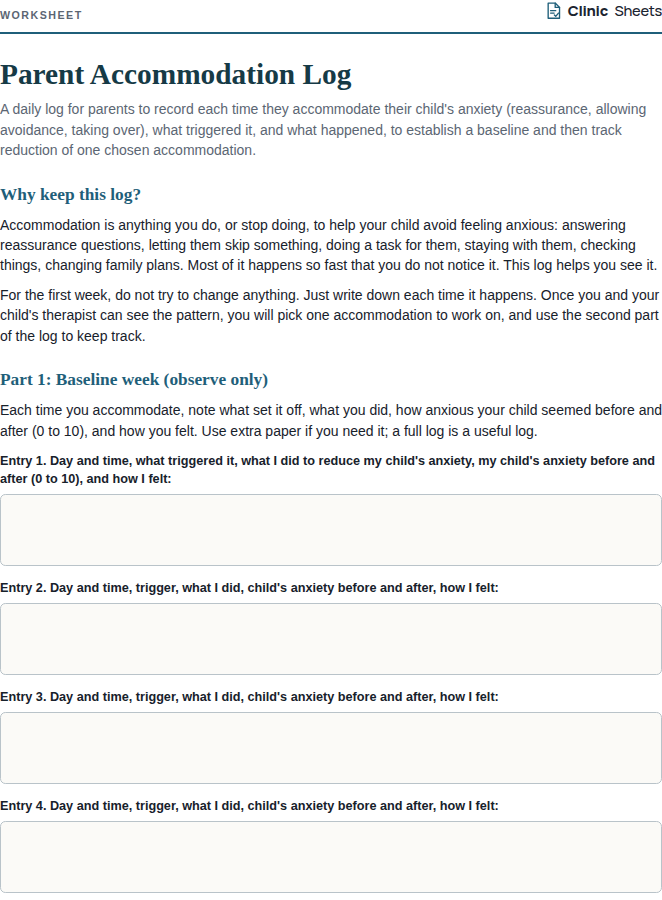
The professional version notes that accommodation should be reduced gradually and with a plan, one target at a time, rather than all at once, and that this handout is best paired with the Parent Accommodation Log. It also flags that parents who accommodate heavily are often anxious themselves and may need their own support to tolerate their child's distress.
How to use it
- Introduce the handout after assessing the child's anxiety and asking the parent directly what they do to help their child feel less anxious. Most parents will describe several accommodations without recognising them as such.
- Read the handout with the parent. Normalise accommodation as a natural, loving response before explaining why it maintains anxiety. Avoid any sense of blame.
- Help the parent identify their two or three most frequent accommodations. Use the Parent Accommodation Log for a week to establish a baseline.
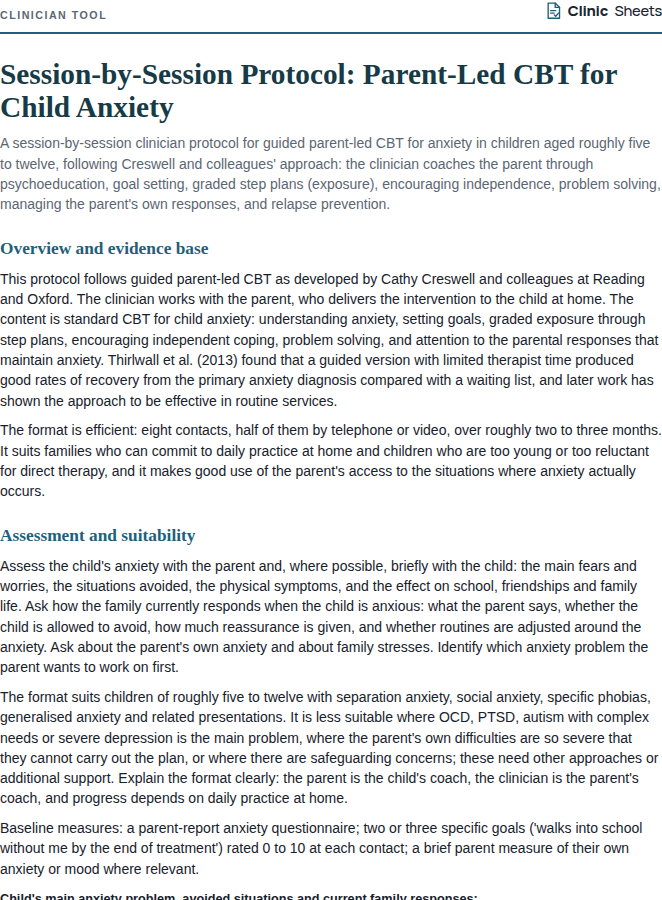
- Choose one accommodation to reduce first, usually one that is frequent and that the parent feels able to change. Plan exactly what the parent will say and do instead, using the supportive statement.
- Prepare the parent for a temporary increase in distress and protest. Review weekly, praise the parent's consistency, and move to the next target once the first has settled.
References
- Lebowitz, E. R. (2019). Addressing Parental Accommodation When Treating Anxiety in Children. Oxford University Press.
- Lebowitz, E. R., Marin, C., Martino, A., Shimshoni, Y., & Silverman, W. K. (2020). Parent-based treatment as efficacious as cognitive-behavioral therapy for childhood anxiety: A randomized noninferiority study of supportive parenting for anxious childhood emotions. Journal of the American Academy of Child and Adolescent Psychiatry, 59(3), 362-372.
- Rapee, R. M., Wignall, A., Spence, S. H., Cobham, V., & Lyneham, H. (2022). Helping Your Anxious Child: A Step-by-Step Guide for Parents (3rd ed.). New Harbinger.