Group Session Plan: 8-Week Anxiety Management Group
A facilitator's plan for an eight-week transdiagnostic CBT anxiety management group: purpose, format, materials, and session-by-session aims, content and between-session tasks, based on the cognitive model of anxiety and group CBT practice.
About this resource
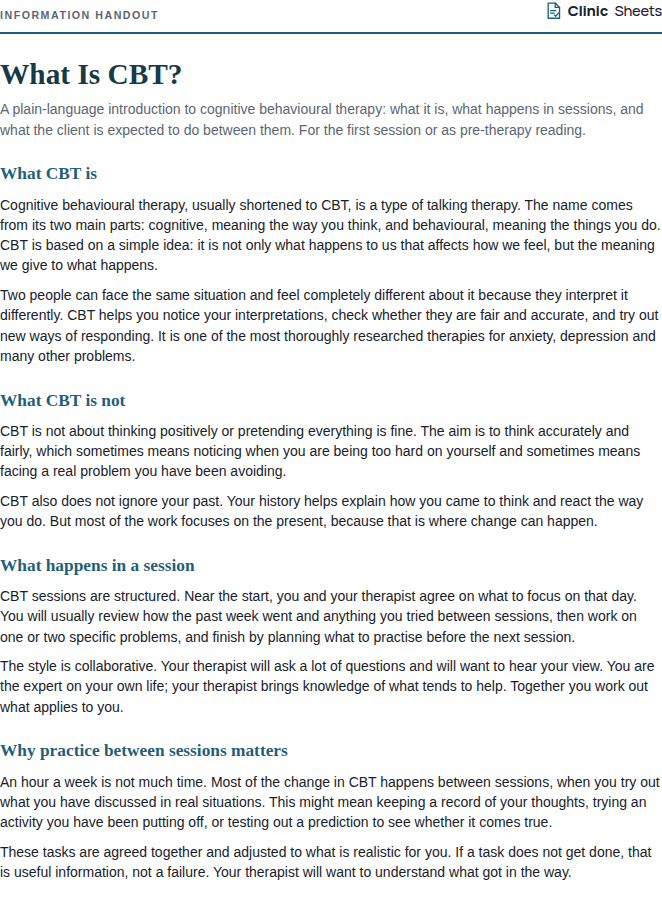
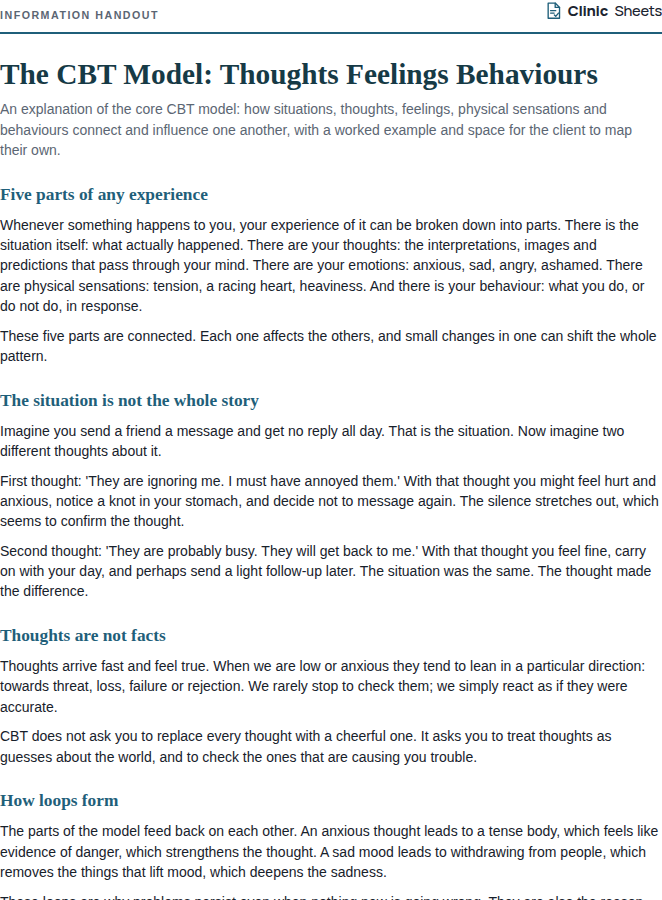
Anxiety management groups are among the most widely delivered group treatments in outpatient and primary care settings. They suit clients with generalised anxiety, panic, health anxiety, mild to moderate social anxiety and mixed anxiety presentations who share the same maintaining processes: threat-focused appraisal, overestimation of danger and underestimation of coping, physiological arousal, avoidance and safety behaviours. Group CBT for anxiety has a substantial evidence base, and group delivery adds normalisation, modelling and the chance to run in-session experiments with an audience.
This plan follows the structure common to Beck-style cognitive therapy for anxiety and to the transdiagnostic protocols that grew from it: psychoeducation on the anxiety response and the cognitive model, self-monitoring, arousal reduction as a coping skill rather than a safety behaviour, cognitive restructuring of threat appraisals, graded exposure using a personal hierarchy, dropping safety behaviours, and relapse prevention. Each session has a consistent shape: check-in and homework review, a teaching component, in-session practice, and setting the between-session task.
The professional version gives the facilitator a complete session outline with aims, content and homework for each of the eight sessions, format and screening recommendations, and a section on the challenges that arise most often in anxiety groups, including members who avoid exposure homework and members whose panic or health anxiety needs a more specific model than the group can offer.
How to use it
- Screen each prospective member individually before the group starts. Confirm that anxiety is the primary problem, that the person can tolerate a group, and that there is no acute risk, active substance dependence or untreated severe depression that would make individual work the better first step.
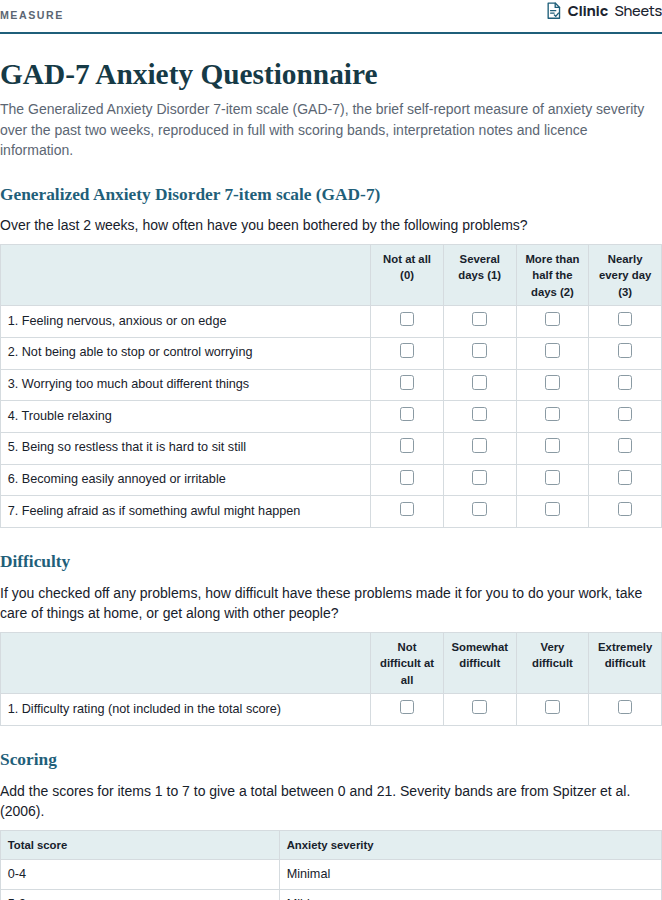
- Administer the GAD-7 at screening, at session 4 and at session 8, and a problem-specific measure where relevant. Share scores with members as part of the review sessions.
- Run the group with two facilitators where possible. One leads the teaching and the other tracks the room, supports members who are struggling, and helps set up in-session experiments.
- Keep to the session structure. Homework review is not optional; groups that skip it teach members that the between-session work does not matter.
- Give each member a folder with the handouts for each session and a personal hierarchy sheet, and encourage them to keep every completed worksheet so that the last session can look back across the whole course.
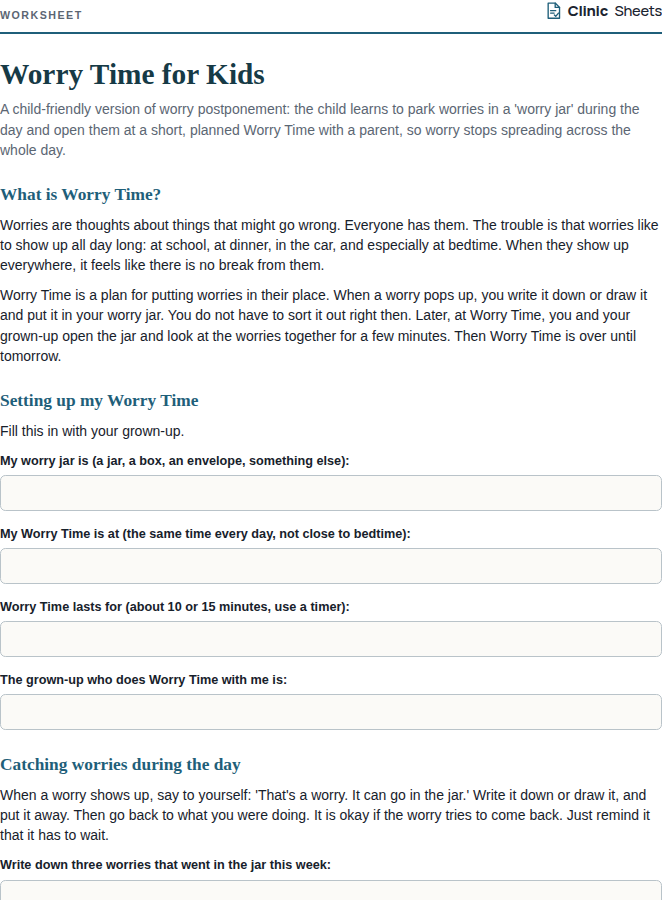
- Adapt the emphasis to the group. If most members have panic, spend more of session 3 on interoceptive work; if most have worry, expand the cognitive sessions to include worry postponement and intolerance of uncertainty.
References
- Clark, D. A., & Beck, A. T. (2010). Cognitive Therapy of Anxiety Disorders: Science and Practice. Guilford Press.
- Barlow, D. H., Farchione, T. J., Sauer-Zavala, S., Latin, H. M., Ellard, K. K., Bullis, J. R., Bentley, K. H., Boettcher, H. T., & Cassiello-Robbins, C. (2018). Unified Protocol for Transdiagnostic Treatment of Emotional Disorders: Therapist Guide (2nd ed.). Oxford University Press.
- Bieling, P. J., McCabe, R. E., & Antony, M. M. (2006). Cognitive-Behavioral Therapy in Groups. Guilford Press.
- Yalom, I. D., & Leszcz, M. (2020). The Theory and Practice of Group Psychotherapy (6th ed.). Basic Books.