Supporting a Loved One with Addiction
A handout for family members and partners of someone with a substance use problem. Drawing on the CRAFT approach, it explains what helps and what backfires, how to talk without arguing, how to stop shielding the person from consequences, and how to protect your own wellbeing.
About this resource
Family members of people with substance use problems frequently arrive in distress, having tried pleading, threatening, monitoring, covering up, and confrontation, often in cycles, with little effect. Community Reinforcement and Family Training (CRAFT), developed by Meyers and Smith, is the family approach with the strongest evidence for engaging a reluctant user in treatment. Its principles are practical: reinforce sober behaviour, allow the natural consequences of use to occur rather than cushioning them, communicate in a way that reduces conflict, and attend to the family member's own life and wellbeing regardless of whether the user changes. Motivational interviewing supplies the communication style: open questions, reflective listening, avoiding argument, and respecting that the decision to change belongs to the person.
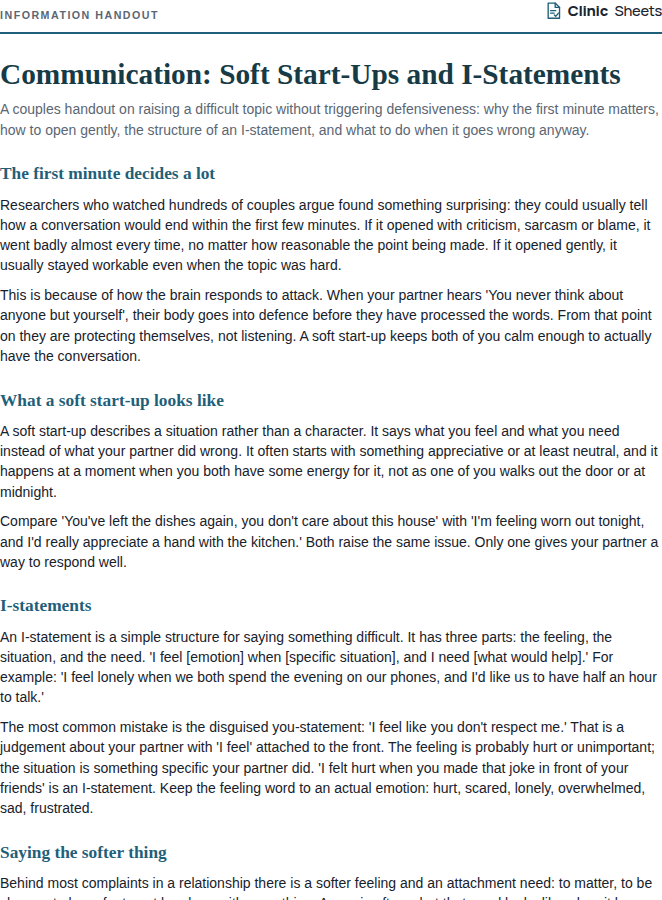
This handout translates those principles for a lay reader. It normalises the family member's exhaustion and anger, explains why confrontation and rescuing both tend to entrench the problem, offers a concrete communication approach for raising concerns, discusses safety, and directs attention to the family member's own supports. It is careful not to blame the family member for the substance use or to promise that the approach will make the person seek help.
The professional version adds notes on assessing domestic safety before recommending any change in the family member's behaviour, on the full CRAFT protocol for clinicians who wish to deliver it, and on referral to family-specific supports.
How to use it
- Assess for safety first. If there is any history of violence or intimidation, plan around safety before discussing changes to how the family member responds to use.
- Ask what the family member has already tried and how it went. Most have tried everything in the 'what backfires' section and will recognise it.
- Work through the communication section with a live example from the family member's week, and rehearse one conversation in session.
- Help the family member identify one consequence of use they have been absorbing and decide whether they can safely stop absorbing it.
- Give explicit attention to the family member's own life: sleep, friendships, activities and support. Offer referral to family support groups or a CRAFT program where available.
References
- Smith, J. E., & Meyers, R. J. (2004). Motivating substance abusers to enter treatment: Working with family members. Guilford Press.
- Meyers, R. J., & Wolfe, B. L. (2004). Get your loved one sober: Alternatives to nagging, pleading, and threatening. Hazelden.
- Copello, A. G., Velleman, R. D. B., & Templeton, L. J. (2005). Family interventions in the treatment of alcohol and drug problems. Drug and Alcohol Review, 24(4), 369-385.
- Miller, W. R., & Rollnick, S. (2013). Motivational interviewing: Helping people change (3rd ed.). Guilford Press.