Supporting a Partner with PTSD
A handout for the partners and family members of someone with PTSD: what the symptoms look like from the outside, how they affect the relationship, what helps, and what tends to backfire. Written for both partners to read together.
About this resource
PTSD is a relational condition as much as an individual one. Emotional numbing, irritability, withdrawal, avoidance of shared activities and disrupted sleep all land on the people closest to the person, and meta-analytic evidence links PTSD with poorer relationship satisfaction, higher conflict and greater partner distress. Partners often oscillate between over-accommodation (taking over tasks, avoiding topics, tiptoeing around triggers) and frustration or withdrawal, and both patterns can inadvertently maintain the avoidance at the heart of the disorder.
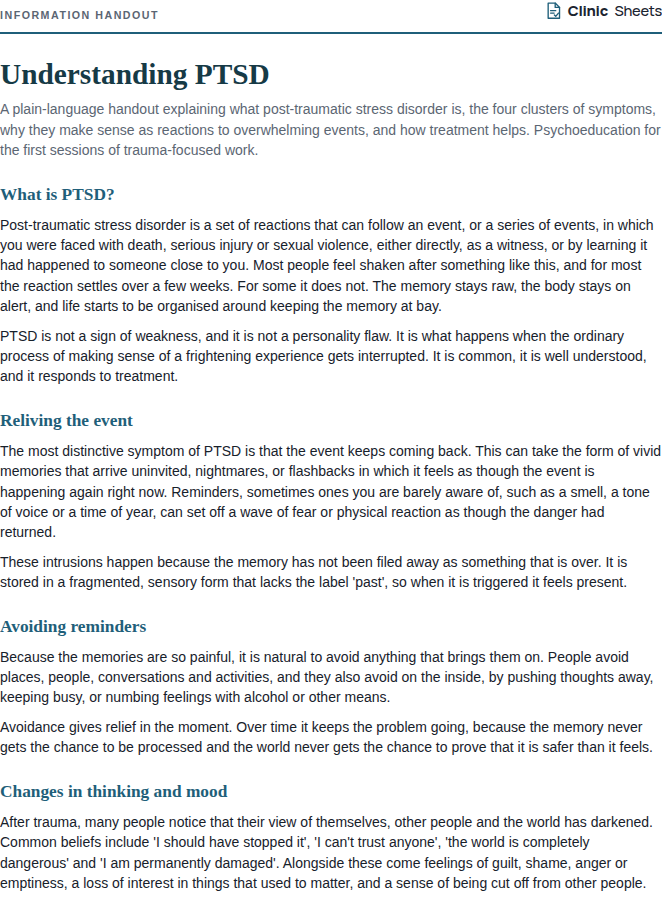
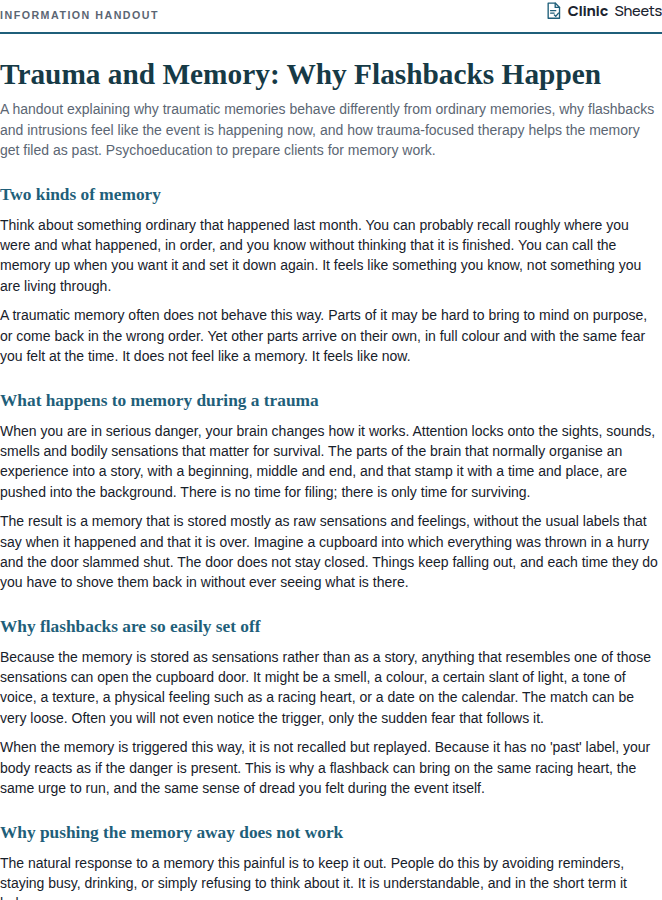
This handout gives partners an accurate picture of PTSD through the lens of the cognitive model: symptoms as products of a memory that has not been filed as past and a threat system stuck on, rather than as choices or as evidence of how the person feels about the relationship. It then describes what genuinely helps (understanding, predictability, encouragement of approach rather than avoidance, looking after oneself) and what tends to backfire (pushing for details, accommodating avoidance, taking anger personally, becoming the therapist). It draws on the principles of cognitive-behavioural conjoint therapy for PTSD, in which the partner is enlisted as an ally in reducing avoidance while the couple work on communication and closeness.
The professional version notes indicators for referring the couple to conjoint or couples therapy, the importance of assessing for intimate partner violence in either direction before any joint work, and the value of a separate support conversation with the partner, who may be carrying significant distress of their own.
How to use it
- Offer the handout once the client with PTSD has agreed that their partner or family member be given information. Discuss what the client is and is not comfortable with the partner knowing.
- Where possible, invite the partner to a session to go through the handout together. Frame it as a way of helping the relationship, not as the partner being taught to manage the client.
- Ask the couple to identify one accommodation pattern (something the partner does that helps the client avoid) and one thing the partner could do differently that supports approach instead. Keep changes small and agreed by both.
- Encourage the partner to attend to their own wellbeing and to seek support if needed. Offer information about partner support services where available.
- If the couple describe frequent high conflict, coercion or fear, assess safety separately with each partner before proceeding with any joint work.
References
- Monson, C. M., & Fredman, S. J. (2012). Cognitive-Behavioral Conjoint Therapy for PTSD: Harnessing the Healing Power of Relationships. Guilford Press.
- Taft, C. T., Watkins, L. E., Stafford, J., Street, A. E., & Monson, C. M. (2011). Posttraumatic stress disorder and intimate relationship problems: A meta-analytic review. Journal of Consulting and Clinical Psychology, 79(1), 22-33.
- Ehlers, A., & Clark, D. M. (2000). A cognitive model of posttraumatic stress disorder. Behaviour Research and Therapy, 38(4), 319-345.