Teen Thought Record
A thought record written for adolescents: catch the thought behind a strong feeling, check it against the facts, and land on a more accurate take. Straight talking, no lectures.
About this resource
Adolescents are often well able to use cognitive restructuring, but they are quick to disengage from worksheets that feel childish, preachy or like homework. A thought record for this age group needs to respect their intelligence, use their language without imitating it, and make the point of the exercise obvious. Teenagers also tend to have a sharp sense of when an adult is trying to talk them out of a feeling, so the framing here is not 'your thought is wrong' but 'let's check whether your brain is giving you the full picture'.
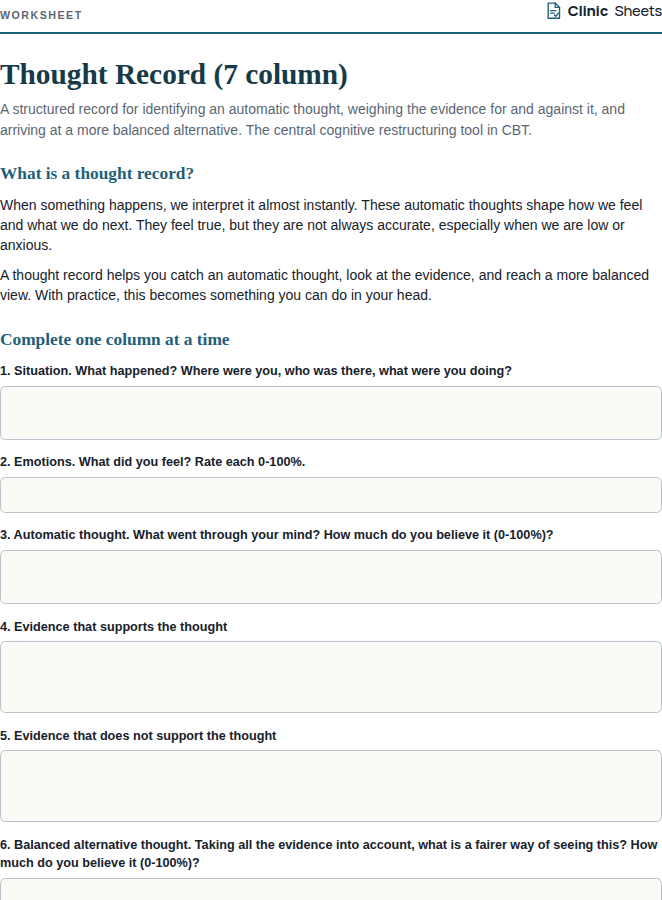
This worksheet follows the standard sequence of a thought record with a shorter column count and prompts designed for common adolescent situations: social exclusion, academic pressure, conflict with parents, and body image. It asks the young person to identify the situation, the feeling and its intensity, the thought, the evidence on each side, a more accurate thought, and the feeling afterwards. A final prompt asks what they would say to a friend, which is often the fastest route to a balanced view for this age group.
The professional version adds guidance on collaborative rather than directive completion, on common thinking traps in adolescence (mind reading, catastrophising, all-or-nothing thinking about identity), on adapting the record for digital formats such as a notes app, and on when to hold off on thought challenging because the thought is accurate and the task is problem solving or acceptance.
How to use it
- Introduce the thoughts-feelings link with an example from the young person's own week rather than a textbook one. Ask what went through their mind, not why they felt that way.
- Complete the first record together and let the young person write. Position yourself as curious rather than corrective: 'I'm not saying the thought is wrong. Let's just see what the evidence says.'
- For the evidence against, use the friend question early. Most adolescents can generate a fairer view for a friend long before they can for themselves.
- Agree on a format for between-session use that fits their life. A photo of the sheet, a notes app template, or a voice memo all count. One record a week is a realistic target.
- Review records briefly at the start of each session. Notice patterns across records (the same thinking trap, the same theme) and name them together.
References
- Friedberg, R. D., & McClure, J. M. (2015). Clinical Practice of Cognitive Therapy with Children and Adolescents: The Nuts and Bolts (2nd ed.). Guilford Press.
- Stallard, P. (2019). Think Good, Feel Good: A Cognitive Behavioural Therapy Workbook for Children and Young People (2nd ed.). Wiley.
- Greenberger, D., & Padesky, C. A. (2015). Mind Over Mood (2nd ed.). Guilford Press.