Thought Detective (CBT for Kids)
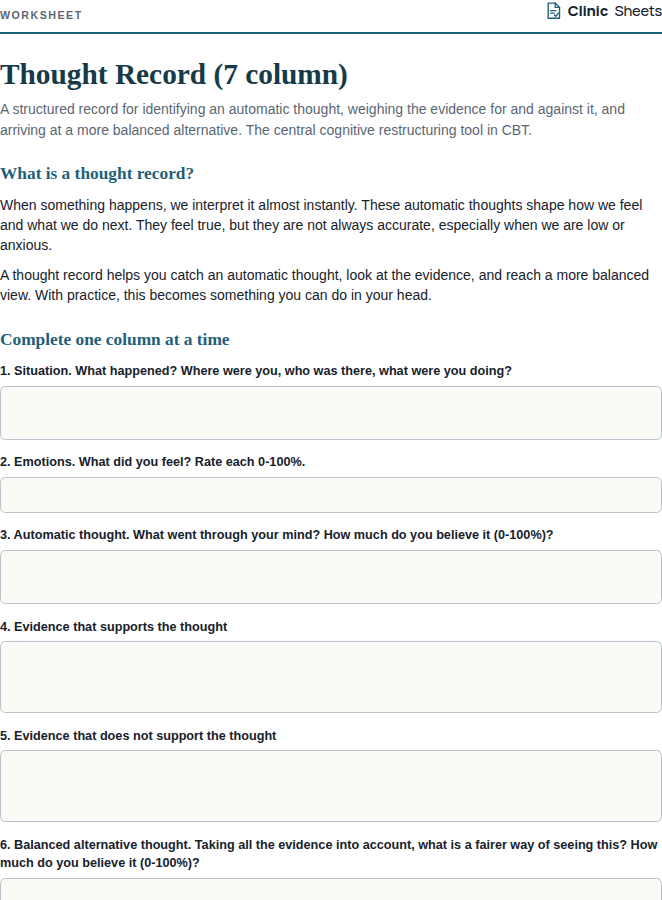
A simplified thought record for children in which they play detective: catch a worried or gloomy thought, hunt for clues that support and go against it, and decide what a fair verdict would be.
About this resource
Cognitive restructuring with children works best when it is framed as a game rather than a debate. The detective metaphor gives the child a role (investigator), a task (find the clues), and a goal (a fair verdict) that keeps the exercise concrete and playful. It also makes an important point implicitly: thoughts are suspects to be investigated, not facts to be obeyed. This framing is widely used in child CBT programs for anxiety and low mood.
This worksheet takes the child through a shortened thought record. They describe what happened, name the feeling and its size, catch the thought that popped up, collect clues for and against it, and write a fairer thought. It is written for children aged roughly seven to twelve who can read and write with some support. Younger children can complete it with a parent scribing.
The professional version adds guidance on helping a child find the 'hot' thought when they can only name a feeling, on the difference between clues and wishes, and on when a thought is actually accurate and the task becomes coping rather than reappraisal. It also flags that thought challenging is generally less effective for young children than behavioural strategies, and should sit alongside exposure or activity rather than replace them.
How to use it
- Introduce the link between thoughts and feelings with a shared example: two children hear a noise at night. One thinks 'it's a burglar' and feels scared; the other thinks 'it's the cat' and goes back to sleep. Same noise, different thought, different feeling.
- Explain the detective job: a good detective does not decide who is guilty before looking at the clues. Our job is to find the clues about whether the thought is true.
- Complete the first record together in session, using a real situation from the past week. Help the child turn a feeling ('I felt bad') into a thought ('I thought nobody wanted to play with me').
- Collect clues on both sides. Prompt for clues against with questions like: Has this happened before and turned out okay? What would your best friend say? What would a detective notice that you might have missed?
- Write the fair verdict together and re-rate the feeling. Point out any change, even a small one.
- Ask the parent to help the child complete one detective case between sessions when a big feeling comes up. Review it at the next session and praise the detective work, not the outcome.
References
- Stallard, P. (2019). Think Good, Feel Good: A Cognitive Behavioural Therapy Workbook for Children and Young People (2nd ed.). Wiley.
- Kendall, P. C., & Hedtke, K. A. (2006). Cognitive-Behavioral Therapy for Anxious Children: Therapist Manual (3rd ed.). Workbook Publishing.
- Friedberg, R. D., & McClure, J. M. (2015). Clinical Practice of Cognitive Therapy with Children and Adolescents: The Nuts and Bolts (2nd ed.). Guilford Press.