Understanding Dissociation
A handout explaining dissociation in plain terms: what it feels like, why it develops as a response to overwhelming experiences, the range from everyday zoning out to more severe forms, and how it can be managed and treated.
About this resource
Dissociation is a disruption in the normal integration of consciousness, memory, identity, perception and bodily awareness. It ranges from ordinary experiences such as losing track of a familiar drive, through depersonalisation and derealisation, to gaps in memory and, at the far end, dissociative identity. In trauma populations it is extremely common and frequently unrecognised by clients themselves, who may describe it as 'spacing out', 'going blank' or 'not being here' without knowing that it has a name or a cause.
The handout presents dissociation as a protective response that develops when escape from an overwhelming situation is not possible, so the mind creates distance instead. This framing, drawn from structural dissociation theory and from the clinical literature on trauma-related dissociation, reduces shame and gives clients a rationale for grounding and stabilisation skills. It also explains why dissociation that was once adaptive becomes a problem when it is triggered automatically in situations that are not dangerous, and why it interferes with therapy if it is not addressed.
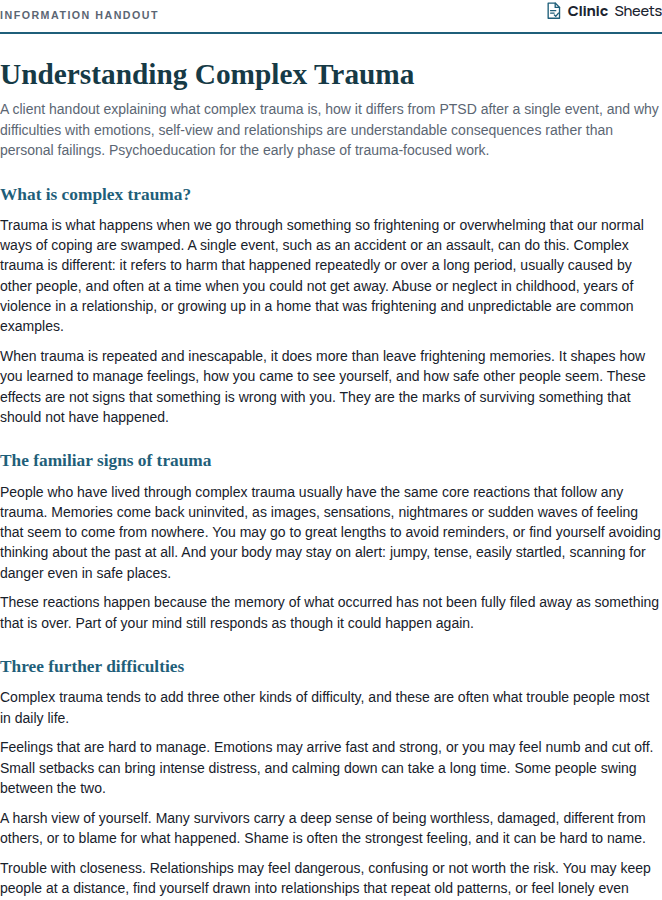
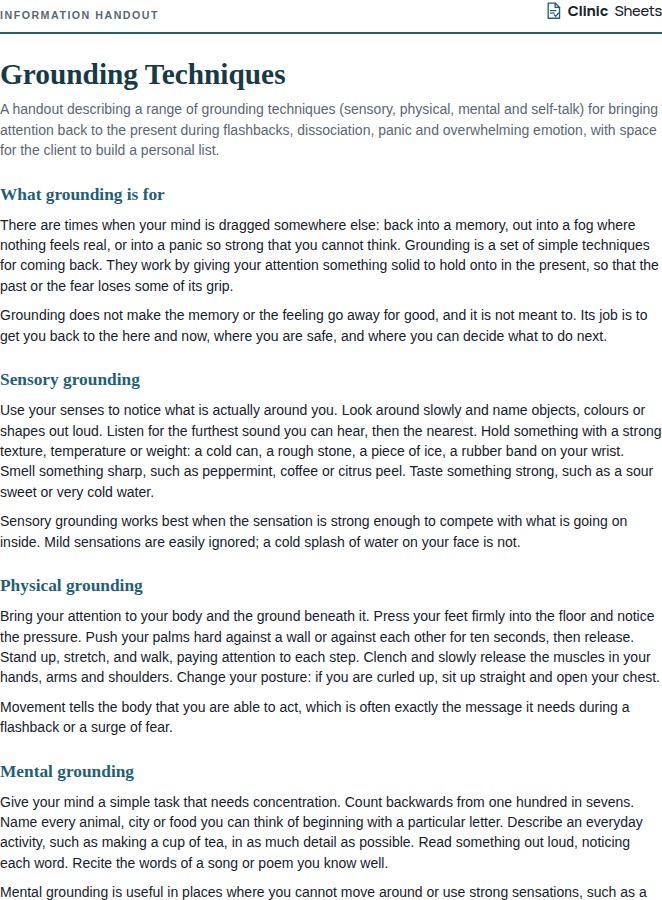
The resource is designed for adults with trauma histories and for anyone whose assessment reveals significant dissociative symptoms. It pairs with Grounding Techniques and Window of Tolerance. The professional version adds guidance on screening (including the DES-II), on recognising dissociation in session, on the distinction between dissociation and psychosis, and on the importance of establishing stabilisation before trauma processing in clients who dissociate heavily.
How to use it
- Use after assessment has identified dissociative symptoms, and before trauma processing. Many clients are relieved simply to learn that their experience has a name.
- Read the handout together and ask the client to describe their own experiences in their own words. Note the phrases they use so you can recognise dissociation when it happens in session.
- Explore when dissociation first started and what it protected the client from. Frame it explicitly as a survival skill that has outlived its usefulness in some settings.
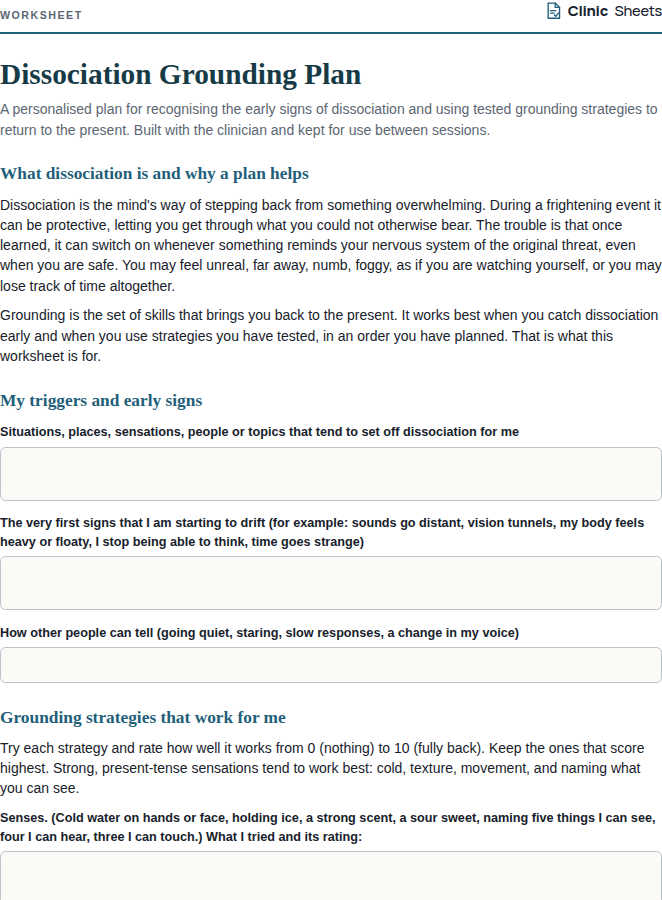
- Identify the client's current triggers and early signs, and agree a grounding signal you can use in session if they begin to drift.
- Follow with Grounding Techniques and a personalised plan for staying present. Reassure the client that trauma work will be paced around their capacity to stay within their window.
References
- Van der Hart, O., Nijenhuis, E. R. S., & Steele, K. (2006). The Haunted Self: Structural Dissociation and the Treatment of Chronic Traumatization. W. W. Norton.
- Bernstein, E. M., & Putnam, F. W. (1986). Development, reliability, and validity of a dissociation scale. Journal of Nervous and Mental Disease, 174(12), 727-735.
- Kennedy, F., Kennerley, H., & Pearson, D. (Eds.). (2013). Cognitive Behavioural Approaches to the Understanding and Treatment of Dissociation. Routledge.
- International Society for the Study of Trauma and Dissociation. (2011). Guidelines for treating dissociative identity disorder in adults, third revision. Journal of Trauma and Dissociation, 12(2), 115-187.