Validation for Parents
A worksheet that teaches parents the DBT skill of validation: what it is (and is not), how to find the kernel of truth in a child's reaction, and how to practise validating statements in the situations that usually go badly.
About this resource
In DBT, validation means communicating to another person that their feelings, thoughts or actions make sense given their situation and history. It does not mean agreeing, approving or giving in. Linehan's biosocial model proposes that emotion dysregulation develops partly from an environment that repeatedly invalidates a child's inner experience (telling them they are overreacting, that they should not feel that way, or that the feeling is wrong), and DBT for adolescents makes validation a core family skill for exactly this reason. Fruzzetti's work on family and couple validation describes the same mechanism: accurate validation lowers emotional arousal, which makes problem-solving possible; invalidation raises it, which makes the problem worse even when the parent's point is correct.
This worksheet gives parents a working definition, a set of distinctions (validating the feeling is not the same as validating the behaviour; validating is not the same as fixing), and a simple method: find the part that makes sense, say it in plain words, and pause before doing anything else. Parents then practise on three of their own recent situations, writing what they actually said, what the invalidating message may have been, and a validating alternative. The worksheet ends with what to do when a child's demand cannot be met, which is where parents most often abandon validation.
The professional version notes that many parents fear validation will reward bad behaviour or 'wallowing', and that this fear needs addressing directly with the distinction between validating emotion and permitting action. It also cautions against formulaic validation ('I hear that you feel...'), which children detect immediately, and suggests parents aim for their own natural words.
How to use it
- Define validation and, just as importantly, what it is not. Give examples in the parent's own context. Check that the parent understands validating a feeling does not mean changing a limit.
- Ask the parent to describe a recent conflict. Identify together what the child may have heard as invalidating, even if the parent's intent was good.
- Practise finding the kernel of truth: what about the child's reaction makes sense, given their age, their day, and what they wanted? Draft a validating sentence in the parent's own words, then role-play it.
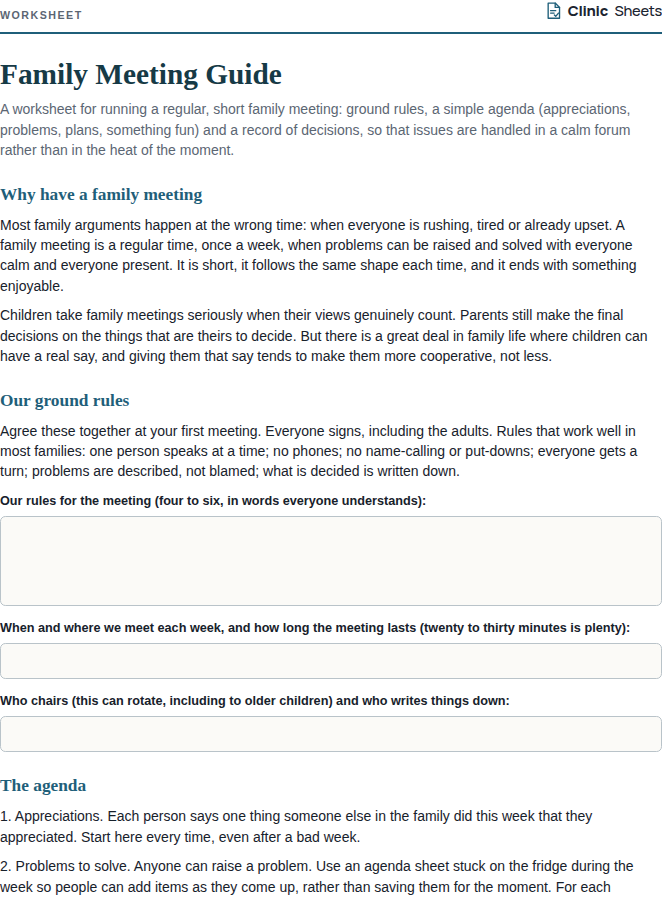
- Have the parent complete the three practice situations on the worksheet, ideally in session for the first one and at home for the rest.
- Set a home task: validate first, before any teaching, limit or solution, in at least one hard moment this week. Review what the child did in response.
References
- Linehan, M. M. (1997). Validation and psychotherapy. In A. C. Bohart & L. S. Greenberg (Eds.), Empathy Reconsidered: New Directions in Psychotherapy (pp. 353-392). American Psychological Association.
- Rathus, J. H., & Miller, A. L. (2015). DBT Skills Manual for Adolescents. Guilford Press.
- Fruzzetti, A. E. (2006). The High-Conflict Couple: A Dialectical Behavior Therapy Guide to Finding Peace, Intimacy, and Validation. New Harbinger.