Co-Regulation: Helping Your Child Calm Down
A handout for parents on co-regulation: why children borrow calm from adults, what to do in the moment of a meltdown (and what makes it worse), and how repeated co-regulation builds a child's own ability to self-regulate.
About this resource
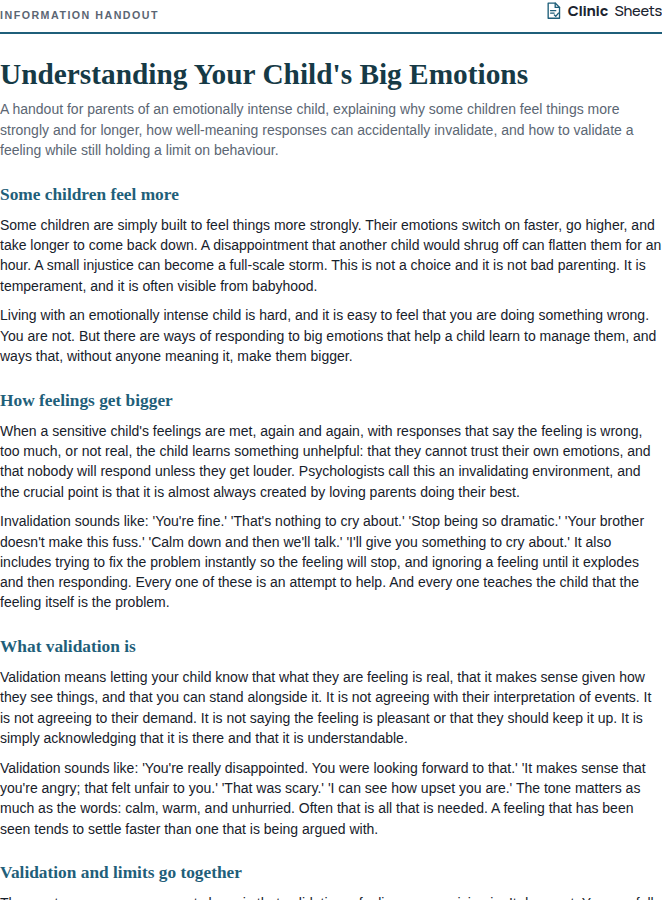
Children are not born able to regulate strong emotion. They learn it gradually, over years, by being regulated: a calm, attuned adult lends the child their nervous system until the child can manage on their own. This process, co-regulation, is central to attachment-informed and emotion-coaching approaches to parenting, and it is the developmental basis for the emotion regulation skills later taught in CBT and DBT. Gottman's research on emotion coaching found that parents who notice, name and accept their child's feelings before guiding behaviour raise children who regulate better and have fewer behavioural problems, and Havighurst and colleagues' Tuning in to Kids trials have replicated the benefits of teaching parents this approach.
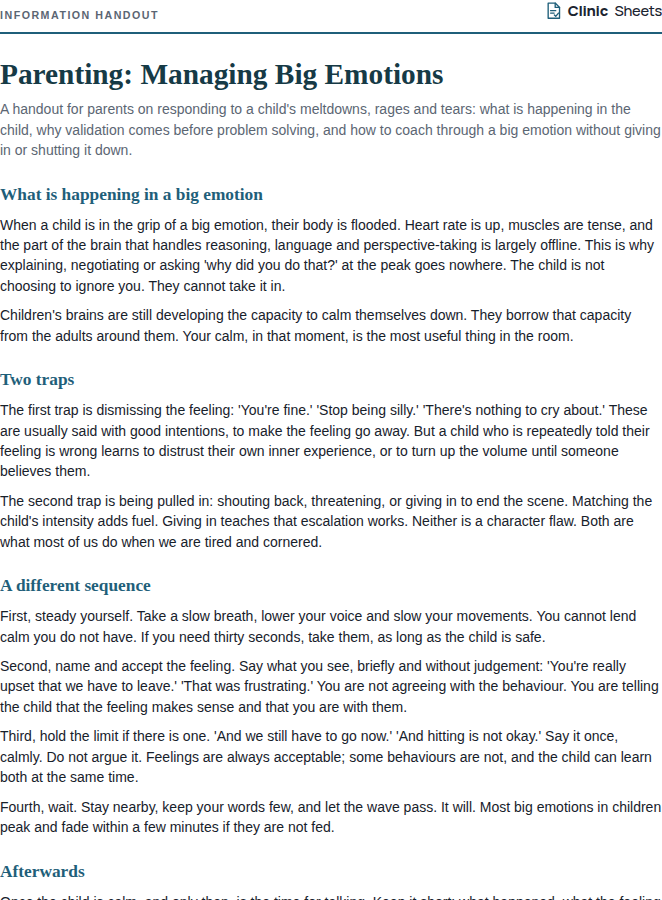
The handout explains the idea in plain language, then gives a practical sequence for the moment of a meltdown: get yourself calm first, get close and low, name the feeling, keep words few and warm, wait, and only then teach or set limits. It also names the common responses that escalate a child (reasoning, threatening, matching their volume, demanding they calm down) and explains why they fail. A short section on invalidation covers the ways well-meaning parents accidentally tell a child their feeling is wrong, which DBT identifies as a key contributor to emotion dysregulation.
The professional version adds notes on the parent's own regulation as the real target of the intervention, on parents whose own histories make a child's distress intolerable, and on the difference between co-regulation and giving in: a parent can hold a limit and be soothing at the same time. It pairs with Validation for Parents and Calm Corner Plan.
How to use it
- Use when a parent describes frequent meltdowns, tantrums or explosive outbursts and their attempts to manage them are escalating things. Read the handout with the parent in session if possible.
- Ask the parent to describe a recent incident step by step. Map what they did onto the sequence and the escalators in the handout, without blame.
- Focus first on the parent's own calm. Ask what happens in their body when their child melts down, and agree one thing they will do to settle themselves before responding.
- Practise the naming step with role-play: the parent says the feeling out loud in a low, slow voice, using few words.
- Set one small experiment for the week (for example, at the next meltdown, say nothing for the first thirty seconds except the feeling's name). Review how it went and what the child did.
References
- Gottman, J. M., & DeClaire, J. (1997). Raising an Emotionally Intelligent Child: The Heart of Parenting. Simon & Schuster.
- Havighurst, S. S., Wilson, K. R., Harley, A. E., Prior, M. R., & Kehoe, C. (2010). Tuning in to Kids: Improving emotion socialization practices in parents of preschool children. Journal of Child Psychology and Psychiatry, 51(12), 1342-1350.
- Siegel, D. J., & Bryson, T. P. (2011). The Whole-Brain Child: 12 Revolutionary Strategies to Nurture Your Child's Developing Mind. Delacorte Press.
- Linehan, M. M. (1993). Cognitive-Behavioral Treatment of Borderline Personality Disorder. Guilford Press.