Values Card Sort
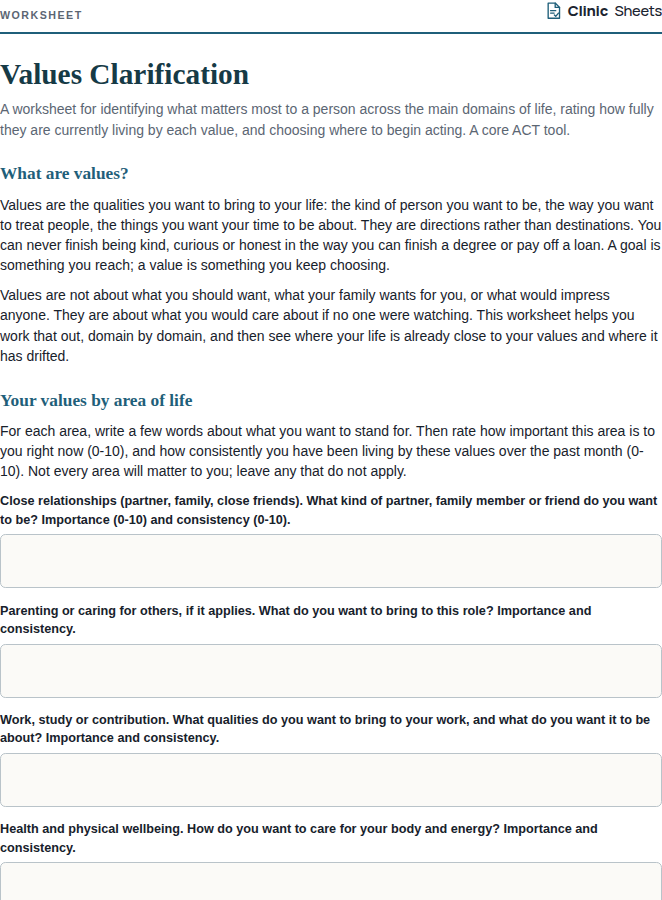
A hands-on values clarification exercise in which the client sorts a set of value words into three piles (very important, somewhat important, not important right now), narrows to a small core set, and reflects on how each is currently lived. Suitable for adults and adolescents.
About this resource
Values clarification is central to acceptance and commitment therapy and to most approaches to motivation and life transition. Values, in the ACT sense, are chosen qualities of ongoing action: how a person wants to behave and what they want to stand for, as distinct from goals, which can be completed. When people lose contact with their values, through depression, avoidance or a major life change, behaviour tends to be driven by short-term relief or by other people's expectations, and life feels flat or directionless. Making values explicit gives direction to committed action and gives the client a reason to tolerate discomfort.
A card sort makes this abstract task concrete. Handling and sorting physical cards engages clients who find open questions ('what matters to you?') difficult, and it produces a visible result the client can photograph and keep. Adolescents often respond better to sorting than to writing. The exercise below can be run with printed cards, index cards the client writes on, or a simple list, and it includes a set of value words to start from.
The professional version adds guidance on separating values from goals and from 'shoulds' during the debrief, on the common situation where a client sorts a value as very important but rates it as barely lived, and on using the final set to seed a committed action plan.
How to use it
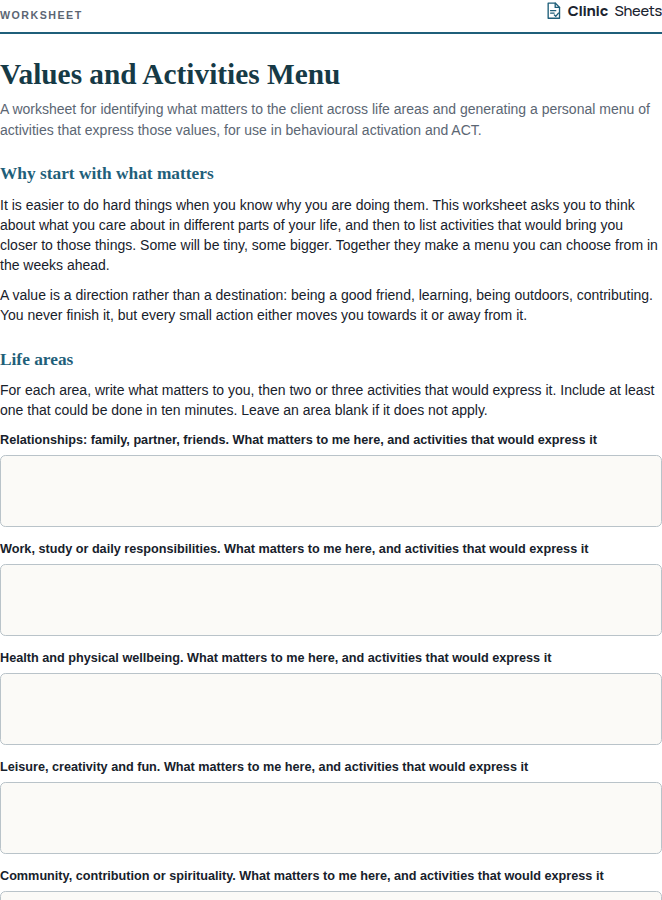
- Prepare a deck of thirty to fifty value words on cards, one per card, including a few blanks. The list in the client section is a starting point; add or remove words to suit the client.
- Ask the client to sort every card into three piles: very important to me, somewhat important, not important to me right now. Encourage quick, gut-level decisions on the first pass.
- From the very important pile, ask the client to choose their five to eight most central values. This is usually harder and more revealing than the first sort. Notice what they struggle to let go of.
- For each chosen value, ask two questions: what does living this look like in practice, and how fully are you living it at the moment (0-10)? The gap between importance and current living identifies where work is needed.
- Debrief the difference between a value and a goal, and between a value and an expectation from others. If a card feels like a should, ask whether they would still choose it if nobody ever knew.
- Photograph or list the final set. Use it to guide goal setting and committed action in later sessions, and repeat the sort after a few months or after a major change.
References
- Hayes, S. C., Strosahl, K. D., & Wilson, K. G. (2012). Acceptance and Commitment Therapy: The Process and Practice of Mindful Change (2nd ed.). Guilford Press.
- Wilson, K. G., & Murrell, A. R. (2004). Values work in acceptance and commitment therapy: Setting a course for behavioral treatment. In S. C. Hayes, V. M. Follette, & M. M. Linehan (Eds.), Mindfulness and Acceptance: Expanding the Cognitive-Behavioral Tradition (pp. 120-151). Guilford Press.
- Harris, R. (2019). ACT Made Simple: An Easy-to-Read Primer on Acceptance and Commitment Therapy (2nd ed.). New Harbinger.