SMART Goals
A goal-setting worksheet that turns a vague intention into a goal that is Specific, Measurable, Achievable, Relevant and Time-bound, then breaks it into a first step and anticipates obstacles. For adults and adolescents in depression, life transitions and general therapy planning.
About this resource
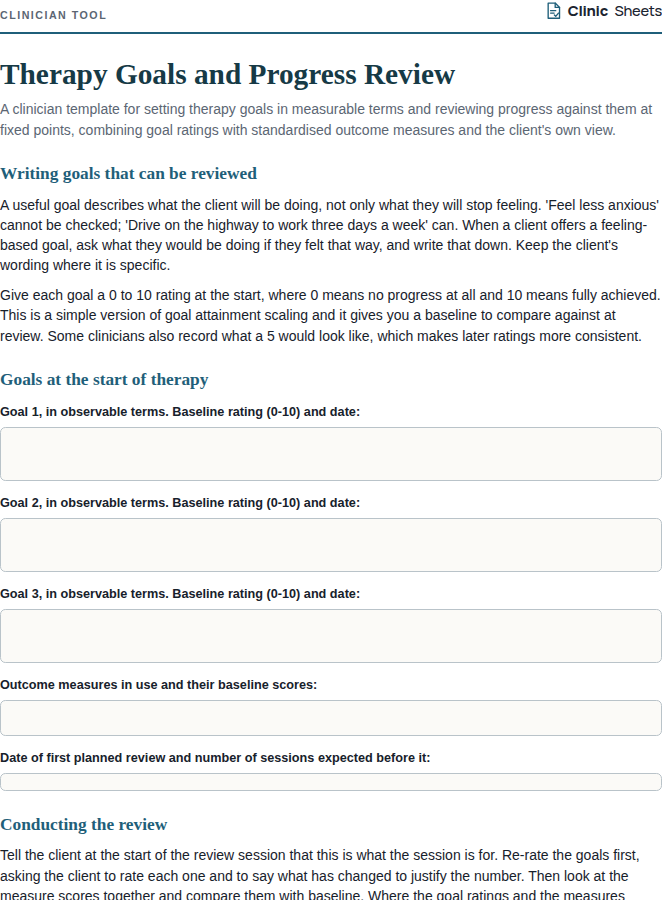
Goal setting is a core, cross-cutting therapeutic task. Clients who arrive in therapy with a goal that is vague ('feel better', 'get my life together') or that is outside their control ('get my ex back') tend to make slow progress and feel discouraged, because there is no way to notice movement. The SMART framework, which originated in management writing and has been widely adopted in behavioural health, gives a simple structure for converting an intention into something that can be planned, attempted and checked. It is particularly useful in depression, where the loss of initiative and the belief that nothing will help make it essential that early goals are small enough to succeed, and in life transitions, where the client's existing routines and identity have been disrupted and new ones need to be built deliberately.
This worksheet walks through each SMART element with a question, then adds two components that the acronym leaves out but that the goal-setting research treats as important: identifying the very first action, and planning for obstacles in an if-then form (implementation intentions). Research by Gollwitzer and others shows that specifying when, where and how a goal will be pursued, and what to do when a predictable obstacle arises, substantially increases follow-through.
The professional version adds guidance on helping clients who set goals that are too large or too many, on distinguishing outcome goals from process goals, and on using the worksheet with adolescents, where the goal should be the young person's own rather than a parent's or a school's.
How to use it
- Start with the client's own words for what they want. Write it at the top before applying any structure, so the goal stays theirs.
- Work through each SMART question in turn. The Specific and Measurable questions usually do most of the work; a goal that survives those two is often already achievable and time-bound.
- Check that the goal is within the client's control. If it depends on someone else's behaviour, reframe it around what the client can do.
- For depressed clients, deliberately shrink the goal until the client rates their confidence at 7 out of 10 or higher. Early success matters more than ambition.
- Spend time on the obstacle step. Ask what has stopped similar plans before and write an if-then plan for the two most likely obstacles.
- Review the goal at every session until it is met or revised. Revising a goal is normal, not a failure.
References
- Locke, E. A., & Latham, G. P. (2002). Building a practically useful theory of goal setting and task motivation: A 35-year odyssey. American Psychologist, 57(9), 705-717.
- Gollwitzer, P. M., & Sheeran, P. (2006). Implementation intentions and goal achievement: A meta-analysis of effects and processes. Advances in Experimental Social Psychology, 38, 69-119.
- Doran, G. T. (1981). There's a S.M.A.R.T. way to write management's goals and objectives. Management Review, 70(11), 35-36.
- Martell, C. R., Dimidjian, S., & Herman-Dunn, R. (2010). Behavioral Activation for Depression: A Clinician's Guide. Guilford Press.