Values and Activities Menu
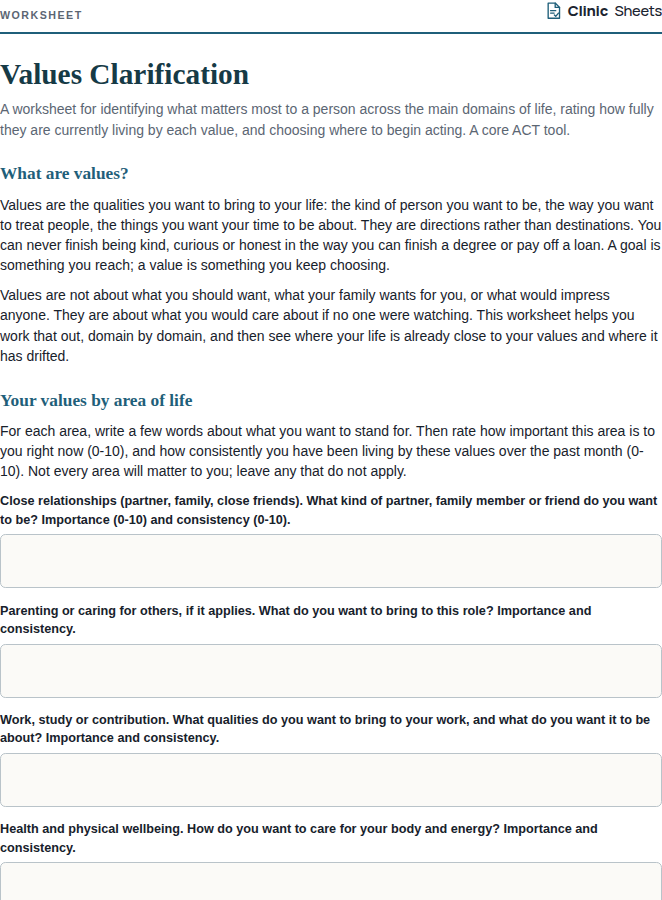
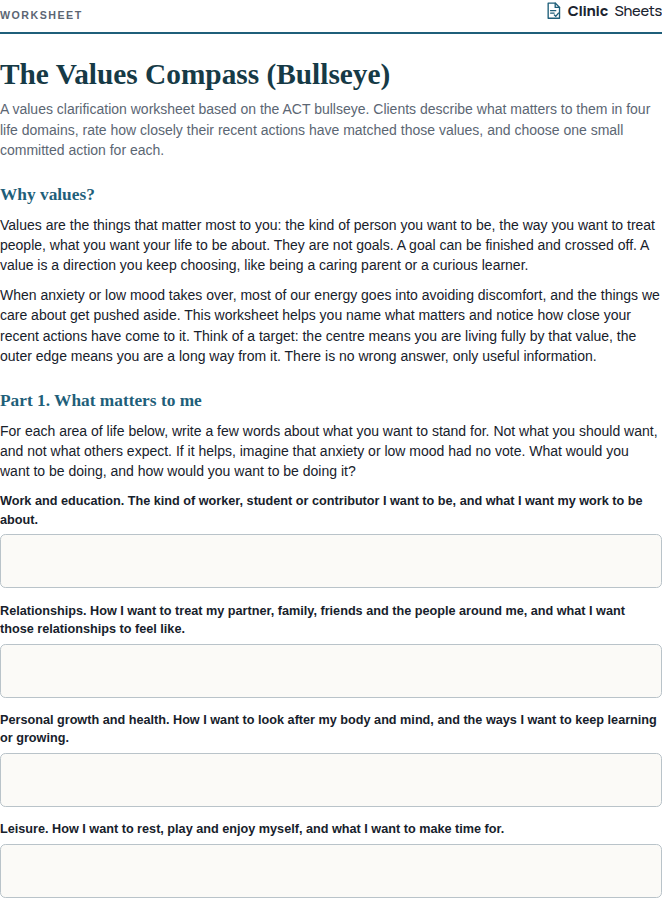
A worksheet for identifying what matters to the client across life areas and generating a personal menu of activities that express those values, for use in behavioural activation and ACT.
About this resource
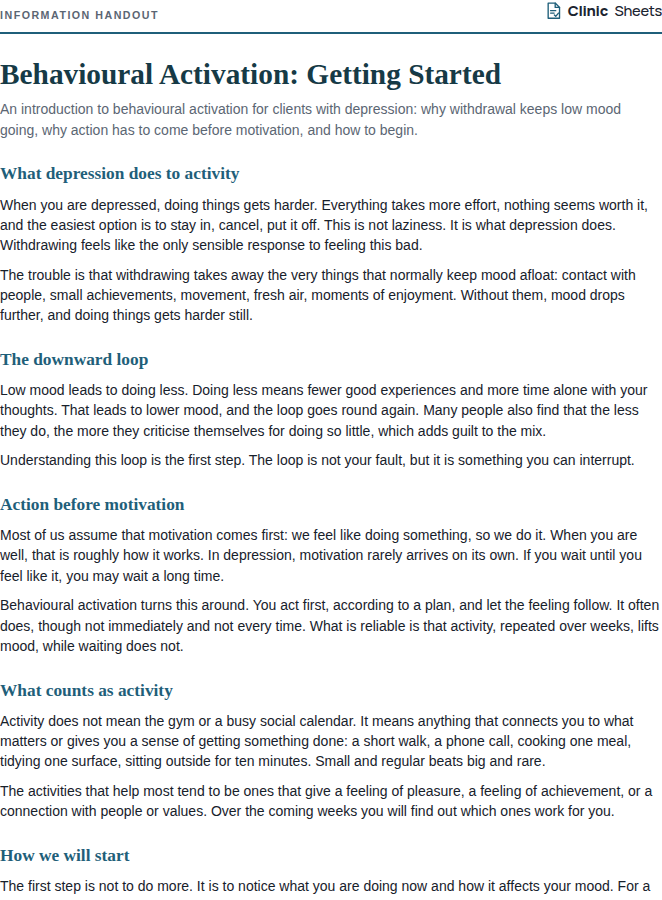
Activity scheduling works best when the activities are chosen for their meaning rather than pulled from a generic list. Values-based activation, drawn from the contextual tradition in behavioural activation and from acceptance and commitment therapy, asks the client first what matters to them in different areas of life, and only then what actions would move them towards those things. This produces activities the client is more willing to attempt when mood is low, because the reason for doing them is their own.
The worksheet walks through several life areas: relationships, work or study, health, leisure and creativity, community, and personal growth. For each, the client writes a sentence or two about what they care about and then lists a few concrete activities, small and large, that would express it. The result is a menu the client can draw on week after week, which is particularly useful once the initial easy activities have been exhausted.
In ACT terms, the exercise also helps distinguish values, which are ongoing directions, from goals, which are completable. Both are useful, but values give a reason to keep going after a goal is reached or missed.
The professional version includes prompts for clients who find it hard to identify values while depressed, notes on the difference between values and rules ('should'), and guidance on using the menu alongside the Activity Scheduling Planner.
How to use it
- Introduce after the client has completed a baseline Activity Diary and understands the rationale for activation, or as part of values work in ACT.
- Work through one or two life areas together in session, modelling the move from a value to concrete actions of varying size.
- Ask the client to complete the remaining areas between sessions. Not every area needs to be filled; blank areas are also informative.
- Use the menu to select activities for the weekly planner, choosing from different areas and different levels of difficulty.
- Revisit the menu every few weeks and add to it as mood and engagement improve.
References
- Martell, C. R., Dimidjian, S., & Herman-Dunn, R. (2010). Behavioral Activation for Depression: A Clinician's Guide. Guilford Press.
- Hayes, S. C., Strosahl, K. D., & Wilson, K. G. (2012). Acceptance and Commitment Therapy: The Process and Practice of Mindful Change (2nd ed.). Guilford Press.
- Lejuez, C. W., Hopko, D. R., Acierno, R., Daughters, S. B., & Pagoto, S. L. (2011). Ten year revision of the brief behavioral activation treatment for depression: Revised treatment manual. Behavior Modification, 35(2), 111-161.