Worry Bully: Talking Back to Worry
A worksheet that helps a child externalise worry or OCD as a 'worry bully', learn what the bully says and what it wants, and practise talking back to it instead of obeying it.
About this resource
Externalising the problem is a well-established technique in child anxiety and paediatric OCD treatment. March and Mulle's manual for childhood OCD has the child give the OCD a name and treats it as an unwelcome visitor rather than as part of the child, and White and Epston's narrative therapy work described the same move more broadly: the child is not the problem, the problem is the problem. Externalising reduces shame, creates a shared enemy for child, parent and therapist, and makes it easier for the child to notice a worry thought as something separate from themselves. It also makes the cognitive work concrete: a child can argue with a bully more readily than they can 'evaluate a cognition'.
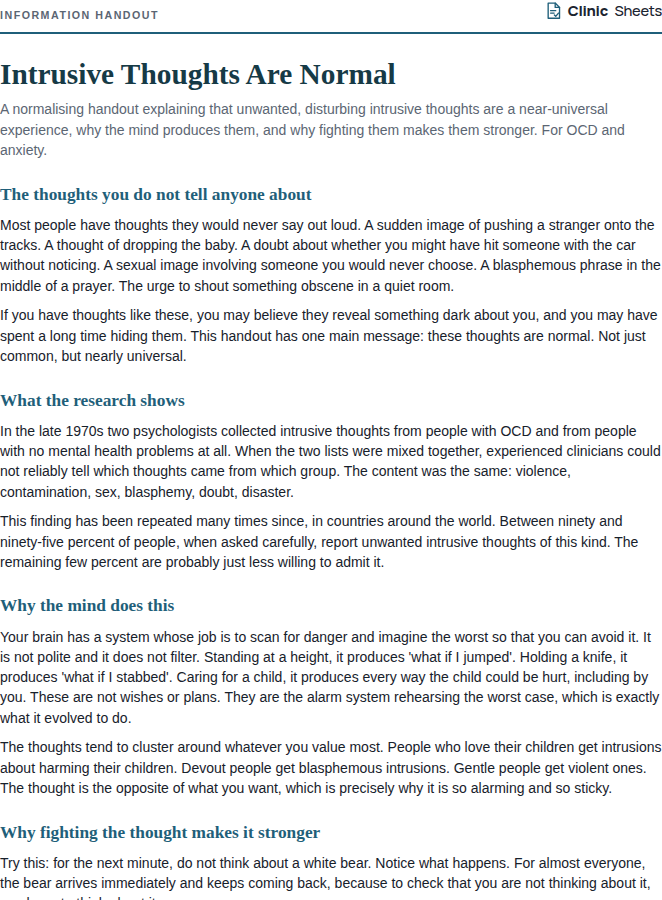
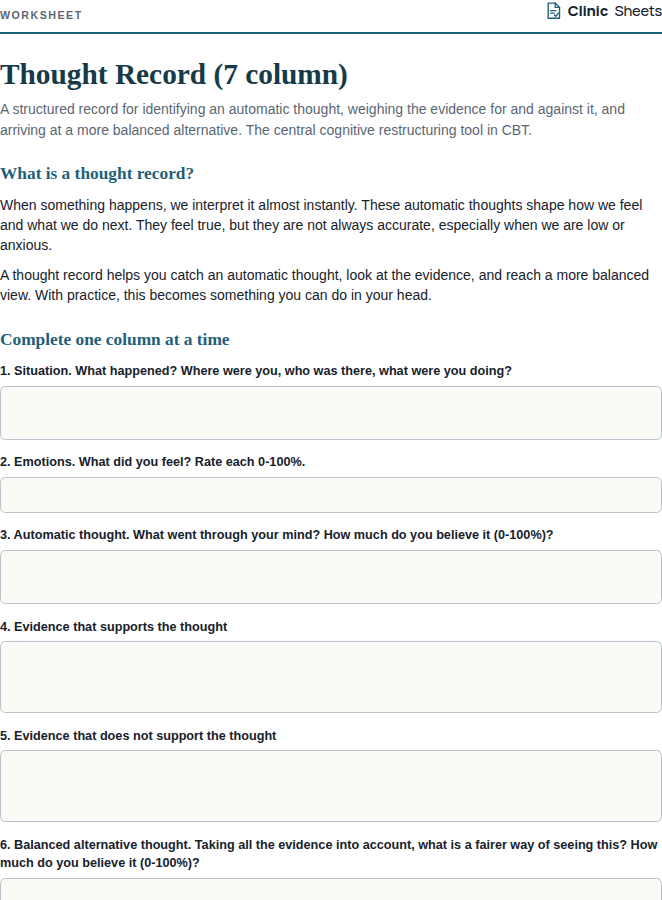
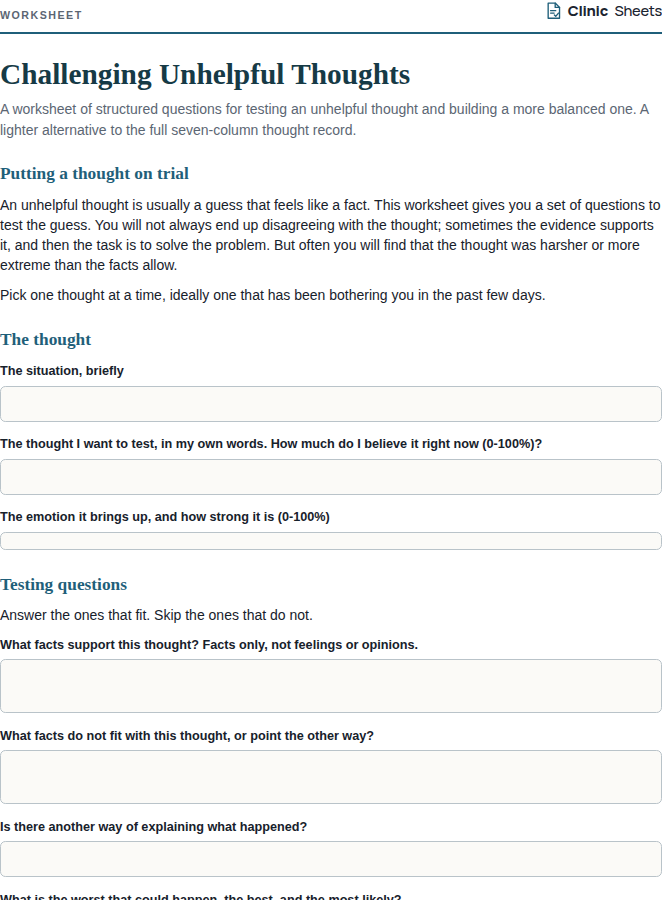
This worksheet frames worry as a bully who is loud, bossy and not very honest. The child records what the worry bully says, notices what the bully wants them to do (usually avoid, check, ask for reassurance, or do a ritual), and learns that doing what the bully says makes it stronger. The child then writes their own 'talk back' lines. These draw on two techniques at once: defusion, in the sense of noticing that a thought is just the bully talking and does not have to be obeyed, and cognitive restructuring, in the sense of answering the bully's claims with fairer ones. The final section links talking back to doing the brave thing anyway, which is where the real change happens.
The professional version notes that for OCD, talking back is a support for exposure and response prevention, not a substitute for it: the child should not be taught to argue with intrusive thoughts until they feel certain, which becomes a mental ritual. The aim is a short, dismissive reply ('that's just the bully, I'm not doing it') followed by getting on with the exposure. It also advises choosing the character with the child; some children prefer a monster, a pest or a nagging robot to a bully.
How to use it
- Introduce the idea that worry (or OCD) is like a bully that lives in the head: it bosses, it exaggerates, it is not honest, and it gets stronger when you do what it says. Let the child name and draw it if they like.
- Collect the bully's lines. Ask the child to remember the last time worry was loud and write down what it said, word for word.
- Work out what the bully wants: avoiding, checking, asking mum, doing something over. Explain simply that obeying the bully feeds it.
- Write talk-back lines together. Keep them short and confident. Rehearse them out loud in the bully's voice and the child's voice.
- Link talking back to action. The child talks back, then does the brave thing (or does not do the ritual). For OCD, keep replies brief and move quickly to response prevention; do not let arguing become a new ritual.
- Ask the parent to use the same language at home ('is that the bully talking?') and to avoid answering the bully's questions for the child.
References
- March, J. S., & Mulle, K. (1998). OCD in Children and Adolescents: A Cognitive-Behavioral Treatment Manual. Guilford Press.
- White, M., & Epston, D. (1990). Narrative Means to Therapeutic Ends. W. W. Norton.
- Huebner, D. (2005). What to Do When You Worry Too Much: A Kid's Guide to Overcoming Anxiety. Magination Press.
- Hayes, S. C., Strosahl, K. D., & Wilson, K. G. (2012). Acceptance and Commitment Therapy: The Process and Practice of Mindful Change (2nd ed.). Guilford Press.