Worry Monster / Worry Box
A child-friendly worry postponement exercise: worries are written down and posted into a box or fed to a worry monster, then looked at together during a short daily worry time. Teaches that worries can wait and that they often shrink.
About this resource
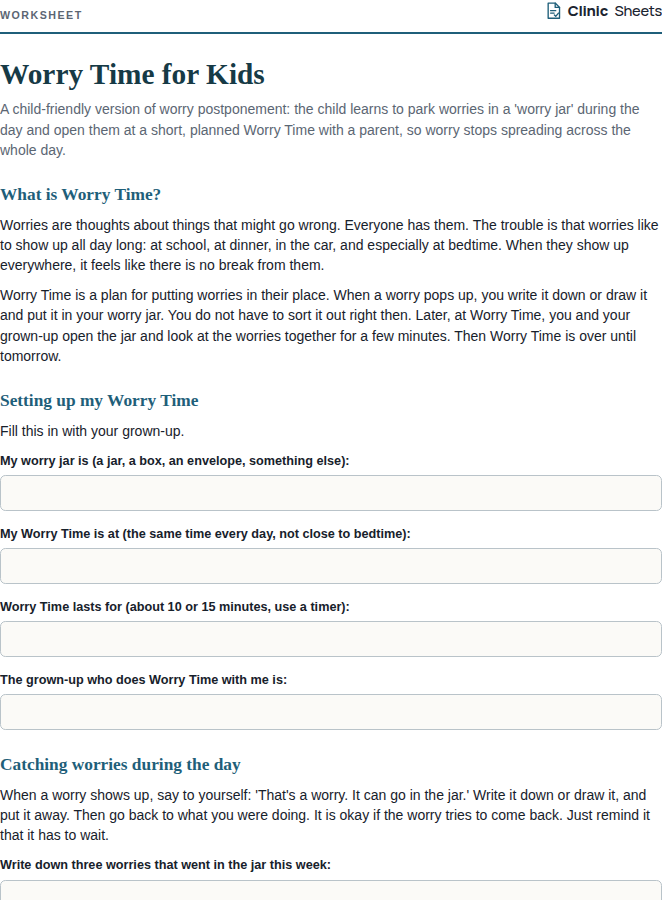
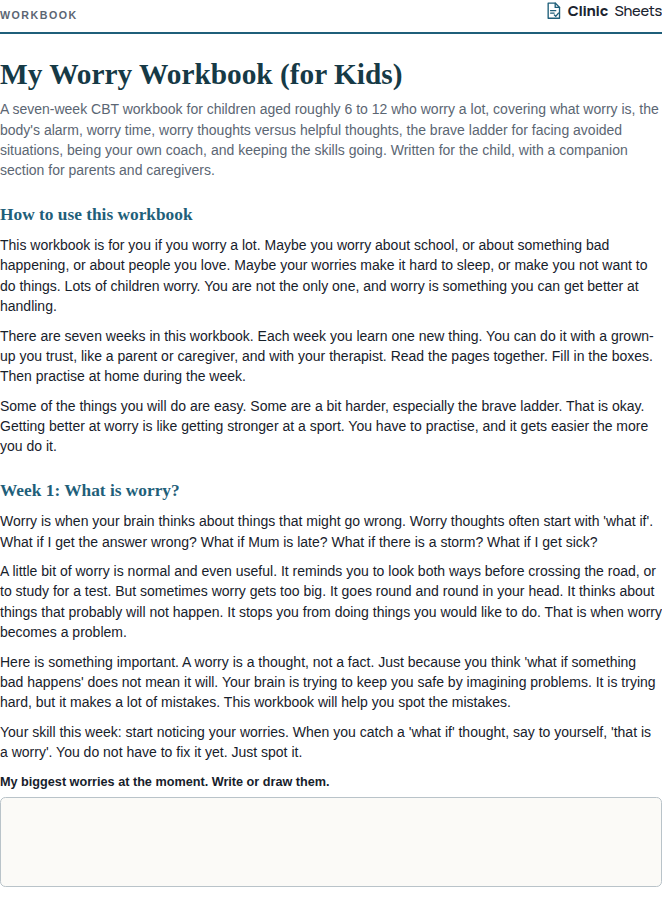
Worry postponement is a core technique in cognitive treatments for generalised anxiety. The client learns to notice a worry, set it aside for a scheduled worry period, and return to the task at hand. Over time this weakens the belief that worries must be dealt with immediately, reduces the total time spent worrying, and often reveals that many postponed worries have lost their force by the time worry time arrives. For children, the abstract instruction 'postpone it' needs a concrete, physical form. The worry box or worry monster provides one.
In this exercise the child writes or draws each worry on a slip of paper and puts it in a decorated box, or into the mouth of a cardboard or fabric monster who 'looks after' worries so the child does not have to. Once a day, at a fixed time and with a parent, the box is opened and each worry is read out. Some are solved, some are found to have already passed, and some go back in the box until tomorrow. The exercise combines postponement with externalisation, a narrative technique in which the problem is placed outside the child, and with simple problem solving.
The professional version adds guidance on choosing the worry time (not at bedtime), on what parents should and should not say when a worry is read out, and on adapting the exercise for children who worry at school. It also notes when a worry that keeps reappearing signals the need for a targeted exposure or a family-level intervention rather than more postponement.
How to use it
- Introduce the idea that worries are like a bag of stones the child carries all day, and that the box or monster is a place to put the stones down. Let the child choose between a box and a monster, and spend part of a session making or decorating it.
- Agree a daily worry time with the parent: ten to fifteen minutes, at a consistent time, at least an hour before bed. The parent sits with the child, opens the box, and reads each slip aloud in a calm, curious tone.
- Teach the parent the three responses to a worry: solve it (if there is a real problem with a real fix), let it go (if it has already passed or turned out fine), or keep it for tomorrow. Discourage long reassurance conversations.
- Practise the full sequence in session with a real, current worry so the child has done it once before trying it at home.
- Review at the next session. Count how many worries went in, how many were solved, and how many had disappeared. Use the numbers to build the message that worries are often smaller than they seem.
- If the same worry appears every day, treat it as a target in its own right: a fear to face with a brave ladder, or a family issue to address with the parents.
References
- Borkovec, T. D., Wilkinson, L., Folensbee, R., & Lerman, C. (1983). Stimulus control applications to the treatment of worry. Behaviour Research and Therapy, 21(3), 247-251.
- Creswell, C., Parkinson, M., Thirlwall, K., & Willetts, L. (2019). Parent-Led CBT for Child Anxiety: Helping Parents Help Their Kids. Guilford Press.
- Huebner, D. (2005). What to Do When You Worry Too Much: A Kid's Guide to Overcoming Anxiety. Magination Press.